The first time most founders use AI, it feels like cheating.
The tenth time, it feels like a scam.
You ask for a landing page. It gives you a landing page that sounds like every other landing page. You ask for customer research. It gives you recycled advice that could describe a payroll tool, a meditation app, or a dog food startup with equal confidence. You ask for sales copy and get something so polished, so empty, that it somehow makes your product look less real.
That is usually the moment the frustration sets in. Not because AI is useless. Because the output keeps reflecting the vagueness of the input. Founders think they have an AI problem. Most of the time, they have a prompt problem. Or more precisely, a thinking problem disguised as a prompt problem.
This article is for the founder who is tired of getting generic answers from smart tools. The one wearing five hats. The one trying to move faster without sounding fake. The one who wants better prompts for research, content, sales, and product work but also wants a sharper way to think.
Because good prompt engineering is not about learning magic phrases. It is about asking with precision, context, tension, and judgement.
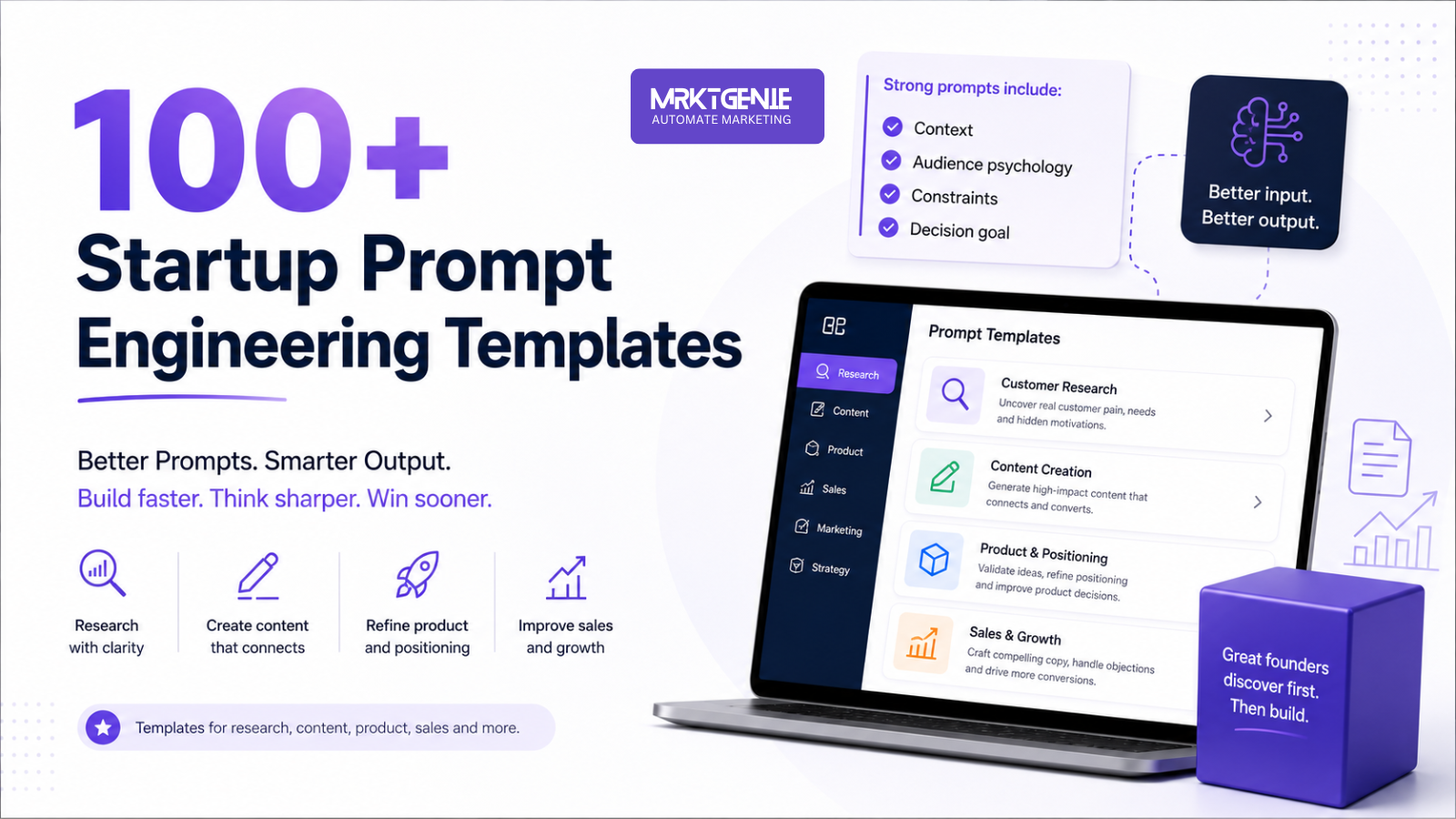
Below are 100+ startup prompt engineering templates you can actually use. But first, one uncomfortable truth.
Most founders are not under-prompting. They are under-specifying.
I have seen this pattern over and over. A founder types, "Write a homepage for my startup.” The model replies with something painfully familiar: streamlined workflows, seamless collaboration, powerful insights built for modern teams.
Then the founder says, “AI content is all the same.”
Well, yes. Because the brief was all the same.
A better prompt does not start with what you want written. It starts with what is true.
What is the customer afraid of? What have they already tried? What language do they use when annoyed, rushed, sceptical, or embarrassed? What would make them say, “Finally, someone gets it”?
If you want your AI output to stop sounding generic, read how founders can use AI without sounding like everyone else. It explains why sameness is usually a strategy problem before it becomes a writing problem.
Here is the simple rule behind every template in this article:
Weak prompts ask for content. Strong prompts supply context, constraints, audience psychology, and a decision goal.
Use these templates as starting points. Replace the placeholders. Add your market specifics. Challenge the output. Make the machine earn the answer.
How to use these startup prompt templates without getting lazy
Before the templates, a quick warning. Prompt libraries can become another form of procrastination.
Founders love systems. Sometimes too much. A prompt template should not become a substitute for talking to users, reviewing call transcripts, studying objections, or making decisions.
Think of prompts like a great chief of staff. Useful, fast, tireless. But still dependent on the quality of the briefing.
Use this four-part structure whenever you adapt any template below:
Role: Tell the model who it should act like.
Context: Explain your startup, audience, and situation.
Task: Ask for a specific output.
Constraints: Define tone, format, exclusions, and decision criteria.
That one shift alone improves output dramatically.
Research prompt engineering templates for founders
Most startup mistakes begin before marketing. Before sales. Before product. They begin in false certainty.
A founder hears five positive comments, mistakes politeness for demand, and starts building. Two months later, they are not validating a business. They are defending a belief.
These prompts help you think more clearly about markets, customers, positioning, and demand.
Customer pain and problem discovery prompts
Act as a startup researcher. My product helps [target user] solve [problem]. List 15 likely frustrations this user experiences before they look for a solution. Separate emotional frustrations from operational frustrations.
Act as a customer interview analyst. Based on this audience [describe audience], generate 20 interview questions that uncover current workarounds, urgency, budget signals, and hidden resistance. Avoid leading questions.
I am targeting [audience] with [product]. What are the top reasons this audience might tolerate the problem instead of paying to solve it?
Analyse this problem statement: [insert statement]. Rewrite it in the language a frustrated customer would actually use in a Slack message, support ticket, or team meeting.
Give me 10 examples of “trigger moments” that would cause [audience] to actively search for a solution like [product].
Compare surface-level pain versus root pain for [problem]. Show how a founder might incorrectly market to the symptom instead of the cause.
One founder I worked with kept describing his tool as “AI workflow orchestration for RevOps". Accurate, technically. Useless commercially. When we rewrote the problem in customer language, it became "Our sales team keeps following the wrong lead data, and nobody trusts the CRM.” Suddenly, the messaging had a pulse.
If your startup still sounds clearer inside your head than outside it, this guide to messaging validation will feel painfully familiar.
Market and competitor research prompts
Act as a market analyst. I am building [product] for [audience]. Identify 10 adjacent competitors, 10 direct competitors, and 10 substitute solutions customers may use instead.
For these competitors [list competitors], compare their messaging, pricing, target audience, proof points, and likely weaknesses.
What category assumptions do customers likely have when evaluating products like [product]? Which assumptions help me and which hurt me?
Generate a competitor teardown framework I can use to analyze homepage messaging, onboarding friction, pricing psychology, and trust signals.
Based on the category [category], what claims are overused and no longer persuasive? Suggest sharper alternatives rooted in specifics.
Map the likely buying criteria for [audience] when evaluating [product category]. Rank by importance and explain why.
This matters because founders often think they are competing against similar startups. They are not. They are competing against spreadsheets, habits, internal politics, and “we will deal with it next quarter.”
That is why generic claims fail. If you say you are innovative, efficient, and built for modern teams, you are not differentiating. You are blending in. Read why users ignore generic startup claims if you want a sharper lens on credibility.
Positioning and ICP prompts
Help me define an ideal customer profile for [product]. Include company size, role, urgency triggers, current workaround, budget sensitivity, and likely objections.
Create 3 different ICP options for [product]: one narrow niche, one mid-market segment, and one broad segment. Explain the tradeoffs for each.
What type of customer would get value from [product] but still be a bad early customer? Explain why.
Based on this startup description [insert], identify where my positioning is too broad, too abstract, or too feature-led.
Give me 5 positioning angles for [product], each optimized for a different buyer motivation: saving time, reducing risk, increasing revenue, improving status, and simplifying complexity.
Rewrite this startup description [insert] for a skeptical buyer who has seen too many similar tools.
A surprising observation: many early-stage founders choose an ICP based on ego, not evidence. They want the sophisticated buyer, the big logo, the sexy market. But often the best early customer is the one with the most painful problem, the shortest path to decision, and the least patience for inefficiency. This is one reason boring startups often win.
Validation and demand-testing prompts
Act as a brutally honest advisor. Here is my startup idea: [insert]. List the top 10 reasons this may fail to get traction.
Generate 12 low-cost validation experiments for [startup idea] that do not require building the full product.
What evidence would meaningfully prove that [audience] has urgent demand for [solution]? Separate weak signals from strong signals.
Design a 2-week validation sprint for [idea], including interview goals, landing page tests, and success criteria.
What are the most dangerous assumptions in this startup concept [insert]? Rank them by risk and suggest how to test each one quickly.
Create a pre-mortem for my startup idea. Assume it failed in 18 months. What likely happened?
The best prompts do not just help you create. They help you avoid expensive delusion.
Content prompt templates for founder-led growth
Content is where founders often waste the most AI time. Not because AI cannot help. Because founders ask it to produce assets before they have angles.
A bad content system starts with formats: “write a post,” “write a blog,” “write a thread.”
A good one starts with tension: what does the market misunderstand, underestimate, avoid, or keep getting wrong?
If your content feels flat, the issue may not be writing quality. It may be that your ideas are detached from real customer pain. That is exactly why generating content ideas from real customer pain works better than random brainstorming.
Content strategy prompts
Act as a content strategist for an early-stage startup. My product is [product], audience is [audience], and goal is [goal]. Build a 90-day content plan organized by awareness stage.
Create a topic cluster strategy for [startup] based on customer pain points, comparison intent, implementation questions, and product-adjacent searches.
List 30 article ideas for [audience] that are specific, contrarian, or experience-based rather than generic educational content.
Map content ideas for [product] across the buyer journey: problem-aware, solution-aware, comparison-ready, and post-purchase adoption.
Suggest 20 founder-led content angles based on mistakes, lessons, unpopular opinions, and behind-the-scenes decisions in building [startup].
Turn these customer interview notes [insert] into a repeatable content engine with themes, content formats, and distribution ideas.
A practical question worth asking: are you publishing to look active, or publishing to reduce buyer confusion?
Those are not the same thing.
Blog writing prompts
Write a blog outline for the topic [topic] aimed at [audience]. Focus on real founder pain, objections, and decision-making mistakes. Avoid generic intros and definitions.
Draft an article introduction for [topic] that starts with a relatable founder mistake or contradiction instead of a broad overview.
Take this rough idea [insert] and turn it into a structured blog post with one strong argument, three examples, and a practical conclusion.
Rewrite this article section [insert] to sound more specific, sharper, and more credible. Remove clichés and inflated claims.
Generate 10 headline options for this article [summary], with a mix of curiosity, specificity, and search intent.
Review this draft blog post [insert] and identify where it sounds generic, repetitive, or disconnected from lived experience.
One of the easiest ways to improve AI-written articles is to give the model a real scene. Not “founders struggle with marketing.” Better: “A solo founder spends three hours writing a LinkedIn post after midnight, posts it, gets 4 likes, and concludes content does not work.” That image does more work than five paragraphs of theory.
Social content prompts
Turn this article [insert] into 10 LinkedIn post ideas, each with a different hook style: contrarian, story, mistake, observation, question, and lesson.
Write 5 short founder posts about [topic] that sound experienced rather than motivational.
Take this customer pain point [insert] and create 7 social posts that teach without sounding promotional.
Rewrite this LinkedIn draft [insert] to increase specificity, tension, and readability while keeping my voice direct and credible.
Create a 2-week founder content calendar for [startup], balancing trust-building, product education, and audience growth.
Generate 15 hooks for a post about [topic] that would make a skeptical B2B founder stop scrolling.
If you keep posting and getting silence, it is usually not because the algorithm hates you. It is because the post did not create recognition. The reader did not see their own problem in it. That is why so many LinkedIn posts get ignored.
Repurposing and distribution prompts
Turn this long-form article [insert] into 20 distribution assets across LinkedIn, X, email, short video scripts, and sales enablement snippets.
Extract the strongest quotes, contrarian lines, and practical lessons from this article [insert] for social distribution.
Create 5 email newsletter versions of this content [insert], each for a different audience segment.
Repurpose this webinar transcript [insert] into blog ideas, social clips, FAQs, and a customer education sequence.
Build a content recycling workflow for a founder with 3 hours per week. Prioritize high-return formats and low-friction repurposing.
Take this feature release note [insert] and turn it into launch content, SEO content, onboarding content, and social posts.
The founders who get the most from AI are rarely the ones asking it to create from scratch every time. They are the ones feeding it raw material: call notes, customer complaints, feature updates, failed pitches, founder rants, support logs.
Sales prompt templates for clearer messaging and better conversations
Sales is where vague language gets punished fastest.
You can hide weak thinking in a strategy doc. You cannot hide it on a call with a buyer who asks, “So why should we switch?”
These prompts help founders tighten positioning, handle objections, and prepare better sales assets.
Value proposition and pitch prompts
Act as a B2B sales strategist. Based on this product description [insert], create a sharper value proposition for a buyer who is skeptical and time-poor.
Rewrite my startup pitch [insert] in plain language for a prospect who has never heard of this category.
Create 5 one-sentence explanations of my startup [insert], each optimized for a different audience: investor, customer, partner, employee, and friend.
Turn this feature list [insert] into outcome-based messaging tied to buyer pain, urgency, and proof.
Give me 10 ways a prospect might describe the value of my product after using it successfully.
Audit this homepage copy [insert] for clarity, differentiation, and trust. Highlight what a buyer may misunderstand in the first 5 seconds.
That last prompt matters more than founders realize. A lot of “sales problems” begin on the homepage. Confused traffic becomes weak pipeline. If you suspect your site is making your product harder to trust, this piece on why most startup websites fail in 5 seconds is worth reading.
Objection handling prompts
List the top 15 objections a [role] at a [company type] might raise about buying [product]. Include what they say and what they actually mean.
For each of these objections [list], write a response that is honest, calm, and specific. Avoid sounding defensive or over-rehearsed.
What objections are likely to appear because of category confusion rather than true product weakness?
Help me prepare for the objection, “We can do this internally.” Give 5 nuanced responses based on time cost, maintenance burden, and execution risk.
Help me answer, “This seems similar to [competitor].” Show how to differentiate without sounding petty or vague.
Simulate a skeptical buyer call for [product]. Ask me difficult questions one by one and critique my answers.
A founder once told me, “Prospects keep saying they will just build it themselves.” He thought it was a product issue. It was actually a framing issue. His pitch focused on functionality. The buyer heard “tool.” What he should have sold was speed, reliability, and the cost of internal distraction.
Same product. Different frame. Very different conversation.
Outbound and follow-up prompts
Write 5 cold email variations for [audience] about [product]. Each should be short, specific, and based on a real operational pain point.
Create outbound messaging for 3 different triggers: new funding, hiring surge, tool migration, or regulatory change.
Rewrite this cold email [insert] to sound less templated and more observant.
Generate 10 personalized first-line ideas for reaching out to [persona] at [company type] without fake flattery.
Write a follow-up email sequence for a prospect who attended a demo but has gone quiet. Keep the tone useful, not needy.
Turn this case study [insert] into 5 prospecting angles for similar companies.
One misconception founders often believe: better sales copy means sounding more impressive. Usually it means sounding more concrete.
Impressive language raises eyebrows. Concrete language lowers resistance.
Sales call and demo prompts
Create a discovery call script for [product] that uncovers pain severity, current workflow, internal blockers, and buying criteria.
Design a demo flow for [product] tailored to [persona]. Start with their problem, not the feature tour.
What are the most important questions to ask on a second sales call for [product] before presenting pricing?
Review this sales call transcript [insert] and identify missed opportunities, weak questions, and vague positioning.
Generate 8 talk tracks that explain ROI for [product] without relying on inflated assumptions.
Help me prepare a business case summary a champion can send internally after a demo.
Notice the pattern? The strongest prompts are not asking AI to “sell better.” They are asking it to expose ambiguity, sharpen relevance, and reduce buyer risk.
Product prompt templates for startup operators and builders
Founders often use AI for writing first and product second. That is backwards.
Some of the highest-return prompt use cases sit inside product work: user stories, onboarding flows, prioritization, feedback analysis, release messaging, and support pattern detection.
This is where AI becomes less of a content machine and more of a thinking partner.
User research and feedback analysis prompts
Act as a product researcher. Analyze these customer feedback notes [insert] and identify recurring themes, feature requests, confusion points, and emotional signals.
Cluster these support tickets [insert] into root problem categories. Separate onboarding issues from product gaps and expectation mismatches.
Based on these interview transcripts [insert], what jobs are customers really hiring this product to do?
What language do users use when they describe success with [product]? What language do they use when frustrated?
Identify which requests in this feedback set [insert] are likely edge cases versus broad demand.
Summarize these user calls [insert] into a product insight memo with opportunities, risks, and open questions.
Here is a subtle but important distinction: customers are good at describing friction. They are less reliable at prescribing the solution. Your prompts should help separate the two.
Roadmap and prioritization prompts
Help me prioritize these feature ideas [insert] using impact, urgency, strategic fit, implementation effort, and customer frequency.
Create a simple scoring model for roadmap prioritization for an early-stage startup with limited engineering capacity.
For this feature request [insert], argue both sides: why we should build it now and why we should delay it.
Turn these customer pains [insert] into a ranked problem backlog rather than a feature backlog.
What roadmap mistakes do founders commonly make at my stage [describe stage]? Which of those risks appear in my current plan [insert]?
Create a quarterly roadmap narrative that explains not just what we are building, but why these priorities matter now.
This is one of the most useful contrarian habits in startups: prioritize the pain, not the request. Users ask for visible fixes. Great product teams diagnose invisible causes.
Onboarding and activation prompts
Design an onboarding flow for [product] that gets a new user to first value quickly. Include likely drop-off points and how to reduce them.
Analyze this signup flow [insert] and identify where confusion, hesitation, or unnecessary effort may reduce activation.
Create 10 onboarding email ideas for new users of [product], each tied to a different activation milestone.
Help me rewrite this in-app onboarding copy [insert] so it is clearer, shorter, and more motivating.
What are the likely reasons users sign up for [product] but fail to activate? Separate messaging mismatch from product friction.
Build a first-7-days user education sequence for [product] focused on adoption, confidence, and habit formation.
Founders often assume churn starts after disappointment. Often it starts earlier, during confusion. The user does not leave because the product failed. They leave because the path to value felt foggy.
Feature launch and release prompts
Turn this feature update [insert] into a launch narrative that explains the problem, the change, and the user benefit.
Create launch assets for this feature [insert]: changelog summary, email announcement, blog post outline, social posts, and in-app tooltip copy.
Help me position this feature release [insert] for existing users versus new prospects. What should change in the messaging?
Write release notes for [feature] that are concise, useful, and customer-centered rather than engineering-centered.
Generate 5 customer scenarios that show when and why this feature matters in real workflows.
Review this launch copy [insert] and identify where it overstates novelty or fails to connect to user pain.
This is where many teams accidentally write for themselves. They announce what changed in the product. Users care why it matters in their day.
Support and retention prompts
Analyze these cancellation reasons [insert] and identify preventable churn patterns, messaging issues, and product gaps.
Create a retention content plan for [product] based on common post-purchase friction points.
Write 10 help center article ideas based on these recurring support issues [insert].
Help me design a customer save playbook for users showing signs of disengagement in [product].
What user behaviors in [product] might predict churn? Suggest interventions for each one.
Turn this support backlog [insert] into product, education, and messaging recommendations.
If you only use AI for top-of-funnel content, you are leaving a lot of value on the table. Some of the best ROI comes from reducing confusion after the signup, after the sale, after the launch.
Cross-functional prompt templates every founder should keep nearby
Some prompts do not fit neatly into research, content, sales, or product. They sit in the messy middle where founders actually live.
Decision-making prompts
Act as a skeptical board advisor. Review this decision [insert] and list the strongest arguments against it.
I am choosing between [option A] and [option B]. Compare them across speed, reversibility, strategic upside, resource load, and downside risk.
What assumptions am I making in this plan [insert] that I may not realize are assumptions?
Create a pre-mortem and post-mortem framework for this project [insert].
Help me distinguish urgent work from important work in this weekly founder task list [insert].
Messaging consistency prompts
Review this homepage copy, pitch deck, and sales email [insert]. Identify messaging drift, contradictions, and inconsistent value framing.
Create a message spine for [startup] including problem, audience, value, differentiation, proof, and tone guidelines.
Rewrite these 5 assets [insert] so they all tell the same product story while fitting their channel.
Identify where my product story becomes too technical for non-technical buyers.
Turn this founder explanation [insert] into a consistent narrative for website, social, and sales use.
If your startup sounds different in every place it appears, buyers feel that inconsistency even when they cannot name it. This is why a framework like a messaging drift detector becomes more valuable as your channels multiply.
Founder productivity prompts
Turn this messy brain dump [insert] into a prioritized weekly operating plan.
Help me batch my founder marketing tasks into a 3-hour weekly visibility system.
Create a meeting prep checklist for investor calls, customer calls, and hiring interviews.
Summarize this week’s notes [insert] into decisions made, open loops, and next actions.
Design a lightweight operating cadence for a startup team of [size] balancing product, growth, and customer feedback.
The best founder prompts are often the least glamorous. Not “write me a viral thread.” More like: “Help me think clearly with limited time and too many moving parts.”
What separates a mediocre prompt from a high-performing one
Let’s make this concrete.
Weak prompt: “Write a landing page for my AI sales tool.”
Better prompt: “Act as a conversion copywriter for early-stage B2B SaaS. I run a product that helps SDR teams at 20-100 person SaaS companies clean inbound lead data automatically before it enters HubSpot. Our buyers are RevOps leaders who are frustrated by routing errors, duplicate records, and wasted rep time. They are skeptical of AI claims and care more about reliability than novelty. Write a landing page hero, subhead, 3 problem sections, and 5 FAQ answers. Use plain language, avoid hype, and include trust-building cues.”
Same tool. Different briefing. Different result.
Notice what changed:
The audience became specific.
The pain became concrete.
The buyer psychology became visible.
The output format became clear.
The tone constraints reduced fluff.
This is why prompt engineering is less about tricks and more about operational clarity.
A simple founder framework for better prompts
When in doubt, run every prompt through this checklist:
What real-world situation is this for?
Who exactly is the audience?
What do they already believe?
What are they skeptical of?
What decision should this output help them make?
What should the response avoid?
If you answer those six questions inside the prompt, the quality usually improves fast.
And if it still sounds generic, ask the model a much better follow-up: “What assumptions did you make because my prompt lacked detail?”
That question alone can expose what you forgot to specify.
The real point of prompt engineering for startups
Here is the misconception that costs founders time: they think prompt engineering is about getting AI to do more work.
The real value is getting yourself to think more clearly.
A sharp prompt forces you to define the customer, the pain, the stakes, the objection, the context, the desired outcome. In that sense, prompt engineering is not just an AI skill. It is a founder skill.
It reveals whether you actually understand your market or are still speaking in startup vapor.
That is why the founders who get the best results from AI are usually the founders who already know how to observe, listen, specify, and decide. The tool amplifies clarity. It also amplifies fuzziness.
So yes, save these templates. Use them. Adapt them. Build your own library.
But do not stop at better prompts.
Use them to become a better operator.
Because once you learn how to brief AI properly, you usually discover something more useful than a stronger output.
You discover where your own thinking was still vague.