For many founders, visibility feels like a trap. You know your startup needs attention, trust, and steady market presence, but the internet often makes it seem as if the only way to stay relevant is to post constantly, comment everywhere, and spend half the day performing online. That approach is exhausting, unsustainable, and usually a poor use of leadership time.
The good news is that startup visibility does not require becoming chronically online. It requires systems. When founders build practical visibility systems, they can stay visible to customers, investors, partners, and talent without sacrificing focus, product work, or mental bandwidth.
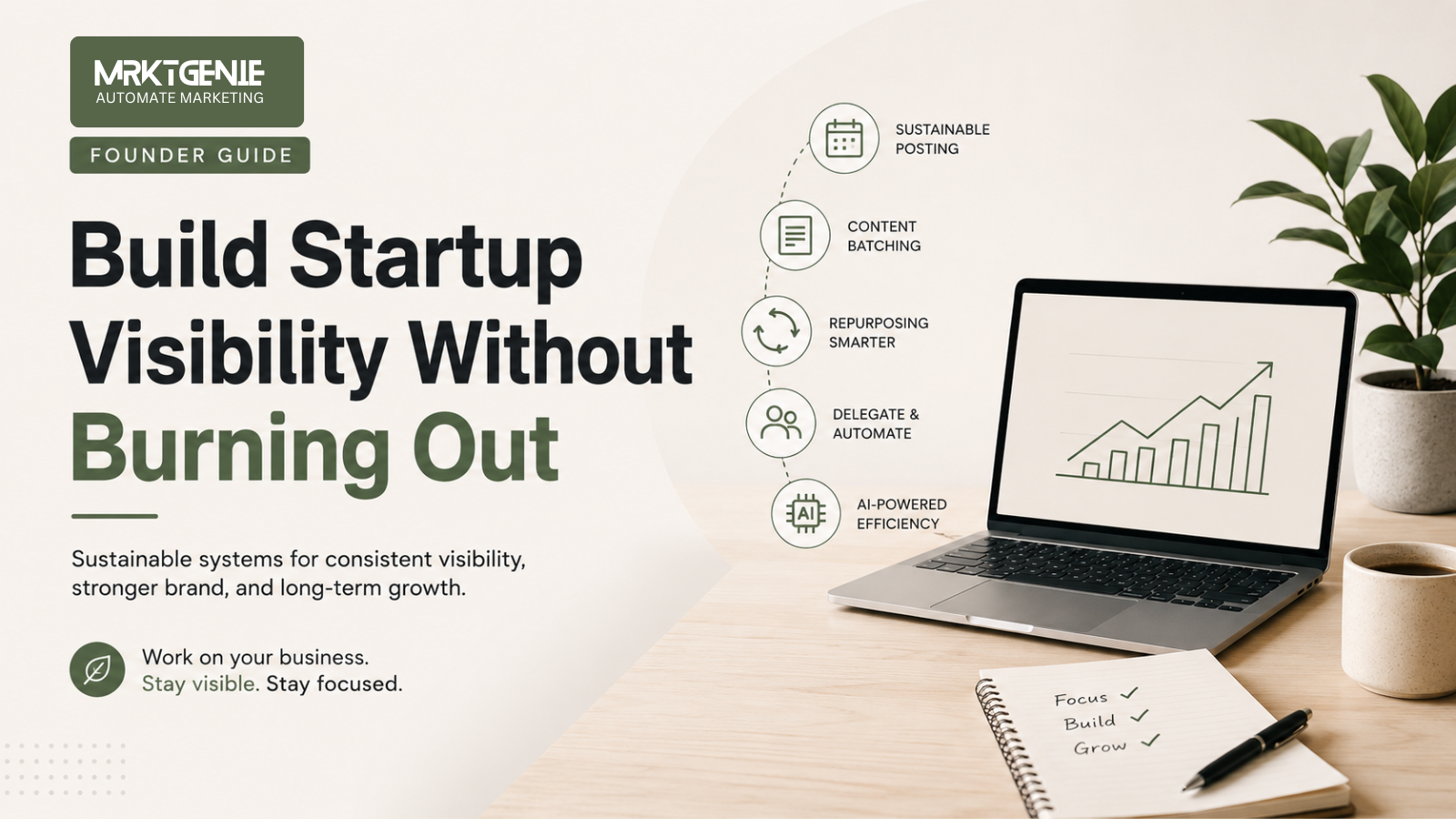
This guide explains how to build startup visibility in a sustainable way. It covers sustainable posting, content batching, repurposing, delegation, AI assistance, and the long-term consistency that turns sporadic marketing into durable brand presence.
Sustainable Posting
The first mistake many founders make is confusing frequency with effectiveness. Posting all day is not the same as building authority. In fact, sporadic bursts of high activity followed by silence often create less trust than a simple, reliable cadence.
Sustainable posting starts with one question: what level of visibility can you maintain for the next six to twelve months? Not this week. Not during a launch sprint. Over time.
For most busy founders, the answer is smaller than they think. A realistic visibility system may look like two thoughtful LinkedIn posts per week, one short founder update, one customer insight, and one monthly deeper piece of content. That is enough to create momentum if the content is relevant and consistent.
Why sustainable posting works
- It reduces decision fatigue because you know when and where you will post.
- It improves quality because you are not scrambling to publish daily.
- It builds trust through consistency rather than noise.
- It protects founder energy for product, hiring, sales, and strategy.
Instead of trying to be visible everywhere, choose one primary platform and one secondary platform. For example, a B2B SaaS founder may prioritize LinkedIn and email. A consumer founder may prioritize short-form video and Instagram. The goal is not platform dominance. The goal is audience relevance.
A simple sustainable posting framework can be built around three content types:
- Point of view: what you believe about your market, customers, or category.
- Proof: customer wins, product updates, milestones, behind-the-scenes progress.
- Practical insight: lessons, frameworks, mistakes, and observations others can use.
When these three are repeated consistently, startup visibility becomes less about constant performance and more about clear market positioning.
The best founder visibility strategy is not the loudest one. It is the one you can keep doing when the business gets busy.
Content Batching
If sustainable posting is the strategy, content batching is the operational engine behind it. Batching means creating multiple pieces of content in one focused session rather than reinventing the wheel every day.
This is especially valuable for founders because context switching is expensive. Writing a post between investor calls, product reviews, and hiring interviews usually leads to mediocre content and unnecessary stress. Batching solves this by turning visibility into a repeatable workflow.
How to batch content efficiently
Set aside one block of time each week or every two weeks. During that session, focus only on content creation. You are not checking analytics, replying to comments, or brainstorming from scratch. You are producing assets from a prepared list of ideas.
A simple batching session might include:
- Drafting two to four social posts
- Recording one short video or audio note
- Writing one founder newsletter
- Capturing recent customer stories or team learnings
- Creating a bank of future post ideas
To make batching easier, founders should keep an ongoing idea capture system. This can be a notes app, voice memo folder, or shared document. Every time you answer a customer question, explain a market trend, or reflect on a startup lesson, add it to the list. Those raw thoughts become future content.
What to batch
Not all content needs the same level of founder involvement. The most efficient founders batch the parts that require their unique perspective and systematize the rest.
- Founder insights: batch by outlining opinions, lessons, and narratives.
- Customer proof: batch by collecting screenshots, metrics, testimonials, and anecdotes.
- Educational content: batch by turning repeated answers into posts, articles, or short videos.
Once you have a batch, you can schedule posts in advance or hand them off for editing and publishing. This keeps your startup visible even during intense operating periods.
Content batching also helps founders avoid the emotional volatility of real-time posting. You do not need to wake up every day and ask, what should I say today? The answer is already in the system.
Repurposing
One of the most effective startup marketing habits is repurposing. Founders often create valuable ideas once and then abandon them after a single use. That is a waste of time and attention. A strong idea should be distributed in multiple formats across multiple touchpoints.
Repurposing means taking one source asset and turning it into several pieces of content. This approach increases reach without increasing founder workload.
Examples of smart repurposing
- A customer onboarding call becomes a LinkedIn post about user pain points.
- A product update email becomes a founder post about roadmap thinking.
- A podcast interview becomes short clips, quote posts, and a newsletter summary.
- A conference talk becomes an article, a video snippet, and a series of social posts.
- An internal memo becomes thought leadership content for your audience.
The key is to stop thinking of content as isolated posts and start thinking of it as reusable intellectual property. Every strong insight can be adapted.
Build a repurposing pipeline
A practical repurposing pipeline usually starts with one pillar asset each week or month. That pillar asset could be a founder memo, webinar, podcast appearance, customer case study, or article. From there, break it into smaller assets:
- One long-form article
- Three to five social posts
- One short email
- Two quote graphics or pull quotes
- One short video or audio clip
This strategy makes startup visibility more efficient because the founder is not creating from zero each time. Instead, the founder is extracting more value from ideas they already expressed.
Repurposing also improves message consistency. If you want your startup to be known for a specific category insight, customer problem, or product philosophy, repeating that message across formats helps the market remember it.
Visibility grows faster when the same clear message appears in many places, not when you invent a new message every day.
Delegation
Many founders assume visibility must remain entirely personal. While founder voice matters, not every task in the visibility process needs to be founder-owned. Delegation is what separates occasional posting from a scalable visibility system.
The founder should own the perspective. The team or external support can own the process.
What founders should personally handle
- Core opinions and strategic messaging
- Personal stories and founder lessons
- High-stakes thought leadership
- Final approval on content that represents the brand or leadership voice
What can be delegated
- Content formatting and editing
- Scheduling and publishing
- Clip extraction from video or audio
- Design for visual assets
- Analytics reporting
- Comment monitoring and light community management
- Content research and idea organization
Even a very small startup can delegate parts of this workflow. That might mean assigning a marketing generalist to turn founder notes into polished posts. It might mean hiring a freelance editor to shape newsletter drafts. It might mean using a virtual assistant to organize a content calendar and collect source material.
The point is not to remove the founder from visibility. It is to remove the low-leverage friction that keeps visibility inconsistent.
Create a founder-friendly delegation system
Delegation works best when the founder does not need to manage every detail. A simple system may include:
- A shared document for content ideas
- A weekly 20-minute voice note from the founder with updates and opinions
- A content manager who drafts assets from those notes
- A lightweight approval process
- A publishing calendar aligned with company priorities
This approach preserves authenticity while reducing time cost. It also ensures that startup visibility does not disappear when the founder enters a fundraising cycle, product sprint, or hiring push.
AI Assistance
AI can play a major role in founder visibility, but only when used correctly. It should not replace genuine perspective. It should reduce operational burden, speed up production, and help organize ideas. Used well, AI helps founders stay visible without spending hours writing, editing, and repackaging content manually.
Where AI helps most
- Turning rough notes into draft posts
- Summarizing meetings, interviews, or recordings into usable content ideas
- Generating multiple headline or hook options
- Adapting one piece of content for different platforms
- Creating first drafts of newsletters, articles, or social captions
- Organizing content themes and editorial calendars
- Refreshing old content into updated versions
For example, a founder can record a five-minute voice memo after a customer conversation. AI can transcribe it, identify key themes, and turn it into several draft posts. The founder then reviews, sharpens, and approves. This saves time while keeping the original insight intact.
Where AI should be used carefully
AI-generated content becomes a problem when it sounds generic, overproduced, or disconnected from real company experience. Startup audiences respond to specificity. They want evidence, conviction, and honest observations. If AI strips out the founder’s voice, the content may be efficient but ineffective.
To use AI well, founders should provide strong raw material:
- Real customer examples
- Original opinions
- Actual metrics or milestones
- Personal reflections from building the company
- Clear brand language and positioning
Think of AI as a content operator, not a substitute for thought leadership. It can help draft, structure, summarize, and scale. It cannot invent authentic founder credibility.
AI is most useful when it saves time on packaging your ideas, not when it tries to invent the ideas for you.
Long-Term Consistency
The most underrated advantage in startup visibility is consistency over time. Not virality. Not daily posting streaks. Not chasing every trend. Long-term consistency is what compounds trust, familiarity, and authority.
Most people underestimate how much visibility comes from simply showing up with a clear point of view for a long enough period. Customers start recognizing your company name. Investors begin seeing your market insight repeatedly. Potential hires understand what your startup stands for. Partnerships become easier because your startup feels known before the first conversation begins.
How to build consistency without burnout
- Choose a posting cadence you can maintain comfortably.
- Focus on a few repeatable themes rather than endless novelty.
- Use batching and repurposing to reduce production pressure.
- Delegate execution wherever possible.
- Use AI to accelerate drafting and organization.
- Review results monthly, not obsessively every day.
Consistency also requires accepting that not every post will perform well. Startup visibility is not built by one breakout moment alone. It is built by the accumulation of useful signals over time. A post that gets modest engagement may still influence a future customer, candidate, or investor who has been quietly watching for months.
That is why founders should measure visibility with a wider lens. Look beyond likes and impressions. Track:
- Inbound leads mentioning your content
- Partnership opportunities from online presence
- Investor familiarity before outreach
- Candidate quality and brand recognition in hiring
- Audience growth in your most important channels
- Repeated engagement from ideal customers
These are stronger indicators that your visibility strategy is working.
A practical weekly visibility system for busy founders
If you want a simple model to follow, use this:
- 15 minutes: capture ideas from the week in notes or voice memos
- 45 to 60 minutes: batch two to four posts or one newsletter
- 30 minutes: review drafts prepared by a team member or AI assistant
- 10 minutes: engage selectively with key comments or industry conversations
- Monthly: review what themes, formats, and channels are creating meaningful business outcomes
This kind of system is enough to keep your startup visible without requiring constant online presence.
Founders do not need to become full-time creators to build brand awareness. They need a repeatable process that turns their existing expertise, customer conversations, and company progress into consistent market visibility.
In practice, that means posting sustainably, batching content in focused sessions, repurposing every strong idea, delegating production tasks, using AI to reduce friction, and committing to long-term consistency. When these systems are in place, startup visibility becomes far more manageable and far more effective.
The founders who win attention over time are rarely the ones posting nonstop. They are the ones who make visibility habitual, strategic, and sustainable.