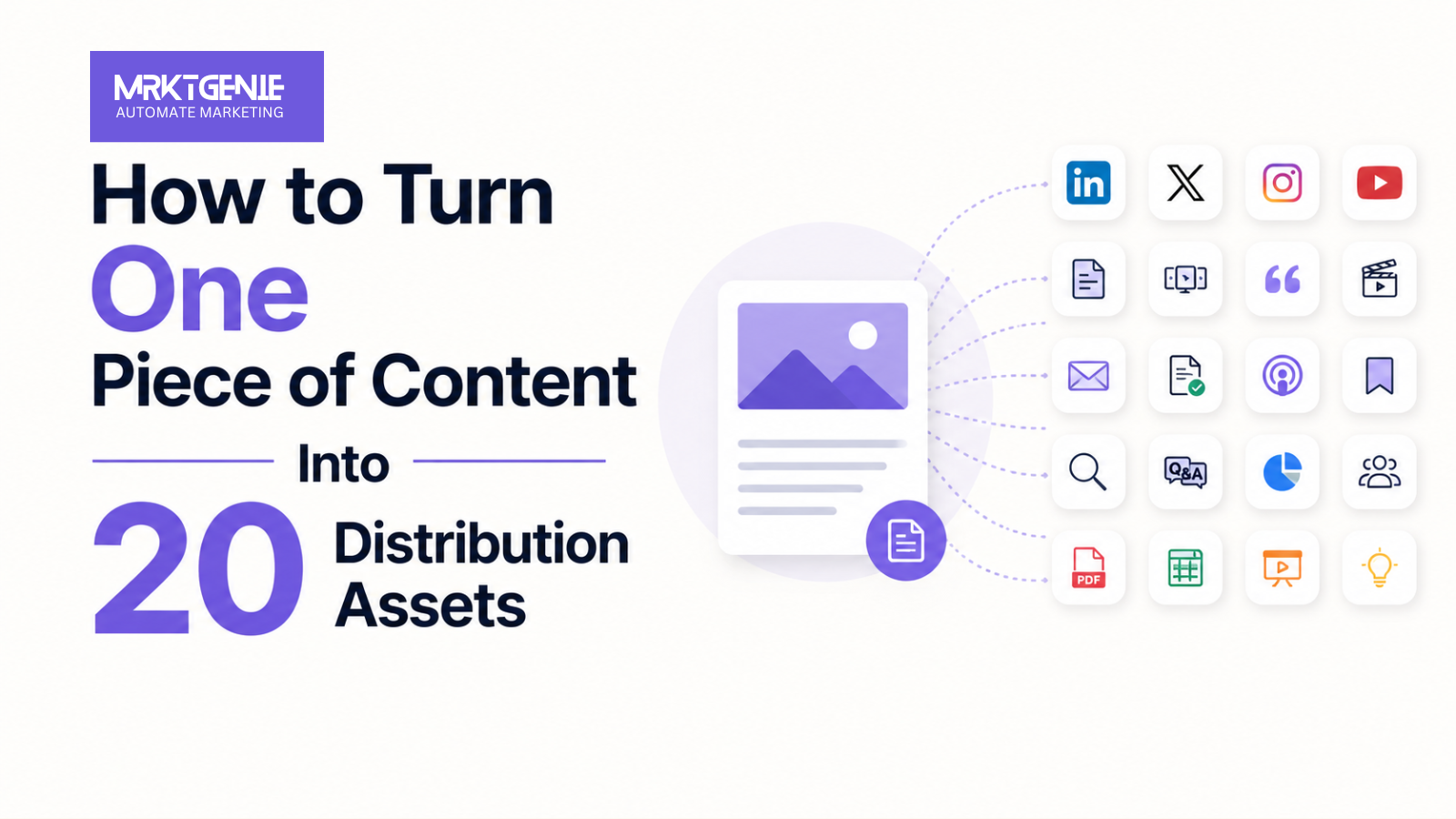
You spent hours recording a webinar, writing a deep-dive article, or publishing a podcast episode and then posted it once, watched the engagement spike for a day or two, and moved on to the next thing. That is the content treadmill most brands, founders, and creators get stuck on. They work hard to create valuable material, but they never build the distribution system that turns one idea into weeks of visibility. If that sounds familiar, this article will show you exactly how to turn one piece of content into 20 distribution assets without making your workflow painfully complicated.
The core shift is simple: stop thinking like a publisher of isolated posts and start thinking like an operator of a content engine. One strong piece of pillar content can become social posts, newsletter editions, SEO articles, discussion prompts, clips, and more. When you repurpose strategically, you increase reach, reinforce your message through repetition, and get more return from every hour you invest in content creation.
Introduction — The Content Multiplication Mindset
Most creators and companies underuse their content because they treat publishing as the finish line. They hit publish on a blog post, upload a podcast, or share a video, then assume the job is done. In reality, publishing is just the starting point. Distribution is what determines whether your ideas disappear after 24 hours or keep attracting attention for weeks.
The “publish once and forget” model creates two problems. First, it makes content marketing feel expensive because every new result requires a brand-new asset. Second, it lowers the odds that your audience will actually see your best ideas. Organic reach is fragmented. A LinkedIn follower may never read your newsletter. A podcast listener may never visit your blog. Repetition across formats is not redundant; it is how modern audiences discover and remember you.
That is where content repurposing creates leverage. A single high-quality piece of core content often contains dozens of usable angles: a bold opinion, a practical framework, a memorable quote, a customer example, a data point, and a step-by-step process. Instead of squeezing all of that value into one format, you can extract and repackage it for different channels and audience behaviors. One strong core piece can fuel an entire distribution system—and that is how smart teams create more output without constantly starting from zero.
Start With a “Pillar Content” Asset
Not every piece of content is worth repurposing heavily. The best starting point is a pillar content asset: a substantial piece that contains depth, structure, and multiple subtopics. Good examples include a podcast episode, webinar, long-form article, workshop, YouTube video, case study, or founder interview. These formats naturally generate multiple talking points because they are layered, not one-dimensional.
High-repurposing content usually has a few clear characteristics. It solves a meaningful problem, includes specific examples, and has a logical structure that can be broken into sections. A 45-minute webinar on customer retention, for example, can yield tactical clips, a checklist, a FAQ article, and a newsletter commentary. A founder interview can produce quote graphics, leadership lessons, contrarian social posts, and a short case study. The more substance the original asset contains, the easier repurposing becomes.
Choosing the right format matters because some formats naturally generate more angles than others. A short announcement post rarely has enough depth to become 20 assets. But a workshop with slides, Q&A, examples, and a framework can. If you want to build a repeatable system, prioritize content formats that create raw material by default. Long-form creates optionality. Short-form usually does not.
- A podcast episode works well because conversation naturally surfaces stories, opinions, and quotable moments that can be clipped or rewritten.
- A webinar is highly repurposable because it often includes teaching points, audience questions, and slide-based frameworks that can be turned into standalone educational assets.
- A case study is powerful because it combines narrative, proof, metrics, and lessons, which are useful for both SEO content and trust-building social posts.
The 20-Asset Repurposing Framework
Once you have a pillar asset, the goal is not to flood every platform with random fragments. The goal is to turn one core idea into a portfolio of assets designed for different stages of discovery, trust, and conversion. Organizing the assets by category makes the process easier to manage and prevents your content from feeling repetitive.
Below is a practical 20-asset framework you can use. Think of it as a menu, not a rigid rulebook. Some brands will lean more heavily into SEO, while others will prioritize community and social reach. But if your pillar content is strong, you should be able to generate all of these with relatively little additional effort.
A. Short-Form Social Content
Short-form social content is where your pillar asset starts earning attention quickly. These assets are designed to capture interest, spark engagement, and create repeated exposure to the same core message. They are especially useful for platforms where shelf life is short and frequency matters.
From one webinar or article, you can create a LinkedIn text post, an X thread, a carousel post, a quote graphic, a short video clip, and a behind-the-scenes post. For example, if your pillar content is about customer onboarding, your LinkedIn post might share the biggest mistake teams make, while your carousel breaks down the onboarding framework visually. The quote graphic can feature a punchy line from the founder, and the behind-the-scenes post can show how the webinar was prepared or what prompted the topic in the first place.
- A LinkedIn text post should focus on one sharp insight from the original content and frame it around a real business problem your audience already feels.
- An X thread works best when you turn the main argument into a sequence of concise, high-clarity takeaways that build momentum line by line.
- A carousel post is ideal for visualizing a framework, process, or list from the pillar content so users can swipe through the lesson quickly.
- A quote graphic should highlight a memorable line that sounds strong even when separated from the original context.
- A short video clip can extract a 20- to 60-second moment with a clear hook, a specific lesson, and natural energy.
- A behind-the-scenes post adds personality by showing the setup, preparation, or story behind the creation of the original asset.
B. Educational Assets
Educational assets help you go deeper with people who want substance, not just snippets. This is where repurposing starts compounding trust because you are packaging the same idea in more useful formats. Instead of making your audience work to extract the lesson, you reorganize the material for clarity and action.
From one pillar piece, you can create a newsletter edition, blog summary, FAQ article, step-by-step guide, checklist, and mini case study. Imagine a podcast episode about improving sales calls. The newsletter could include your commentary on what most teams get wrong. The FAQ article could answer common objections mentioned in the episode. The checklist could distill the sales call process into a one-page resource. The mini case study could show how one team improved close rates after changing its discovery questions.
- A newsletter edition should add perspective, not just repeat the original content, so readers feel they are getting curated insight rather than recycled text.
- A blog summary can serve readers who want the main points quickly and also helps your site capture additional search intent around the topic.
- A FAQ article is useful because long-form content often contains repeated audience questions that can be reorganized into search-friendly answers.
- A step-by-step guide works when the pillar content includes a process that can be broken into actions readers can follow immediately.
- A checklist is valuable because it turns a complex lesson into a practical tool that people can save, share, or use in meetings.
- A mini case study adds proof by translating the idea into a real-world example with a challenge, action, and result.
C. Audience Engagement Content
Not every asset should teach. Some should invite participation. Audience engagement content helps you turn passive viewers into active contributors, which increases algorithmic reach and gives you insight into what your audience cares about most.
Useful examples include a poll or question post, an AMA topic, a community discussion prompt, and a webinar teaser. If your pillar content was a founder interview about scaling a remote team, you might run a LinkedIn poll asking what remote management problem people struggle with most. You could host an AMA around hiring mistakes, post a discussion prompt in your Slack or Circle community, and create a teaser inviting people to the next live session.
- A poll or question post should focus on one decision, pain point, or debate from the original content so people can respond quickly.
- An AMA topic works well when the pillar asset raises follow-up questions that deserve direct conversation rather than one-way publishing.
- A community discussion prompt should be framed to encourage stories and opinions, not just yes-or-no answers.
- A webinar teaser can reuse the strongest insight or tension point from the original content to build anticipation for a live event.
D. SEO & Discovery Assets
Discovery assets are what help your content travel beyond your existing audience. Social content creates bursts of attention, but SEO and searchable platforms create longer-term visibility. This is where repurposing can continue generating traffic months after the original asset was published.
From one pillar piece, you can create a keyword-focused article, YouTube Shorts or Reels, podcast snippets, and a search-friendly LinkedIn article. For example, a webinar on B2B lead generation could become an SEO post targeting “how to build a B2B lead generation funnel,” several vertical clips for YouTube Shorts, audio snippets for podcast promotion, and a LinkedIn article optimized around a specific business problem. These assets meet people where they search, scroll, and browse.
- A keyword-focused article should target a distinct search query related to the pillar content rather than simply duplicating the original title.
- YouTube Shorts or Reels are useful for top-of-funnel discovery because strong hooks can introduce your ideas to people who have never heard of you.
- Podcast snippets can pull out high-retention moments that encourage listeners to explore the full episode.
- A search-friendly LinkedIn article can rank both inside LinkedIn and in Google results when it is structured around a clear topic and intent.
A Practical Repurposing Workflow
The easiest way to repurpose content consistently is to build the process into your workflow from the start. Begin by recording or creating your pillar content once. Then transcribe it so the ideas become searchable and easy to extract. A transcript turns a 45-minute conversation into raw text you can scan for hooks, frameworks, objections, stories, and quotes.
Next, extract key insights and organize them by theme. One theme might be mistakes, another might be process, and another might be examples. Once you have those buckets, match each theme to the right platform and format. A bold opinion may work best as a LinkedIn post. A process may become a carousel or checklist. A story may become a newsletter opening or short video clip. This step is where repurposing becomes strategic rather than random.
Finally, schedule distribution over several weeks instead of dumping everything at once. A single webinar can support a month of content if you sequence it well: week one for awareness, week two for education, week three for engagement, and week four for search and evergreen assets. This pacing also gives you feedback. If one angle performs well, you can create more around that message.
Tools That Help Automate Repurposing
You do not need a huge team to run this system. A few tools can dramatically reduce friction. Transcription tools like Otter or Descript help you turn audio and video into editable text. Scheduling platforms like Buffer, Hootsuite, or Later help you spread assets across time. AI writing and clipping tools can help generate draft posts, summaries, and highlight moments faster—as long as a human still edits for quality and relevance.
A practical example: a marketing team records one customer webinar, uploads it to a transcription tool, highlights six strong moments, turns those into social drafts with AI assistance, and then refines them manually. The same transcript becomes a newsletter, a FAQ article, and two short clips. What once felt like six separate projects becomes one coordinated workflow.
Platform-Specific Adaptation
Repurposing does not mean copy-pasting the same content everywhere. Each platform rewards different behavior and audience expectations. If you post the exact same paragraph on LinkedIn, X, Instagram, and your newsletter, performance usually drops because the format does not match the environment.
LinkedIn tends to reward insight-driven content with a clear business lesson, especially when it includes a personal observation or contrarian angle. X works better when the idea is compressed into concise, sharp statements. Instagram favors visual storytelling, whether through carousels, quote graphics, or short-form video. Newsletters give you room for deeper commentary and context. TikTok and Reels prioritize hooks, emotion, movement, and immediate relevance.
For example, if your pillar content is a founder interview about pricing strategy, your LinkedIn version might open with “Most startups underprice because they fear rejection.” Your X version might become a 7-post thread on pricing mistakes. Your Instagram version might be a carousel called “5 Signs You Are Charging Too Little.” Your newsletter might unpack the emotional side of pricing decisions. Same core idea, different packaging.
Common Mistakes to Avoid
The first common mistake is republishing identical content everywhere. This saves a little time in the short term but weakens results in the long term. Audiences behave differently across platforms, and content should respect that. Repurposing should preserve the idea while adapting the delivery.
The second mistake is starting without a distribution plan. If you create content first and only later ask how to promote it, you miss opportunities during production. A better approach is to plan for clips, quotes, screenshots, and follow-up questions before you record or write. That way, your pillar content is designed to produce assets from the beginning.
Other mistakes include making everything promotional, ignoring audience behavior, and overcomplicating the workflow. If every asset points aggressively to your product, people tune out. If you ignore what each platform rewards, reach suffers. And if your process requires ten approvals and twelve tools, your team will abandon it. The best repurposing system is simple enough to repeat every week.
- Do not treat every repurposed asset like an ad, because educational and engaging content builds more trust than constant promotion.
- Do not ignore analytics, because the best-performing snippets often reveal which angle deserves a full follow-up piece.
- Do not make the workflow too complicated, because consistency beats a perfect system that nobody can maintain.
Conclusion — Build a Content Engine, Not Individual Posts
Content creation is expensive in time, energy, and budget. Distribution is what creates ROI. When you learn to turn one webinar, article, podcast, or interview into 20 distribution assets, you stop wasting good ideas after a single post. You create more reach from the same effort, reinforce your message through repetition, and make consistency far easier to maintain.
The real goal is not just volume. It is reach, repetition, and recall. People trust what they encounter multiple times in useful formats. A strong pillar asset can become short-form social content, educational resources, engagement prompts, and SEO-driven discovery pieces—all working together to move the same core message through your audience's ecosystem.
Create once and distribute strategically many times. If you want better results from your content marketing, start with your next pillar asset and build a simple 1-to-20 repurposing plan before you publish. Then follow it for the next 30 days and measure what happens. That is how you build a content engine instead of chasing individual posts.