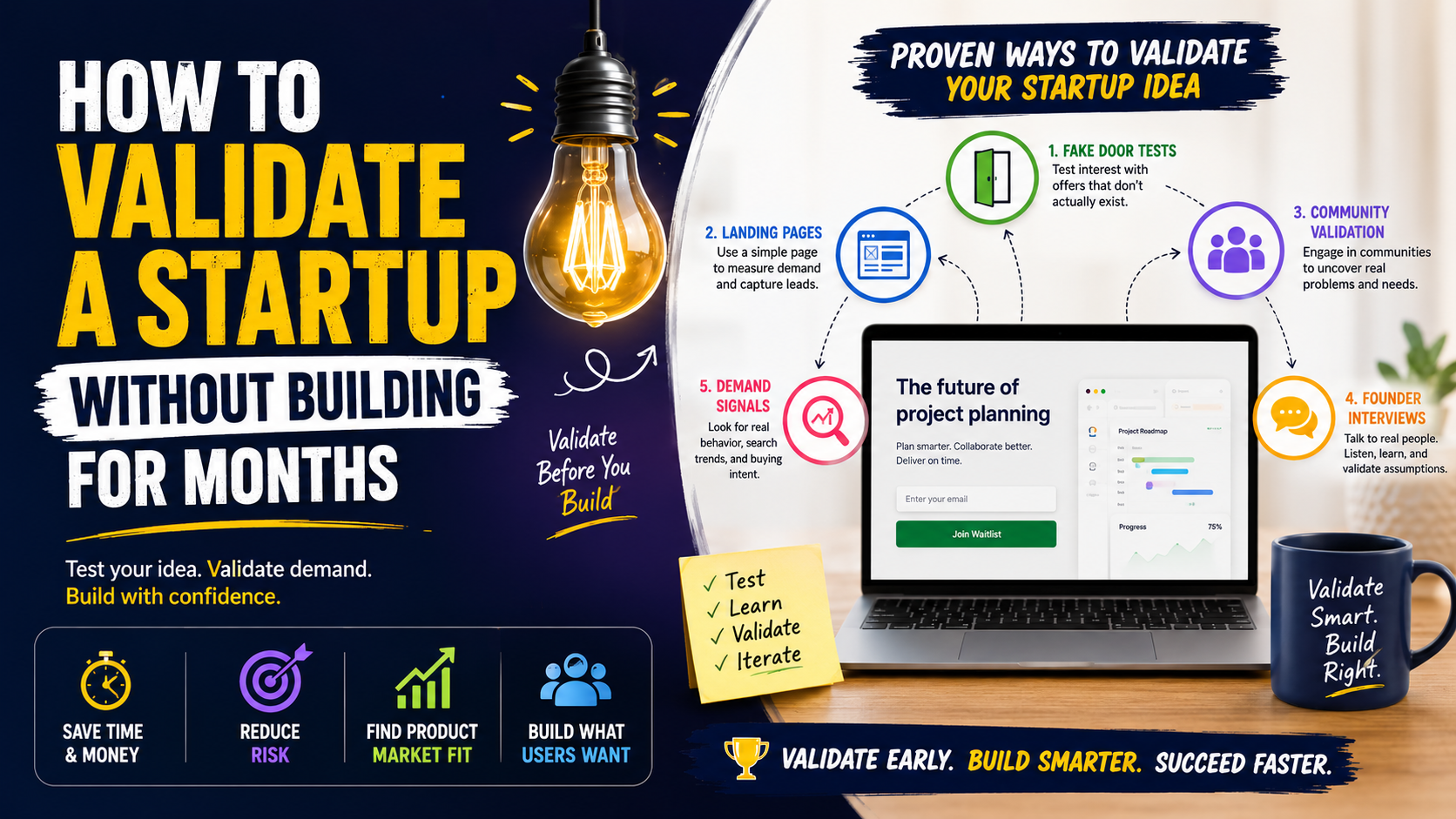
If you want to validate a startup without spending months building, the goal is simple: learn as much as possible with the least amount of time, money, and complexity. That means testing demand before writing substantial code, collecting evidence from real users, and focusing on behaviors instead of opinions. The best validation strategies are fast, practical, and grounded in real market signals.
This article breaks down how to validate a startup idea using fake door tests, landing pages, community validation, founder interviews, demand signals, and a clear framework for deciding what counts as real validation.
1. Fake Door Tests
A fake door test is one of the fastest ways to measure interest in a startup idea before building the actual product. The concept is straightforward: present people with an opportunity to use, buy, or learn more about a product that does not yet fully exist, then measure how many take action.
Think of it as testing the door before building the house. If nobody tries to open the door, there is little reason to invest months constructing what is behind it.
How fake door tests work
You create a simple touchpoint that makes the offer feel real enough for users to respond. This might include:
A button on a website for a feature that is not yet available
An ad promoting a product concept
A product listing with a waitlist or early access form
An email campaign inviting users to try a new solution
When someone clicks, signs up, or requests access, you capture that interest. You are not deceiving people for the sake of deception; you are measuring whether the problem and positioning are compelling enough to generate action.
What to measure
The most useful fake door tests track intent-based metrics, such as:
Click-through rate on the offer
Email sign-up rate
Waitlist joins
Demo requests
Pre-order interest
These metrics help you understand whether your value proposition resonates. If traffic is high but action is low, your messaging, audience targeting, or product concept may be weak.
Best practices for fake door validation
Test one clear problem and one clear promise at a time
Target a specific audience rather than a broad market
Use realistic language that reflects the actual value you intend to deliver
Follow up with interested users to learn why they clicked
Be transparent after the action, such as saying the product is in early access or not yet live
Fake door tests are especially useful when founders are unsure whether demand exists at all. They help answer an essential startup question quickly: will anyone lean in before the product exists?
2. Landing Pages
A landing page is one of the most effective startup validation tools because it turns an idea into a concrete offer. Instead of describing your startup vaguely in conversation, a landing page forces you to define the problem, the audience, the benefit, and the action you want users to take.
For many founders, this is the first real test of product-market interest.
What a validation landing page should include
A strong startup landing page does not need to be complex. In fact, simpler is usually better. It should include:
A headline focused on the problem or outcome
A short explanation of how the product helps
A clear target audience
A call to action such as join the waitlist, book a call, request early access, or pre-order
Optional trust signals like founder background, testimonials from interviews, or partner logos if relevant
The key is clarity. If visitors cannot understand what the product does and why it matters within a few seconds, your validation data will be weak.
How to drive traffic to the page
A landing page without traffic tells you very little. To validate a startup idea properly, you need to put the page in front of your target market. Common traffic sources include:
Organic posts in niche communities
Direct outreach to potential users
Small paid ad campaigns
Email newsletters
Social media content aimed at a specific pain point
You do not need a large budget. Even a modest amount of targeted traffic can reveal whether people care enough to act.
What landing page results mean
Landing page validation works best when you interpret the data carefully. A high conversion rate may indicate strong interest, but context matters. Ask:
Who visited the page?
How targeted was the traffic?
What action were they asked to take?
Did they only browse, or did they commit in some way?
A page that converts cold traffic into demo requests is a stronger signal than one that gets casual email sign-ups from friends and peers. The more friction in the action, the more meaningful the validation.
Validation is not about collecting compliments. It is about collecting commitments.
3. Community Validation
Communities are one of the richest sources of startup insight because they reveal how people talk about their problems in their own words. If you want to validate a startup without building, spend time where your potential users already gather. That might be industry forums, Slack groups, Discord servers, LinkedIn groups, Reddit communities, niche newsletters, or professional associations.
Community validation helps founders answer several important questions at once: Is this problem common? Is it painful? Are people actively looking for solutions? How do they describe the issue?
What to look for in communities
You are not just looking for mentions of your idea. You are looking for repeated pain patterns. Strong signs include:
People asking for recommendations or workarounds
Frustration with existing tools
Manual processes that consume time or money
Repeated complaints about the same bottleneck
Users stitching together multiple tools to solve one problem
When a problem appears repeatedly across different people and contexts, that is often a better signal than one enthusiastic response to your pitch.
How to validate without spamming
Many founders make the mistake of entering communities only to promote their product idea. That usually backfires. A better approach is to participate, observe, ask thoughtful questions, and contribute value. You can validate through:
Problem-focused polls
Discussion prompts about workflows and pain points
Requests for feedback on a concept or mockup
One-on-one follow-up conversations with engaged members
The goal is to learn, not to force demand. Communities can quickly expose whether your startup idea solves a real issue or whether it only sounds interesting in theory.
Why community language matters
One overlooked benefit of community validation is messaging. The exact words people use to describe their frustrations often become your best copy for landing pages, ads, and sales conversations. Founders who listen closely can refine their positioning before they ever build a product.
4. Founder Interviews
Founder interviews are among the highest-value validation methods because they allow you to go deeper than click data. A conversation can reveal urgency, budget, current alternatives, decision-making processes, and emotional context that no analytics dashboard can fully capture.
But not all interviews are useful. The quality of your insights depends on how you conduct them. A poorly structured conversation can give founders false confidence, while a well-run interview can uncover hidden objections, buying triggers, and the real cost of the problem.
Common founder interview mistakes
The biggest mistake founders make is pitching too early. If you spend most of the conversation explaining your idea, you learn very little. People are also naturally polite. They may say your product sounds interesting even when they would never use it.
Avoid questions like:
“Would you use this?”
“Do you think this is a good idea?”
“Would you pay for something like this?”
These questions produce hypothetical answers, not reliable validation.
Better questions to ask
Strong validation interviews focus on existing behavior rather than future intent. Ask questions such as:
How are you currently solving this problem?
How often does this issue happen?
What is the most frustrating part of the current process?
Have you spent money trying to solve it?
What tools or workflows are you using today?
What happens if this problem is not solved?
The more specific and experience-based the answers are, the more valuable the interview becomes.
Signs of real demand during interviews
Certain signals matter more than enthusiasm. Positive indicators include:
Users describing the problem emotionally or in detail
Existing spending on alternatives
Clear operational or financial consequences
Requests to stay updated
Offers to pilot or test the solution
Introductions to other potential users
Real demand often sounds less like excitement and more like relief.
5. Demand Signals That Actually Matter
Founders often confuse attention with validation. Likes, compliments, and casual interest can feel encouraging, but they rarely predict whether people will become customers.
Strong startup validation comes from behaviors that require effort, commitment, or sacrifice.
Weak validation signals
These signals may feel positive, but they are not enough on their own:
Friends saying the idea is good
High social media impressions
Generic compliments
Website visits without action
Survey responses without commitment
People saying they “might use it” someday
These can support validation, but they should not drive major product decisions.
Strong validation signals
These are far more meaningful:
People giving you their email voluntarily
Booking calls or demos
Pre-orders or deposits
Users repeatedly following up
Referrals to others with the same problem
Companies asking when the product will launch
Manual usage of a temporary or no-code version
The strongest signal is when people change their behavior before the product fully exists.
The commitment ladder
One useful framework is to think in terms of increasing commitment:
Attention
Interest
Engagement
Time investment
Money investment
Repeated usage
Referrals
The further someone moves down this ladder, the stronger your validation becomes.
6. Validate the Problem Before the Solution
Many startups fail because founders become emotionally attached to a solution before confirming the underlying problem matters enough.
Problem validation comes first.
Before asking whether people want your product, ask:
Is this problem frequent?
Is it painful?
Is it expensive?
Is it urgent?
Are people actively trying to solve it already?
If the answer to most of these questions is no, even a well-designed product may struggle.
Why urgency matters
Some problems are real but not urgent. Users may agree the issue exists but still not prioritize solving it. Startups gain traction faster when they address problems tied to:
Revenue loss
Time waste
Operational inefficiency
Customer dissatisfaction
Compliance risk
Emotional frustration
The higher the cost of inaction, the easier validation becomes.
Existing alternatives are a good sign
A crowded market is not always bad. In many cases, it proves demand exists. If people are already paying for spreadsheets, consultants, agencies, or competing tools, that means they value solving the problem.
Your goal is not always to invent a completely new category. Often it is to solve an existing problem faster, cheaper, simpler, or more effectively.
7. Build the Smallest Possible Test
One reason founders overbuild is because they believe validation requires a polished product. It does not.
The best validation experiments are lightweight and fast.
Examples of low-effort validation methods
A Notion page explaining the offer
A Typeform collecting interest
A manually delivered concierge service
A spreadsheet-based workflow behind the scenes
A clickable Figma prototype
A short Loom demo video
A simple AI-assisted mock experience
You are not trying to scale yet. You are trying to learn.
Concierge and Wizard of Oz testing
Two particularly effective approaches are:
Concierge MVP – You manually provide the service yourself before automating it.
Wizard of Oz MVP – Users think the system is automated, but humans are handling key parts behind the scenes.
These approaches allow founders to validate workflows, pricing, and outcomes before investing heavily in engineering.
8. When to Start Building
Validation is not endless research. At some point, you need enough confidence to move forward.
You are probably ready to build when:
A clear audience repeatedly describes the same pain point
Users take meaningful actions consistently
You can explain the value proposition simply
Potential customers ask for access or timelines
You understand the current alternatives and why they fall short
You have evidence that users care enough to switch or pay
At that stage, building becomes less of a gamble and more of an informed bet.
Avoid waiting for perfect certainty
No startup idea comes with guaranteed proof. Validation reduces risk; it does not eliminate it.
The goal is not perfect confidence. The goal is enough evidence to justify the next level of investment.
9. A Simple Startup Validation Framework
If you want a practical validation sequence, use this order:
Step 1: Identify a painful problem
Focus on a specific audience and one clear frustration.
Step 2: Research communities and competitors
Understand how people currently describe and solve the problem.
Step 3: Conduct interviews
Talk directly to potential users and learn about existing behavior.
Step 4: Create a lightweight offer
Build a landing page, prototype, or fake door test.
Step 5: Drive targeted traffic
Reach the exact audience you want to serve.
Step 6: Measure commitment
Track actions, not compliments.
Step 7: Iterate positioning
Refine messaging based on what resonates.
Step 8: Build the smallest usable version
Only after strong signals appear.
Final Thoughts
Startup validation is not about proving you are right. It is about reducing the chances of building something nobody truly needs.
The founders who validate effectively are usually the ones who learn the fastest. They test assumptions early, stay close to users, and treat feedback as data instead of personal judgment.
You do not need months of development to validate a startup idea. In many cases, a landing page, a handful of interviews, targeted outreach, and a fake door test can reveal more truth than an entire product roadmap.
What matters is not how impressive the product looks in the beginning. What matters is whether real people care enough to pay attention, engage, commit, and eventually pay.
A startup that validates early gains three major advantages:
Faster learning cycles
Lower development waste
Stronger product-market alignment
The opposite is also true. Founders who skip validation often spend months building features users never asked for, targeting audiences that do not feel the pain strongly enough, or solving problems that are interesting but not urgent.
Validation is ultimately about momentum. Every experiment should answer one critical question: are you getting closer to evidence of real demand, or are you only collecting optimism?
The faster you learn what people genuinely care about, the faster you can build something that matters.
And in early-stage startups, speed of learning is often a bigger advantage than speed of building.