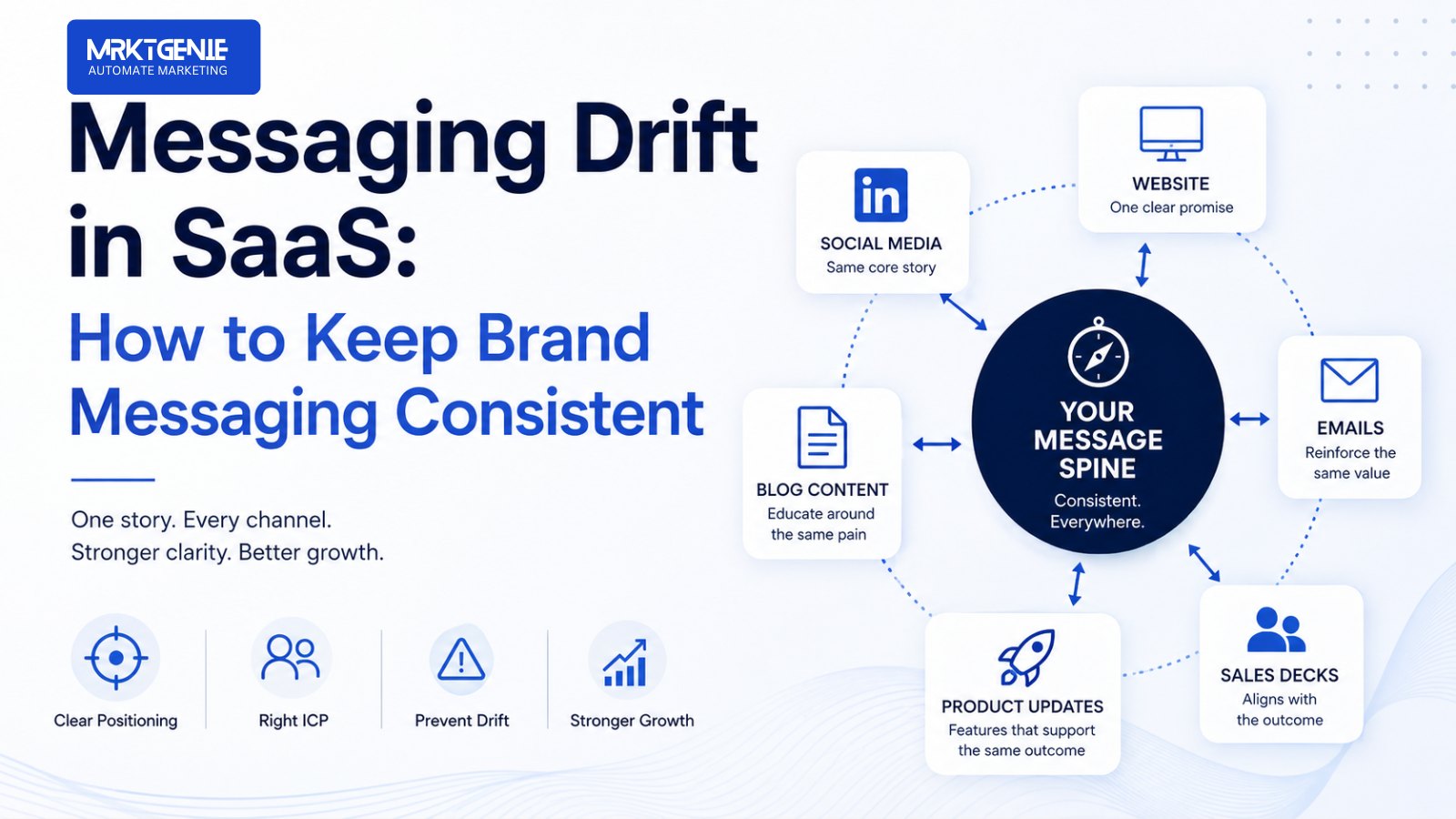
One month your homepage promises faster reporting. The next month your sales emails emphasise automation. Product release notes talk about AI. Social posts focus on collaboration. Each message may be true, but together they create confusion.
That confusion is messaging drift.
A messaging drift detector is not a single tool. It is a discipline for spotting when your product story starts changing across channels, teams, and campaigns. When your positioning is clear but your execution is inconsistent, prospects struggle to understand what you do, who you help, and why they should care now.
The result is lower conversion, weaker brand recall, longer sales cycles, and content that feels disconnected.
This article explains what messaging drift looks like in B2B SaaS, how to build a Message Spine, how to keep every channel aligned, how to write feature updates that reinforce your positioning, and how to run a fast audit that reveals where your story is slipping.
What messaging drift looks like in B2B SaaS
Messaging drift happens when the core narrative of your product changes unintentionally from one asset to another.
It often starts small.
A campaign manager rewrites the value proposition for paid ads. A product marketer frames a new launch around a different pain point. A founder updates the homepage headline to sound more ambitious. A sales team starts using language that closes deals faster but no longer matches the website.
Over time, the market hears multiple versions of your story.
Common symptoms of messaging drift
Your homepage targets one buyer, but your blog content speaks to another.
Your product pages emphasize features, while your emails emphasize outcomes.
Your social content uses trendy category language that never appears on your website.
Your release notes read like engineering logs instead of customer value stories.
Your sales deck promises one transformation, but your case studies prove a different one.
Your team cannot describe the product in the same way without checking old docs.
Your content performance is inconsistent because each channel is optimizing for a different message.
In B2B SaaS, this problem is especially costly because buying journeys are long and involve multiple stakeholders.
Prospects do not evaluate your company through one touchpoint. They may see a LinkedIn post, visit your homepage, read a blog article, sign up for emails, review release notes, and then join a demo.
If every touchpoint tells a slightly different story, trust erodes.
Consistency does not mean repeating the same sentence everywhere. It means reinforcing the same strategic meaning everywhere.
Why messaging drift happens
Rapid product evolution creates new language before positioning is updated.
Different teams create content independently without a shared framework.
Campaign goals override brand clarity.
Feature launches get more attention than customer pains.
New hires inherit fragments of the story instead of a clear source of truth.
AI-assisted content generation scales output faster than strategic review.
The fix is not more approval layers.
The fix is a stronger messaging foundation that every team can use without slowing down.
That foundation is your Message Spine.
Create a Message Spine: Positioning, ICP, Primary Pain, Promised Outcome
A Message Spine is the compact strategic structure that keeps your product story aligned across channels.
It is not a full messaging house or a massive brand document.
It is the minimum viable narrative your team can use every day.
Your Message Spine should answer four questions:
What is your positioning?
Who is your ideal customer profile?
What primary pain do they urgently want solved?
What promised outcome does your product deliver?
1. Positioning
Your positioning defines how your product should be understood in the market.
It clarifies your category, your difference, and the job buyers should associate with your brand.
Strong positioning is specific.
It avoids vague claims like "better," "smarter," or "all-in-one" unless those words are anchored in a meaningful distinction.
Ask:
What category do we want to own?
What alternative are buyers using today?
What makes our approach different?
Example
Weak positioning:
"We are an AI-powered productivity platform."
Strong positioning:
"We help remote product teams reduce decision-making delays by centralizing product feedback and prioritization."
The second version instantly creates a clearer mental picture.
2. ICP
Your ideal customer profile is the segment most likely to buy, succeed, and stay.
Messaging drift often begins when teams broaden the audience to make content feel more inclusive.
But broad messaging usually weakens resonance.
Define your ICP using:
Company size
Industry
Team function
Buyer role
Operational maturity
Purchase triggers
If your homepage speaks to revenue leaders at mid-market SaaS companies but your blog is written for general marketers across all industries, your story is already drifting.
3. Primary Pain
Most products solve many problems.
Great messaging chooses one primary pain to lead with.
That pain should be urgent, expensive, and instantly recognisable.
Examples:
Revenue teams cannot trust pipeline forecasts because data is fragmented.
Product teams struggle to prioritise because customer feedback is scattered across tools.
Marketing teams waste hours repurposing content manually.
Notice that these are business problems, not product capabilities.
Customers buy pain relief before they buy features.
4. Promised Outcome
The promised outcome is the future state your customer wants.
It is the transformation your product delivers.
Examples:
Forecast revenue with confidence.
Make faster product decisions.
Turn one idea into a month of content.
Features support the outcome.
They should never replace it.
How Drift Happens During Growth
Imagine a SaaS company that started as a reporting platform.
Initial message:
"Help operations teams create reports in minutes instead of hours."
Then they launch:
AI insights
Workflow automation
Team collaboration
Without a message spine, every team starts emphasising different capabilities.
Marketing says:
"AI-powered decision intelligence."
Sales says:
"Business process automation."
Product says:
"Collaborative analytics."
Customer success says:
"Reporting made easy."
None are wrong.
Together they create confusion.
A prospect asks:
"So what exactly do you do?"
That question is often a symptom of messaging drift.
The best SaaS companies grow their product while maintaining a stable narrative.
The story evolves.
The strategic meaning remains consistent.
Channel Alignment Framework
Once your message spine exists, every channel should reinforce it.
Homepage
Focus on:
ICP
Primary pain
Outcome
A visitor should understand these within 10 seconds.
Blog Content
Focus on:
Educating around the pain
Building awareness
Reinforcing urgency
Your blog should make readers think:
"This company understands my problem."
Social Media
Focus on:
Repetition of core themes
Market observations
Customer stories
Contrarian insights
Avoid reinventing your positioning every week.
Sales Decks
Focus on:
Problem
Cost of inaction
Outcome
Proof
Sales materials should amplify positioning, not replace it.
Customer Stories
Focus on:
Before
After
Business impact
The best case studies validate your promised outcome.
How to Write Feature Updates Without Creating Drift
This is where many SaaS companies accidentally damage positioning.
Poor release notes:
"We added three new filters, a CSV export enhancement, and a redesigned dashboard widget."
Customers understand what changed.
They do not understand why it matters.
Better release notes:
"We added advanced filtering so operations teams can identify reporting anomalies faster and make decisions with greater confidence."
The feature stays the same.
The narrative changes.
Every feature announcement should connect to:
Feature → Capability → Business Impact → Core Outcome
Example:
Feature:
AI-generated content briefs
Capability:
Creates structured content plans automatically
Business Impact:
Reduces research time
Outcome:
Helps marketers publish more consistently
This approach reinforces positioning every time you ship.
Build a Simple Messaging Drift Detector
Every month, audit five assets:
Homepage
Product page
Recent blog article
Sales deck
Latest product release
For each asset, ask:
Does it target the same ICP?
If not, drift exists.
Does it emphasise the same primary pain?
If not, drift exists.
Does it reinforce the same promised outcome?
If not, drift exists.
Would a prospect believe these assets belong to the same company?
If not, drift exists.
Score each asset:
1 = Aligned
0 = Not aligned
Maximum score = 15
Interpretation:
13–15 = Strong alignment
10–12 = Early warning signs
Below 10 = Significant messaging drift
This audit takes less than 30 minutes and often reveals issues that months of content production failed to surface.
The AI Content Risk Most Teams Ignore
AI makes messaging drift easier than ever.
A founder writes content.
Marketing generates articles.
Sales creates email sequences.
Product launches features.
Everyone uses AI.
Nobody uses the same strategic inputs.
The result is high output but low coherence.
The solution is simple:
Feed your message spine into every AI workflow.
Before generating content, define:
ICP
Positioning
Primary pain
Outcome
When every prompt starts from the same foundation, content scales without sacrificing consistency.
Most SaaS companies obsess over content volume, campaign frequency, and feature velocity.
Few obsess over narrative consistency.
Yet buyers rarely remember individual blog posts, product launches, or social updates.
They remember the story.
The companies that win are not always the loudest.
They are often the clearest.
A strong message spine gives every team a shared language.
A messaging drift detector helps you spot confusion before customers do.
Because the goal is not to say more things.
The goal is to make every touchpoint reinforce the same idea until the market can explain your product as clearly as you can.