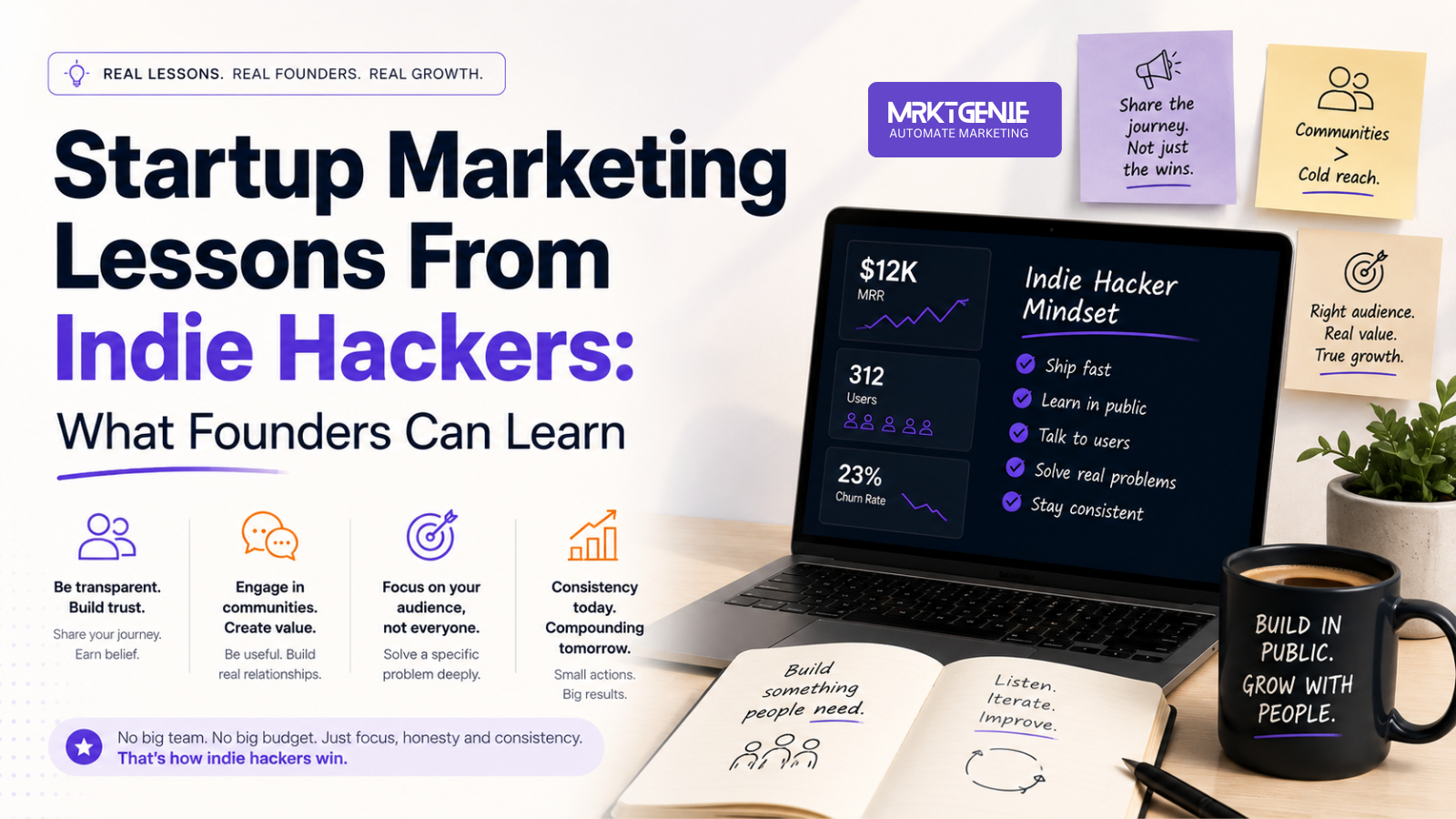
Most startup marketing advice is written for companies that already have momentum, money, and a team. That is exactly why so much of it feels useless when you are sitting alone at midnight rewriting your homepage, posting into the void, and wondering why a product people said they wanted still is not moving.
Indie hackers live in a different reality. No giant launch budget. No brand halo. No headcount to hide behind. Just a builder, a problem, a few early users, and the uncomfortable requirement to make strangers care. That is why founders should pay attention to them. Not because every indie hacker wins, but because bootstrapped builders are forced to learn the kind of marketing lessons venture-backed startups often postpone until it is painful.
If you are an early-stage founder, the problem is probably not that you are lazy or that your product is bad. It is more likely that you are still treating marketing like a campaign instead of a continuous conversation. The recurring frustration is familiar: you build, you launch, you get a small spike, and then silence. The misconception underneath it is dangerous: that better features will eventually fix weak distribution. The costly mistake is waiting too long to earn attention, trust, and relevance. What you actually want is not vanity growth. You want steady demand from people who understand what you do and why it matters.
Indie hackers have been solving that exact problem in public for years.
Transparency is not a branding tactic. It is a trust shortcut.
One of the strangest things in startup marketing is how often young companies try to sound bigger, smoother, and more certain than they really are. They hide numbers. They soften mistakes. They publish polished claims instead of useful truth. Founders do this because they think professionalism means appearing flawless.
Usually, it has the opposite effect.
Indie hackers learned early that transparency can do what polished copy cannot. A builder posts, “I launched to 17 users, 6 churned, and everyone got confused at onboarding step three.” That sounds small. But to the right audience, it sounds real. Real is persuasive.
Why? Because customers are not only evaluating your product. They are evaluating your honesty. When someone sees a founder talk openly about revenue, churn, failed tests, or feature tradeoffs, they do not just learn what is happening. They learn how that founder thinks under pressure.
There is a reason vague startup claims get ignored. People have been trained to distrust them. If your messaging still sounds like “innovative,” “seamless,” and “powerful,” read why users ignore generic startup claims. Specificity beats polish because specificity feels earned.
Transparency also creates a useful marketing byproduct: people start rooting for you. A founder sharing the messy middle invites participation. Users suggest fixes. Followers offer introductions. Prospects remember the candor. You stop looking like a faceless product and start looking like a serious person building in good faith.
That does not mean posting your Stripe dashboard every week because the internet said so. It means revealing the details that reduce buyer uncertainty. What are you learning? What changed? What did customers reject? What are you fixing next?
Trust often grows faster when you admit the rough edges than when you pretend they do not exist.
Communities outperform cold reach when nobody knows who you are
Founders love scalable channels. That is understandable. Scalable sounds efficient. But when you are early, scale is often a trap. You can spend months trying to crack broad social reach or SEO volume before realizing you skipped the more obvious move: go where your users already gather and become useful there.
Indie hackers understand this instinctively because communities are one of the few places where a small unknown builder can still win attention without buying it.
Think about the difference between two founders launching a developer tool. Founder A runs ads to a cold audience with a generic landing page. Founder B spends six weeks answering questions in niche forums, sharing teardown posts, collecting objections, and showing rough prototypes in communities where developers already complain about the problem. Which founder sounds more credible on launch day?
Usually the second one. Not because the product is better, but because familiarity lowers skepticism.
This is the hidden power of communities: they collapse the distance between builder and buyer. You stop guessing what people care about because they tell you in plain language. You stop inventing content topics because every thread is market research. You stop trying to manufacture authority because consistency creates it.
If you are overlooking this, community-led growth is worth studying. And if your instinct is to only post your own content, you are missing one of the easiest trust-building moves available. Strategic replies often outperform original posts, which is why comment marketing matters more than most founders realize.
A practical test: where did your last five customer insights come from? If the answer is your own assumptions, your marketing is underfed.
Audience-first products usually sound obvious after they work
There is a painful pattern in early-stage startups. A founder spends six months building a product for “creators,” “sales teams,” or “small businesses,” then launches and discovers that nobody feels specifically spoken to. The problem was not effort. It was distance from the audience.
Indie hackers often reverse this. They start with an audience, not just an idea.
Sometimes that audience is one they already belong to. A designer builds for designers. A solo consultant builds a tool to fix their own workflow. A developer creates something after seeing the same complaint appear 40 times in Discord. That is not just convenient. It is strategically powerful. When you know the audience deeply, your product decisions improve, but so does your marketing. The words get sharper. The examples get more believable. The positioning gets narrower in a way that actually converts.
One bootstrapped founder I know built an analytics tool and originally described it as “privacy-focused website insights.” Technically correct. Commercially weak. After spending more time with his audience, he reframed it around what they actually cared about: “Know which content drives signups without bloated dashboards or cookie banners.” Same product. Different understanding. Conversion improved because the message finally matched the buyer’s internal monologue.
This is why building audiences before products is not just a content strategy. It is a product strategy. The audience tells you what to build, how to explain it, and what proof they need before they trust it.
Founders often ask, “Should I start marketing before the product is done?” The better question is, “Why would I wait to learn who this is really for?”
Lean experimentation is not about being scrappy. It is about protecting your attention.
Bootstrapped builders cannot afford romantic marketing. They do not have the luxury of spending three months on a giant brand campaign that may or may not matter. So they test smaller. Faster. More honestly.
That is a lesson many funded startups learn too late.
Lean experimentation is often framed as a budget issue. It is also a psychology issue. Big plans feel safer because they let you postpone judgment. Small tests feel uncomfortable because they expose reality quickly. But reality quickly is exactly what you need.
A landing page test is better than a six-week redesign. Ten direct customer emails are better than a vague awareness campaign. Three headline variants with different problem framings can teach you more than another internal strategy meeting.
Consider the founder who believes they have a positioning problem, so they hire a designer, rewrite the site, and relaunch the brand. Traffic stays flat. Signups barely move. Why? Because the issue was not visual polish. It was that visitors did not understand the product in five seconds. That is why articles like why most startup websites fail in 5 seconds matter. Clarity usually beats aesthetics in the early stage.
Indie hackers are good at asking a simple question before they invest: what is the cheapest test that could prove or disprove this belief?
That question is worth stealing.
A simple decision filter for marketing experiments
What assumption are we testing?
What is the smallest version of this test?
How quickly can we get signal?
What result would change our next decision?
If you cannot answer the last question, it is probably not an experiment. It is activity dressed up as progress.
Building in public works best when it creates evidence, not noise
“Build in public” became trendy, then a little performative, then easy to dismiss. That is unfortunate, because underneath the hype is a genuinely powerful marketing principle.
When done well, building in public is not about attention-seeking. It is about compressing trust-building over time.
A founder shares product iterations, customer conversations, lessons from failed launches, screenshots of onboarding changes, and honest reflections on what is not working. Over time, an audience watches competence accumulate. By the time they need the product, they no longer feel like they are buying from a stranger.
That is the part many founders miss. Building in public is not primarily top-of-funnel content. It is pre-sold credibility.
But there is a trap here. Some founders confuse visibility with relevance. They post daily updates no customer cares about: shipped dark mode, fixed a CSS bug, had coffee, working hard. That is not building in public. That is broadcasting your to-do list.
The useful version answers one of three questions:
What did we learn about the customer?
What changed in the product because of that learning?
What does this reveal about the market that others can use?
That is also why founder-led content works better now than logo-led content. People trust people before they trust brands. If you want the larger context, why every founder suddenly wants a personal brand explains the shift well.
A good test for public building is simple: if a potential customer saw this post, would they better understand the problem, the product, or the person behind it? If not, it may be content, but it is not marketing.
Sustainable growth beats impressive spikes
Many founders secretly want the cinematic version of growth. One launch thread. One Product Hunt feature. One viral post. One newsletter mention. Then everything changes.
Sometimes that happens. More often, it does not. And when it does, the spike fades faster than the screenshots.
Indie hackers tend to learn a less glamorous truth: durable growth usually comes from systems that look boring while they are working.
A weekly habit of publishing customer-informed content. A searchable library of useful pages. Consistent community participation. Email capture with a reason to stay. Incremental referral loops. Better onboarding. Small trust signals added over time. None of this makes for dramatic storytelling. It does make for resilient businesses.
This is why bootstrapped builders often develop a healthier relationship with growth. They cannot afford channels that only work when constantly fed. They need compounding assets. Search content. Community reputation. Product word of mouth. Retention. Distribution systems they can sustain without burning out.
If your current plan depends on endless output, endless posting, or ad spend you cannot maintain, it is not a growth strategy. It is a stress strategy.
That is one reason organic growth without paid ads remains such an important operating model for early founders. Not because paid acquisition is bad, but because sustainable channels teach discipline. They force you to earn trust, sharpen messaging, and keep listening.
What venture-backed founders should copy, and what they should not
There is a temptation to romanticize indie hackers. That would be a mistake too. Bootstrapped builders are not automatically wiser. Some stay too small for too long. Some avoid ambition by calling it focus. Some over-index on public approval instead of real customers.
So the lesson is not “become an indie hacker.” The lesson is to borrow the constraints that make their marketing sharper.
What is worth copying
Talking to users early and often
Using transparency to reduce skepticism
Testing messaging before scaling spend
Starting inside communities instead of shouting at broad markets
Treating content as a listening system, not just an output system
Optimizing for channels that compound over time
What is not worth copying blindly
Posting every metric just because it looks authentic
Building a public audience with no connection to revenue
Assuming what worked for a niche solo tool will work for your category
Confusing internet applause with product-market fit
Context matters. It always does. But the broad pattern is clear: founders with fewer resources often develop better marketing instincts because reality gives them faster feedback.
The deeper lesson: marketing gets easier when you stop treating it like decoration
The biggest thing startup founders can learn from indie hackers is not a tactic. It is a posture.
Bootstrapped builders tend to treat marketing as part of product discovery, not something added after the build. They do not have the luxury of separating the two. Every post, conversation, landing page, reply, and test helps answer the same question: do we understand the problem well enough that the right people immediately feel seen?
That is what good startup marketing really does. It does not just attract attention. It creates recognition. The reader thinks, This person gets it. This product was made by someone who has lived near my frustration.
And that is why indie hacker lessons travel so well. They are not really about bootstrapping. They are about closeness. Closeness to the customer. Closeness to the truth. Closeness to the market signals many startups ignore until they become expensive.
If your marketing feels forced right now, do not start by asking how to be louder. Ask how to be closer.