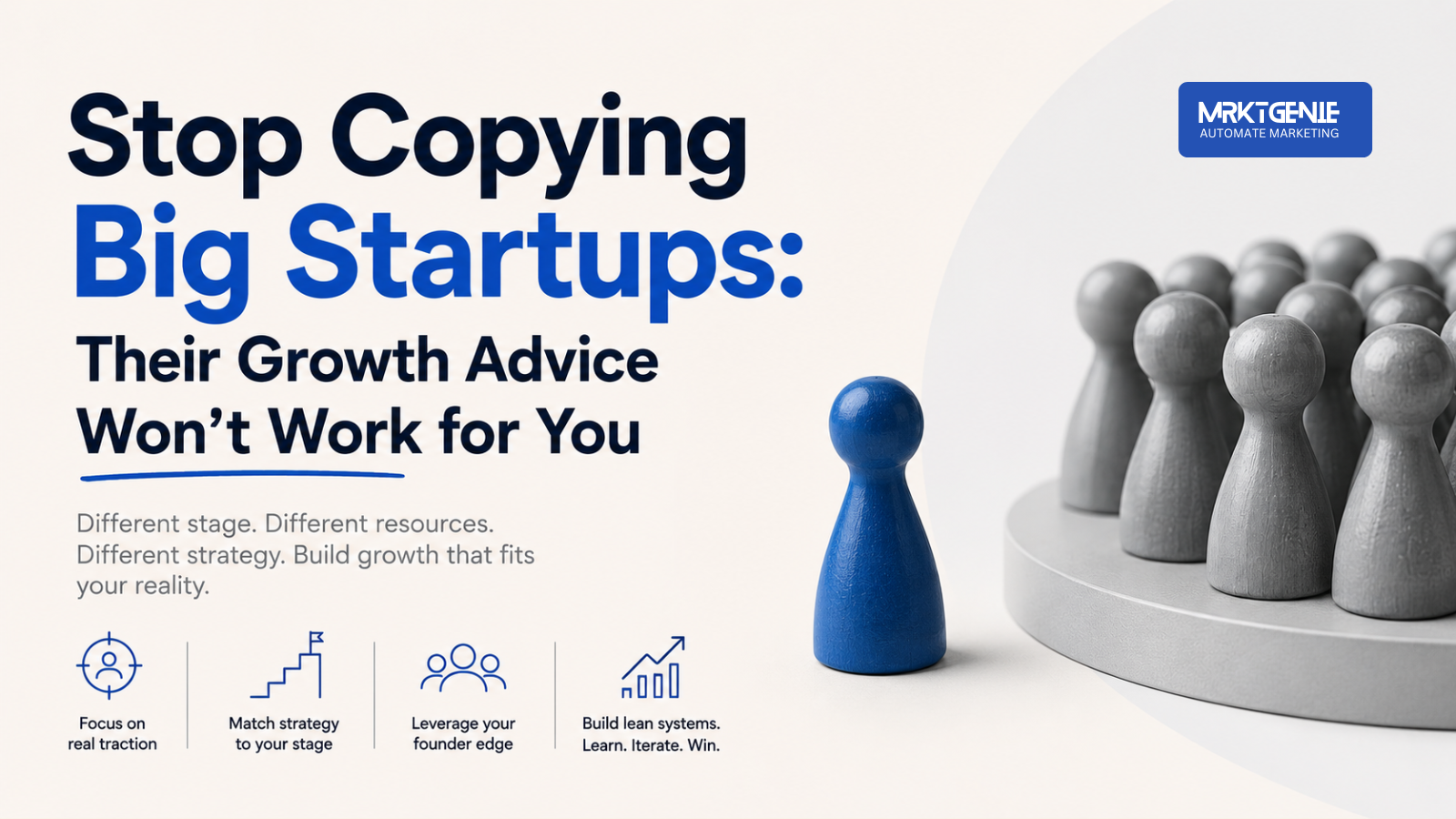
Too many early-stage founders make the same expensive mistake: they study the growth playbooks of famous startups, copy the tactics, and then wonder why nothing works. They build complex funnels, hire agencies too early, obsess over paid acquisition, and chase brand campaigns designed for companies with millions in funding, large teams, and years of market validation.
It is seductive to believe that if a well-known startup used a tactic on the way to scale, that tactic must be universally effective. It is not. Most big-startup advice is written from the top of the mountain, not from the climb. What worked after product-market fit, established demand, and a recognizable brand often fails when applied by a company still trying to earn its first loyal customers.
If you are building at the earliest stage, your job is not to imitate enterprise-style marketing. Your job is to find traction with the smallest possible budget, the shortest feedback loops, and the clearest path to learning. That requires a very different strategy.
1. Survivorship bias makes big-startup advice look smarter than it is
The startup world loves winners. We hear endlessly from founders who broke through, raised giant rounds, and turned a niche product into a category leader. What we do not hear nearly enough about are the thousands of companies that used the exact same tactics and disappeared.
This is survivorship bias in action. We pay attention to the visible success stories and ignore the graveyard of failed copies. A unicorn founder says, “Content marketing was our unlock,” or “Paid ads scaled us,” and early founders assume the tactic itself created the outcome. In reality, timing, market conditions, product quality, investor support, team strength, and plain luck all played major roles.
Enterprise-style marketing often appears effective because it is attached to companies that already had momentum. Their growth advice is filtered through brand authority, PR attention, existing customer trust, and large budgets. By the time they are sharing lessons, they are not solving the same problems you are solving.
Early-stage founders need to ask better questions. Not “What did successful startups do?” but “What constraints did they have when they first started, and what gave them their first repeatable traction?” Those are very different questions.
If your startup is still validating positioning, pricing, and customer need, copying a late-stage company’s acquisition engine is like wearing someone else’s prescription glasses. You may see movement, but not clearly enough to make good decisions.
2. Different stages require different growth strategies
There is no universal startup marketing playbook because startups do not all face the same stage-specific challenges. A pre-seed company, a post-seed company, and a growth-stage company should not market the same way.
Pre-product-market fit
At this stage, the goal is learning. You need to understand who cares, why they care, what language resonates, and what problem is painful enough to trigger action. Marketing should be direct, scrappy, and feedback-driven. Founder-led outreach, customer interviews, niche content, and community participation matter more than scale.
Early traction stage
Once you have some evidence of demand, the focus shifts to repeatability. Which channels consistently bring in qualified users? Which messages convert? Which customer segments retain best? You still do not need bloated systems. You need signal.
Growth stage
Only after a company has stronger positioning, retention, and a clearer customer profile do larger-scale tactics start to make sense. Paid acquisition can be optimized. SEO can be expanded into topic clusters. Marketing teams can specialize. Brand investments can compound.
The problem is that many founders skip the first two stages mentally. They see mature companies running polished campaigns and assume sophistication is the goal. It is not. Relevance is the goal. At an early stage, simple and specific usually outperform broad and expensive.
A useful rule: if your startup still struggles to explain exactly who it helps and why they switch, you do not need more channels. You need more clarity. For a practical look at building around traction instead of vanity, founders may find useful guidance in the MRKT Genie blog, especially articles focused on startup positioning and lean demand generation.
3. Low-budget growth channels are often better for early-stage startups
Big startups can afford channels that are inefficient in the short term because they are playing a longer, capital-backed game. You probably cannot. That is why low-budget growth channels are not just cheaper alternatives for early-stage companies. They are often better strategic choices.
The best early channels usually share four traits: they are inexpensive, measurable, high-feedback, and close to the customer. That makes them ideal for discovering what actually works.
High-leverage low-budget channels
Founder-led outbound: Direct outreach to ideal customers can reveal objections, language, and use cases faster than almost any ad campaign.
Niche content: Instead of trying to rank for giant keywords, create targeted content for specific pain points your buyers actively search for.
Partnerships: Small integrations, co-marketing relationships, and ecosystem referrals can create trust quickly.
Communities: Slack groups, LinkedIn communities, Discord servers, industry forums, and local networks are often where early adopters already gather.
Customer-led referrals: A small but delighted user base can become a powerful acquisition engine if you make sharing easy and worthwhile.
Product-led loops: Even a simple invite flow, shareable output, or collaborative feature can generate compounding distribution.
These channels may not look glamorous in a board deck, but they are often where real traction begins. Early-stage growth is less about buying attention and more about earning trust in concentrated pockets of demand.
Founders who want to improve efficiency should resist the urge to diversify too soon. One channel that reliably brings in qualified users is worth more than six channels that create noise. Lean experimentation beats premature scale every time.
If you are thinking about organic acquisition, it is worth prioritizing content that solves actual buying-stage questions instead of generic thought leadership. Relevant examples and tactical frameworks on startup content strategy can often be found across mrktgenie.com/blog.
4. Founders have advantages big companies do not
Early-stage startups are not weaker versions of large companies. In many ways, they are stronger. The mistake is trying to compete where large companies have structural advantages instead of exploiting the areas where startups win naturally.
Speed
Big companies move slowly. They need approvals, alignment, process, and layers of coordination. Founders can test a landing page today, message customers tonight, and change positioning tomorrow. That speed is a growth asset.
Authenticity
People trust people more than brands. A founder sharing real lessons, asking sharp questions, and engaging directly with customers can create attention and loyalty that polished corporate messaging cannot replicate.
Closeness to the customer
Founders hear objections firsthand. They understand use cases in detail. They can adjust the product and the message simultaneously. This is an enormous advantage over companies where marketing, product, and sales are separated by internal silos.
Focus
Large companies often need broad messaging to support multiple segments and product lines. Startups can go narrow. In fact, they should. A precise message for a specific customer type almost always beats a vague message aimed at “everyone.”
The founder’s edge is not scale. It is proximity: proximity to the problem, the customer, and the truth.
This is why founder-led marketing works so well in early stages. It is not merely a budget workaround. It is often the most credible and efficient way to build demand before a company can afford a full marketing function.
Rather than copying a late-stage brand team, founders should ask: what can only we do right now? Personal outreach, original insight, rapid feedback collection, and direct community participation are all examples of unfair advantages that disappear as companies get bigger.
5. Community-first growth beats broad awareness when no one knows you yet
One of the biggest flaws in enterprise-style marketing playbooks is the obsession with broad awareness. Awareness matters, but for early-stage startups, undifferentiated reach is usually wasteful. If no one knows you, the answer is not necessarily to reach more people. It is to matter deeply to the right people.
That is where community-first growth becomes powerful.
Community-first growth means building attention and trust within concentrated groups of relevant people before trying to market to the masses. Instead of shouting into the internet, you become useful in rooms where your buyers already spend time.
What community-first growth looks like
Joining niche conversations and contributing insight instead of dropping links
Hosting small events, workshops, or office hours for a specific audience
Building relationships with a handful of respected operators in your niche
Publishing content that answers community-specific problems in their own language
Turning early customers into visible champions and collaborators
This approach works because trust transfers socially. In the early stage, people are not buying your category narrative. They are buying confidence. Communities create that confidence faster than broad campaigns because they offer context, conversation, and social proof.
Community-first growth also sharpens positioning. When you stay close to a niche audience, you hear recurring pain points, repeated objections, and the exact language people use to describe their needs. That insight improves everything else: your homepage, your sales calls, your onboarding, and your content strategy.
For startups trying to build momentum from zero, a community can function as a distribution channel, feedback engine, and retention layer all at once. Few enterprise playbooks capture this well because by the time companies become case studies, they have already moved beyond the intimacy that made early traction possible.
6. Lean marketing systems create consistency without bloat
Rejecting enterprise-style marketing does not mean rejecting systems. It means building lighter systems that support learning, execution, and consistency without creating bureaucracy.
Many startups either do too little process or far too much. They improvise endlessly, or they install heavyweight tools and workflows before they have enough volume to justify them. The better path is lean marketing systems: simple structures that help a small team move fast and learn continuously.
What a lean marketing system includes
A clear hypothesis for each channel you test
One source of truth for messaging, ICP notes, and customer insights
A lightweight content calendar tied to business goals
Weekly review of traffic, leads, activation, and qualitative feedback
A repeatable process for capturing customer questions and turning them into content or campaigns
Basic attribution, without pretending every touchpoint can be perfectly measured
The purpose of a lean system is not to look sophisticated. It is to reduce waste. When your team knows what it is testing, what success looks like, and what was learned, marketing becomes a compounding function instead of a series of disconnected tasks.
Early-stage founders should be especially careful about copying enterprise metrics. Impressions, share of voice, and top-of-funnel volume can be misleading if they are not tied to qualified demand and retention. Better questions include: Which messages drive replies? Which channels bring users who stick? Which content creates sales conversations? Which communities produce referrals?
Lean systems also make delegation easier. Once a founder identifies what works, they can hand off pieces of the process without losing the original insight. This is how startups scale marketing intelligently: first by learning manually, then by systematizing what proves effective.
If your team is looking for practical frameworks on simplifying startup marketing operations, exploring related resources on MRKT Genie’s blog can help connect strategy with execution.
Stop borrowing confidence from companies in a different reality
The central problem with big-startup growth advice is not that it is always wrong. It is that it is often contextless. It assumes resources, recognition, data volume, and market certainty that early-stage founders simply do not have. When you copy those tactics too soon, you do not just waste money. You delay learning.
Your startup does not need an enterprise playbook. It needs a stage-appropriate one.
That means ignoring survivorship bias, choosing strategies that match your current reality, leaning into low-budget channels, exploiting founder advantages, building trust through community, and creating simple systems that support fast iteration.
The founders who win early are rarely the ones who look biggest. They are the ones who learn fastest, stay closest to the customer, and build traction before they build theater.
So stop copying big startups. Their growth advice was built for their stage, their resources, and their momentum. Yours should be built for truth, speed, and survival. That is not a limitation. It is your edge.