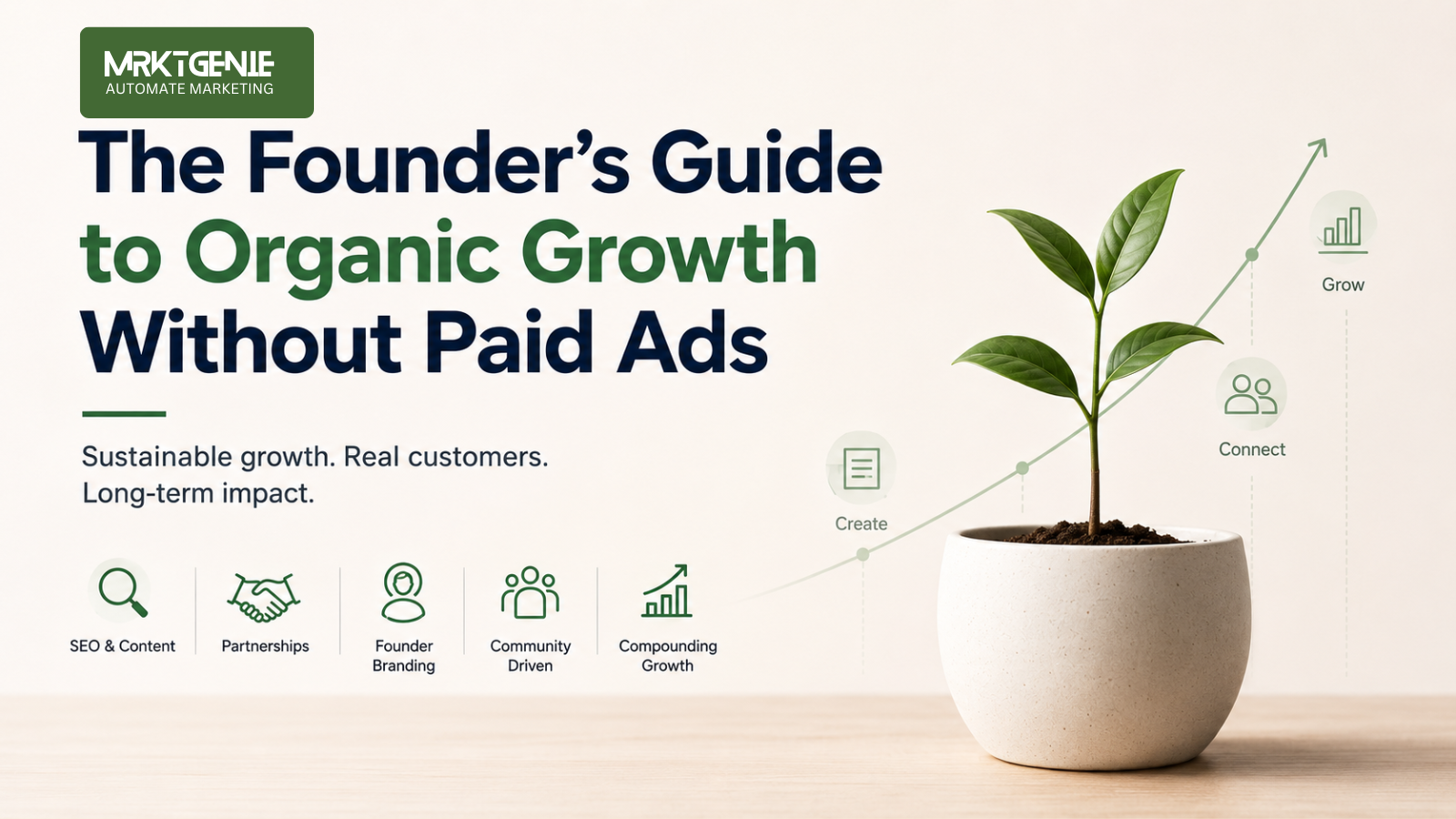
For early-stage founders, paid acquisition can feel like the fastest route to traction. But ads are expensive, increasingly competitive, and often unsustainable for startups that are still refining product-market fit. Organic growth offers a different path: slower at first, but more durable, efficient, and compounding over time.
The founder’s guide to organic growth without paid ads is ultimately about building systems that attract, convert, and retain customers through trust, relevance, and consistency. Instead of renting attention, you create assets that keep working long after they are published. For startups operating on lean budgets, this approach is not just practical. It can become a strategic advantage.
This article breaks down sustainable, low-budget marketing approaches for startups, with a focus on organic growth channels, SEO and content synergy, partnerships, founder branding, community-led acquisition, and the long-term effects that make organic marketing one of the smartest investments a founder can make.
1. Organic Growth Channels
Organic growth channels are methods of acquiring users without directly paying for reach. They rely on visibility, value, word of mouth, search demand, audience trust, and repeat engagement. For founders, the goal is not to be everywhere. It is to identify the few channels where your ideal customers already spend time and where your startup can show up consistently.
What organic growth means for startups
Organic growth is often misunderstood as “free marketing.” It is not free. It requires time, clarity, experimentation, and discipline. But unlike paid ads, the output can continue generating results long after the initial work is done. A useful blog post can rank for months. A founder’s thoughtful post can drive inbound leads repeatedly. A strong customer referral loop can keep bringing in new users with minimal marginal cost.
For startups, the most effective organic channels usually include:
- Search engine optimization through landing pages, blogs, and resource content
- Social media distribution focused on education, perspective, and conversation
- Email newsletters that nurture interest and activate existing audiences
- Customer referrals and word-of-mouth loops
- Online communities, forums, and niche groups
- Public relations and founder-led thought leadership
- Strategic partnerships and co-marketing
How to choose the right channels
Founders often waste energy trying to copy what larger companies are doing. Organic growth works best when the channel matches the product, customer behavior, and team strengths. A B2B SaaS founder may get strong results from SEO, LinkedIn, and webinars. A consumer product may grow through TikTok, creator collaborations, email, and community referrals. A developer tool may thrive on GitHub, technical SEO, and product-led word of mouth.
Start by answering three questions:
- Where do your best customers already look for solutions?
- What kind of content or interaction builds trust in your category?
- Which channels can you realistically sustain for six to twelve months?
Organic growth rewards consistency. A single burst of activity rarely works. The real leverage comes from choosing a small number of channels and building a repeatable operating rhythm around them.
The most effective low-budget marketing strategy is not doing more. It is doing the right few things long enough for momentum to build.
2. SEO + Content Synergy
SEO and content marketing are among the most powerful organic growth levers available to startups. Together, they help you capture demand, educate potential customers, and build authority in your space. SEO brings discoverability. Content creates trust. When aligned, they form a growth engine that compounds.
Why SEO matters for founders without ad budgets
Search traffic is uniquely valuable because it often reflects intent. People searching for solutions, comparisons, templates, pricing, or pain points are already in problem-solving mode. If your startup can appear when that need arises, you can attract highly relevant visitors without paying for every click.
Unlike ads, SEO does not stop the moment your budget runs out. A well-optimized article, landing page, or comparison page can continue driving traffic and signups for a long time. This makes SEO especially attractive for startups seeking sustainable customer acquisition.
Build content around customer intent
Many startup blogs fail because they publish content that is interesting internally but disconnected from what customers are actually searching for. Effective SEO content begins with intent. What does your audience want to know, solve, compare, or evaluate before they buy?
Useful content categories include:
- Problem-aware content that addresses pain points and workflows
- Solution-aware content that explains methods, tools, and frameworks
- Comparison pages such as alternative, versus, and best-tool content
- Use-case pages tailored to industries, team sizes, or roles
- Educational guides, checklists, templates, and glossaries
- Case studies and customer stories that validate outcomes
A founder’s job is to connect content topics directly to the buying journey. If a piece ranks but does not attract the right audience or move readers toward action, it is not truly contributing to growth.
Create a content system, not random posts
SEO success rarely comes from isolated articles. It comes from a structured content system. Start with a few core topics tightly related to your product and build clusters around them. For example, if your startup offers project management software for agencies, your content ecosystem might include pages about agency workflows, client collaboration, time tracking, project planning, and operational efficiency.
Each article should support a broader strategy:
- Target a clear keyword or search theme
- Answer the user’s question comprehensively
- Link to related content and product pages
- Include a relevant call to action
- Be updated as the market and product evolve
This creates synergy between traffic generation and conversion. Readers do not just arrive. They move through a logical journey from education to evaluation.
Combine founder insight with search demand
The strongest startup content sits at the intersection of search demand and original perspective. If you only chase keywords, your content becomes generic. If you only share opinions without considering discoverability, your reach stays limited. Organic growth accelerates when you combine both.
Founders have a natural advantage here. They are close to customer conversations, product decisions, and market observations. Use that proximity to publish content with depth, examples, and conviction. Search engines increasingly reward useful, experience-backed content. Readers do too.
Technical basics still matter
Even great content can underperform if the website experience is weak. Founders do not need to become technical SEO experts, but the basics should be in place:
- Fast-loading pages
- Mobile-friendly design
- Clear site architecture
- Descriptive title tags and meta descriptions
- Internal linking between related pages
- Indexable pages without duplication issues
- Conversion-focused landing pages
Organic growth works best when discoverability and usability support each other. Traffic alone is not the goal. Qualified traffic that converts is.
3. Partnerships
Partnerships are one of the most underused low-budget marketing strategies for startups. They allow founders to tap into existing trust, reach adjacent audiences, and create mutual value without large spend. The right partnership can generate awareness, leads, backlinks, credibility, and retention benefits all at once.
Why partnerships work
Partnerships are effective because they reduce the friction of being unknown. When another company, creator, community, or ecosystem player introduces your startup to their audience, trust transfers faster than it would through cold outreach alone.
For startups, partnerships can be especially powerful when they are:
- Relevant to the same customer segment
- Non-competitive but complementary
- Easy to activate with low coordination overhead
- Structured around shared benefit
Types of startup partnerships that drive organic growth
Not every partnership needs to be formal or complex. Some of the best ones are lightweight and execution-focused. Common options include:
- Co-authored content such as guides, reports, or interviews
- Webinars and live events with complementary brands
- Newsletter swaps and audience cross-promotion
- Integration partnerships that create product utility and co-marketing opportunities
- Affiliate or referral arrangements
- Podcast guest appearances
- Community sponsorship through value exchange rather than direct ad spend
For example, a startup serving remote teams might partner with a payroll platform, an async communication tool, or a founder community. Each serves a similar audience from a different angle. Together, they can create educational content and shared distribution that benefits all sides.
How founders should approach partnerships
The strongest partnerships begin with a simple question: what can we help them achieve? Too many outreach messages focus only on exposure. Better partnership requests are specific, useful, and easy to say yes to.
When reaching out:
- Show clear audience overlap
- Suggest a concrete collaboration idea
- Explain the value for both parties
- Keep the first step lightweight
- Follow through quickly and professionally
Partnerships also work best when treated as a repeatable growth channel rather than a one-off campaign. Build a shortlist of aligned brands, creators, and communities, then test formats to see what drives the strongest engagement and conversions.
4. Founder Branding
In the early stages of a startup, the founder is often one of the company’s biggest growth assets. People trust people before they trust companies. Founder branding can accelerate awareness, credibility, and inbound demand, especially when the product is new and the brand is still emerging.
Why founder-led marketing matters
Founder branding is not about self-promotion for its own sake. It is about putting a credible human voice behind the company. In crowded markets, products can look similar. A founder’s clarity, expertise, and point of view can become a meaningful differentiator.
When founders share what they are learning, building, and observing, they create familiarity. That familiarity lowers resistance. Prospects begin to understand the problem space through the founder’s lens, and the startup becomes associated with insight rather than just features.
What founder branding looks like in practice
Founder branding can take many forms, depending on communication style and audience preferences:
- Posting regularly on LinkedIn, X, or other relevant platforms
- Writing essays or newsletters about industry trends and lessons learned
- Appearing on podcasts or panels
- Sharing product decisions, customer insights, and startup building experiences
- Commenting thoughtfully in communities where customers gather
- Publishing opinionated takes that help the market think differently
The key is consistency and substance. Audiences respond to useful perspective, not recycled motivational content. Founders do not need to become influencers. They need to become recognizable, trustworthy voices in a specific domain.
How to make founder branding effective
Strong founder branding usually has three ingredients:
- Clarity about who you help and what you stand for
- Consistency in showing up and contributing value
- Connection between your ideas and your startup’s category
If your startup serves finance teams, your founder content should regularly touch on finance workflows, operational pain points, tools, changes in the market, and lessons from customers. This creates thematic alignment. Over time, the founder becomes associated with expertise in that space, and the company benefits from that trust.
One practical advantage of founder branding is that it often improves every other organic channel. It raises response rates for partnerships, increases content distribution, helps PR efforts, drives direct traffic, and makes community participation more effective. In many cases, founders become the bridge between unknown startup and trusted solution.
5. Community-Driven Acquisition
Community-driven acquisition is one of the most sustainable forms of organic growth because it is rooted in participation rather than interruption. Instead of pushing messages at people, you become part of the environments where your audience already learns, asks questions, and shares recommendations.
Where community-driven growth happens
Communities can take many forms:
- Slack and Discord groups
- Reddit communities and niche forums
- LinkedIn groups and professional networks
- Industry associations and online events
- Customer communities built around your product
- Creator-led audiences with strong engagement
For startups, community is valuable not just for acquisition but also for research. The same spaces that generate leads also reveal customer language, objections, needs, and emerging trends. That insight can improve messaging, product development, and content strategy.
How to grow through communities without being promotional
The biggest mistake founders make in communities is treating them like ad inventory. Communities reward contribution, not intrusion. If every interaction is a pitch, trust disappears quickly.
A better approach is to:
- Answer questions generously
- Share useful resources when relevant
- Offer frameworks, examples, and lessons learned
- Highlight customer successes and practical takeaways
- Participate consistently rather than only when launching something
As trust builds, people naturally become curious about your startup. This is where community-driven acquisition becomes powerful. The lead does not feel hunted. They feel helped.
Build your own community carefully
Many startups dream of launching their own community too early. A branded Slack group or forum is not inherently valuable unless there is a strong reason for people to engage. Before building your own community, earn participation in existing ones. Learn what your audience cares about, what conversations sustain momentum, and what value your startup can uniquely facilitate.
When the timing is right, your own community can support:
- Customer onboarding and retention
- Peer-to-peer support
- Referral loops and advocacy
- Product feedback and idea validation
- Exclusive educational events
The best startup communities are not built around the company alone. They are built around the customer’s identity, goals, and challenges.
Turn customers into advocates
Community-driven acquisition becomes especially effective when existing users begin sharing your product organically. This usually happens when the product solves a real problem, the experience is memorable, and customers feel seen. Founders can encourage advocacy by making it easy for users to share wins, invite peers, or participate in stories and events.
Word of mouth is not accidental. It can be designed through excellent product experiences, strong onboarding, responsive support, and a clear sense of belonging.
6. Long-Term Compounding Effects
The greatest advantage of organic growth without paid ads is not simply lower cost. It is compounding. Every useful article, every partnership, every founder post, every community contribution, and every customer referral can continue creating value beyond the moment it is launched.
Why compounding matters
Paid ads are linear. You spend money, you get traffic. Stop spending, and the traffic stops. Organic growth is different. It can be slow in the beginning, but over time the returns stack on top of each other.
A startup that consistently publishes high-quality content may see:
- More search traffic month after month
- More backlinks and domain authority
- Better brand recognition
- Higher trust and conversion rates
- Stronger word of mouth
- Lower customer acquisition costs over time
Similarly, a founder who invests in branding may find that outreach gets easier, inbound opportunities increase, and product launches gain more traction with less effort. A partnership signed today may lead to multiple future collaborations. A community contribution may turn into a customer conversation months later.
How to measure organic growth realistically
One reason founders abandon organic strategies too early is that they expect immediate, ad-like results. Organic growth should be measured with a longer horizon and broader set of indicators. Important metrics include:
- Organic website traffic
- Keyword rankings for high-intent terms
- Lead quality from content and partnerships
- Branded search volume
- Referral traffic and referral signups
- Email subscriber growth
- Community engagement and mentions
- Customer retention and referral rates
Not every signal will appear at once. But over time, these indicators reveal whether your startup is building momentum that is durable and self-reinforcing.
Create an organic growth operating system
The startups that win organically do not rely on isolated tactics. They create an operating system. That means setting a cadence for publishing, outreach, distribution, relationship building, and iteration. Even a small team can do this effectively with discipline.
A simple founder-friendly weekly rhythm might include:
- Publishing one high-value content asset
- Repurposing it into several social posts
- Reaching out to two potential partners
- Participating in relevant communities
- Reviewing search and conversion performance
- Collecting customer language and feedback for future content
This kind of repeatable process turns organic growth from a vague ambition into a strategic capability.
The founder’s advantage
Startups often assume they are at a disadvantage because they lack the budgets of larger competitors. In paid channels, that is often true. In organic growth, the opposite can be true. Startups can move faster, speak more directly, experiment more freely, and build more authentic relationships.
Large companies can outspend you. They cannot always outlearn you, outteach you, or outconnect you. Founders who commit to organic growth are not merely saving money. They are building trust-based distribution that becomes harder to replicate over time.
The founder’s guide to organic growth without paid ads comes down to this: choose focused channels, align SEO with useful content, build strategic partnerships, invest in founder branding, participate in communities, and give these efforts enough time to compound. Sustainable low-budget marketing is not about shortcuts. It is about creating assets, relationships, and credibility that keep paying back long after the work is done.