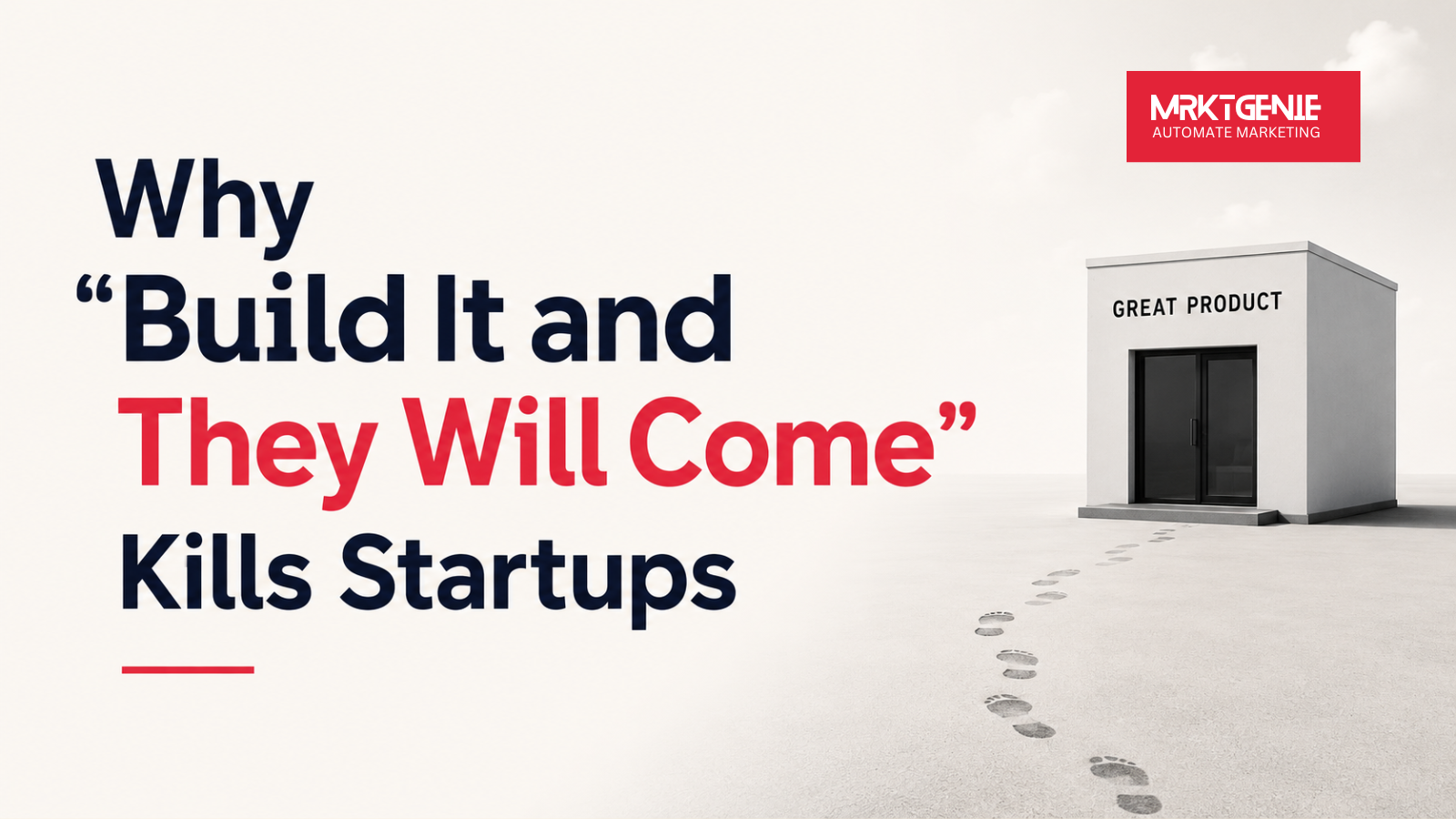
It rarely works that way.
The phrase “build it and they will come” has destroyed more startups than bad code, weak branding, or imperfect pricing. Not because product quality does not matter, but because product quality alone is not a growth strategy. In crowded markets, attention is scarce, trust is expensive, and distribution decides what gets seen. A startup without marketing systems is not product-led. It is invisible.
The reality check is simple: startups do not fail only because they build bad products. They also fail because too few people ever hear about the good ones.
The myth of automatic growth
The myth of automatic growth comes from a misunderstanding of how markets work. Founders often assume that demand behaves like gravity. Create something useful and customers will be pulled toward it. In practice, demand behaves more like a signal problem. People cannot buy what they do not know exists. They cannot trust what they have never encountered. They cannot recommend what they have never tried.
Even exceptional products need a path to market. That path includes discovery, messaging, positioning, trust-building, onboarding, retention, and referral. Without those systems, a startup is depending on luck.
Product-first thinking becomes dangerous when it turns into product-only thinking. Teams spend months polishing features while postponing audience building, content, partnerships, email capture, community engagement, and sales conversations. They tell themselves marketing can come later, after launch, after version two, after a few more improvements. But later often arrives when cash is low, morale is weak, and the market has already moved on.
There is also a psychological trap behind this myth. Building feels concrete. Marketing feels uncertain. Shipping a feature gives immediate satisfaction. Building a distribution engine requires repetition, patience, and public exposure. Many founders prefer the controlled environment of product development over the messy reality of customer acquisition. The result is a startup optimized for creation, not adoption.
A product is only as valuable as the number of right people who discover it, understand it, and decide to use it.
Automatic growth does happen in rare cases, but usually only when one of three conditions exists:
- The market is dramatically underserved and demand is already waiting.
- The founder has an existing audience, brand, or network.
- The product has built-in viral mechanics tied directly to usage.
Most startups have none of these advantages. They need deliberate distribution from day one.
Distribution-first startups
The strongest startups do not treat distribution as a post-launch activity. They build with distribution in mind from the start. That does not mean spamming social media or running ads before product-market fit. It means understanding that reach, trust, and customer access are core business assets, not optional marketing extras.
A distribution-first startup asks different questions early:
- Where do our ideal customers already spend time?
- What language do they use to describe the problem?
- Which channels can we access consistently and affordably?
- What content, partnerships, or communities can create compounding attention?
- How will we capture demand once we generate it?
This mindset changes product decisions. Instead of building in isolation, founders shape the offer around discoverability and adoption. They think about positioning before feature depth. They test messages before scaling development. They create landing pages before full builds. They collect emails before launch. They validate channels before hiring growth teams.
Distribution-first does not mean shallow products. It means products are developed alongside systems that make growth possible. The startup is not just building software. It is building a repeatable path between a problem and a customer.
Some of the most resilient companies in modern markets won not because they had the best technology on day one, but because they had a better way to reach and educate users. They understood that distribution compounds. Every article, email subscriber, webinar attendee, community member, partner relationship, and customer conversation becomes an asset. Over time, those assets lower acquisition costs and increase learning speed.
Founders who ignore distribution often discover too late that they are not competing only on product. They are competing on attention, trust, and access. In that contest, silence is a losing strategy.
Examples of invisible products
The startup world is full of invisible products: smart tools, elegant apps, and technically impressive platforms that never found traction because almost nobody knew they existed. Their failure was not always product failure. Often, it was market access failure.
Consider the common pattern:
- A founder identifies a real pain point.
- The team spends six to twelve months building a polished solution.
- Launch day arrives with a Product Hunt post, a few social updates, and some outreach.
- Traffic spikes briefly, then disappears.
- Signups are low, activation is weak, and the team concludes the market is not interested.
But the market was never truly tested. Exposure was minimal. Messaging was unrefined. The audience was not warmed up. No content engine existed. No email list had been built. No partnerships amplified reach. No community had been cultivated. The startup did not launch into a market. It launched into a void.
This happens across categories:
B2B SaaS tools
A workflow automation product may be better than established alternatives, but if procurement teams, operators, or founders never encounter its message in search, newsletters, podcasts, LinkedIn, or peer recommendations, it remains irrelevant. Better software does not beat entrenched habits by itself.
Consumer apps
A beautifully designed habit tracker or budgeting app can disappear instantly in app stores crowded with substitutes. Without creators, communities, referral loops, or content that speaks to a specific use case, the app becomes one more icon in an endless sea of options.
E-commerce brands
A product may have superior quality, packaging, and customer experience, yet still fail if the brand has no audience, no retention strategy, and no clear acquisition channel. Great products do not sell themselves on shelves people never visit.
Developer tools
Even technically excellent infrastructure products can struggle if documentation is weak, educational content is absent, and developer communities are not engaged. Developers adopt what they can understand quickly and trust through repeated exposure.
The lesson is not that product quality is overrated. It is that product quality is often hidden. Invisible excellence does not create startup growth. Visibility plus relevance does.
Building audience early
One of the most effective ways to avoid the “build it and they will come” trap is to build an audience before the product is fully ready. Audience-building is not a distraction from startup execution. It is startup execution.
An early audience gives founders three advantages: attention, trust, and insight. Attention means there are people ready to hear about the product when it launches. Trust means those people are more likely to try it because they already know the founder’s thinking, values, or expertise. Insight means the audience reveals what problems matter, what language resonates, and what objections block adoption.
Building audience early can take many forms:
- Publishing educational content around the problem space
- Sharing the build process publicly
- Growing an email newsletter
- Hosting webinars or live demos
- Participating in niche communities
- Creating social content tailored to one customer segment
- Interviewing target users and turning insights into content
- Partnering with creators or operators who already serve the audience
The key is specificity. Broad content gets ignored. Narrow, useful content attracts the right people. A founder building software for independent