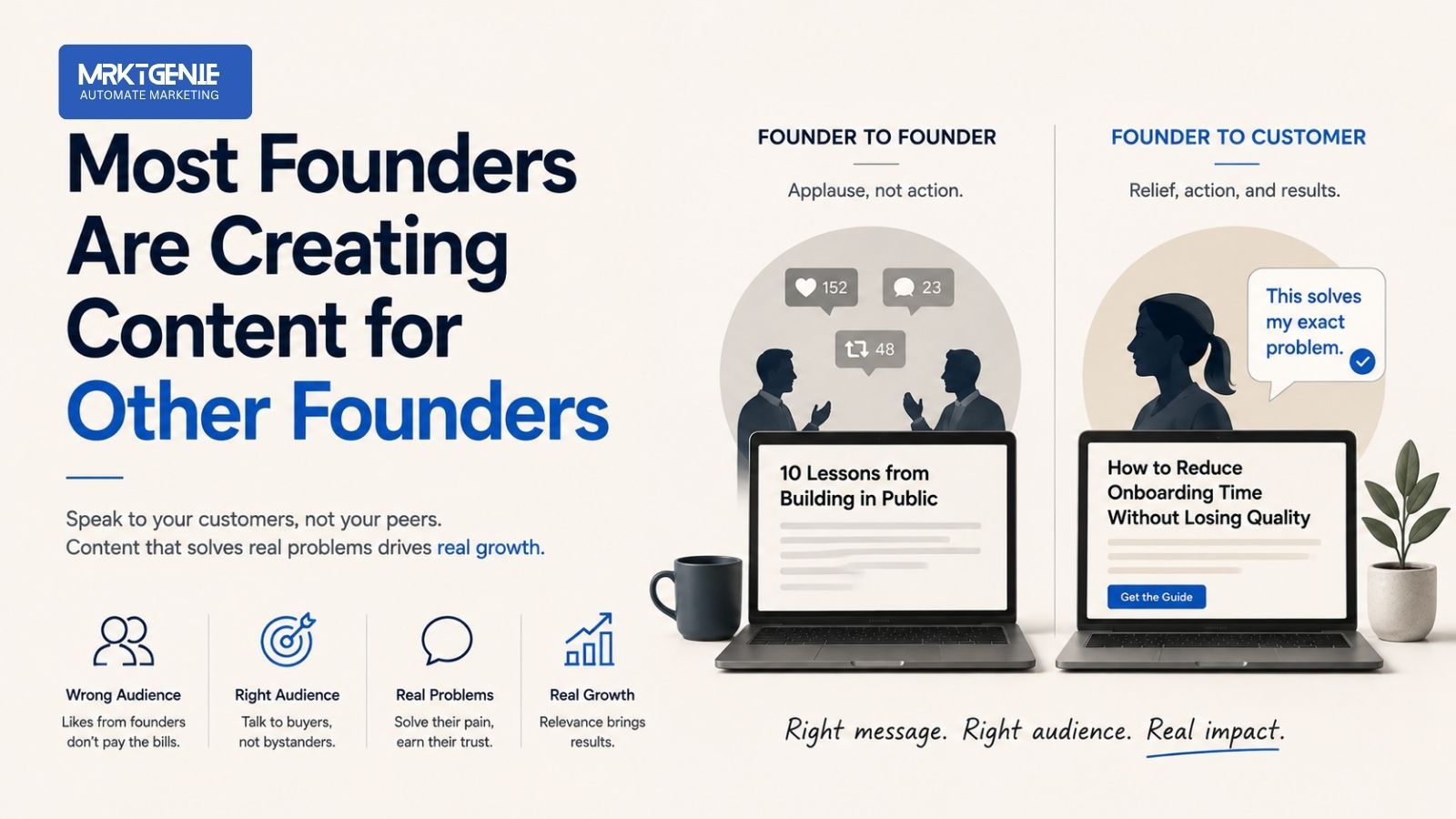
A founder posts a thread about pricing psychology, distribution loops, and what they learned from going from 0 to 1. Other founders love it. Likes roll in. Comments stack up. A few investors bookmark it. Someone says, “This is gold.”
Then nothing happens.
No qualified demos. No signups from the people who actually have the problem. No customer emails saying, “I found this and it felt like you were describing my exact situation.” Just applause from people who were never going to buy.
This happens more than founders admit. They think they are doing content marketing. What they are often doing is founder-to-founder broadcasting. It feels productive because the response is visible. It feels smart because peers approve of it. But it quietly trains the company to speak in a language customers do not use.
If you have ever looked at a post with strong engagement and weak pipeline, you have already met the problem.
The founder echo chamber feels like traction because it is social proof in the wrong room
Most founders do not start by targeting other founders on purpose. They drift there.
Why? Because founders spend time with founders. On LinkedIn, X, Slack groups, podcasts, group chats, accelerators, coworking spaces. They hear startup language all day, so they start writing in startup language. Not customer language.
A B2B SaaS founder says, “We are building an AI-native workflow orchestration layer for revenue teams.” Other founders nod. A sales ops manager, the actual buyer, reads it and thinks: I have no idea what this does.
That is the trap. Your peers understand your abstractions because they live in the same conceptual bubble. Your customers live in Tuesday afternoon. They are not trying to “rethink workflows.” They are trying to stop leads from falling through the cracks before the VP asks uncomfortable questions in the pipeline review.
I have seen this play out in founder-led brands again and again. A startup writes content about fundraising lessons, startup habits, building in public, and productivity stacks. It gets shared widely. But the product sells to clinic operators, procurement managers, finance teams, or local service businesses. Those buyers are not hanging around waiting for your take on startup culture.
The content is not bad. It is just aimed at the wrong dinner table.
Who is clapping, and who is buying?
That question alone can save months.
Imagine you sell software for dental practices. You publish: “5 things building a SaaS startup taught me about resilience.” Founders engage. Dentists do not. Then you publish: “Why front-desk staff double-book appointments and how to fix it without changing software.” Suddenly the audience changes. Fewer likes, more saves. Fewer founder comments, more demo requests.
One post fed identity. The other addressed pain.
Founders often choose identity because it is emotionally easier. Pain requires precision.
Vanity engagement is one of the most expensive false positives in startup marketing
The cruel part is that founder content often performs better on the surface.
It gets reposted because startup people enjoy talking about startup things. It triggers recognition. It flatters the audience. It lets people signal taste, ambition, and intelligence in public.
But vanity engagement is a terrible proxy for buyer intent.
A founder once told me, frustrated, “Our content is doing great. Why is revenue still flat?” When we looked closely, nearly every high-performing post was about entrepreneurship itself: founder mindset, lessons from shipping fast, AI hot takes, contrarian opinions about venture capital. The product, meanwhile, helped HR teams reduce onboarding chaos.
The people applauding the content and the people buying the product were almost entirely different populations.
This is where many teams get misled. They assume attention is attention. It is not.
A crowded restaurant is useful only if the people inside want what is on the menu. If you run a steakhouse and the room is full of vegans complimenting your decor, you do not have demand. You have a misunderstanding.
Good engagement answers: “Did this spread?” Good marketing answers: “Did this move the right buyer closer to action?”
This is also why some of the most effective startup content looks underwhelming on social. It is too specific to go broad. It names niche frustrations. It speaks to moments outsiders do not notice. But those are exactly the pieces that convert.
If this sounds familiar, you may also recognize the pattern in social performance. A lot of founders are not dealing with a content quality problem. They are dealing with an audience mismatch problem, which is often why founder posts get ignored by the people who matter most.
Audience alignment starts with an uncomfortable admission: your customer is not obsessed with startups
This sounds obvious until you review your last ten posts.
Your customer does not wake up wanting insights about distribution strategy. They want relief, status, certainty, speed, less risk, fewer mistakes, and better outcomes inside their own world.
A warehouse manager wants fewer shipping errors. A recruiter wants fewer no-shows. A controller wants cleaner month-end close. A marketing lead wants content that actually brings qualified leads instead of random traffic.
Yet founders routinely create content centered on themselves:
What we learned building in public
Our startup growth experiments
Why we pivoted
My founder routine
10 lessons from shipping our MVP
None of these are automatically useless. But ask the harder question: would your buyer search for this? Would they stop scrolling for it? Would they forward it to a teammate because it solves a live problem?
If the answer is no, you are likely writing for peers, not buyers.
This is where many startups need a full reset in how they think about discoverability. Search, social, and AI recommendations increasingly reward specific expertise, not generic founder commentary. If you want the broader context, AI search will reward experts, not content farms, and not founder performance art either.
A simple test for audience alignment
Take any draft and remove the words founder, startup, growth, building, journey, and product.
Then ask:
Does this still clearly matter to my buyer?
Is the pain concrete enough that a customer would say, “That is my situation”?
Would a sales rep be happy if a prospect read this before a call?
Does this explain a problem the buyer already knows they have, or a hidden cost they have not named yet?
If the piece collapses after removing founder-centric language, it was probably never customer-centric to begin with.
Writing for buyers means entering their day, not narrating your own
The strongest content usually begins with a scene.
Not your scene. Theirs.
For example:
Instead of “What building an AI startup taught us about efficiency,” write about the operations lead who exports data into three spreadsheets every Friday because no one trusts the dashboard.
Instead of “Our lessons from scaling outbound,” write about the sales manager whose reps are sending follow-ups manually because CRM automation keeps breaking at the worst possible time.
Instead of “Thoughts on the future of work,” write about the HR director who loses candidates in the seven-day gap between interview and offer approval.
See the difference? One is commentary. The other is recognition.
Customers respond to content that lowers the effort required to feel understood. That is why the best messaging often sounds less impressive to peers and more obvious to buyers. It names what the buyer has been living with but struggling to articulate.
If you need a more practical framework for this shift, turning customer pain points into growth content is the real work. Not brainstorming clever topics in a vacuum.
Three examples of the shift
Example 1: Fintech for SMBs
Founder version: “How we are reimagining financial operations for modern businesses.”
Buyer version: “Why small business owners always discover cash flow problems two weeks too late.”
The first sounds polished. The second gets read.
Example 2: Dev tool startup
Founder version: “What shipping fast taught us about developer productivity.”
Buyer version: “The hidden cost of waiting three days for code review in a 12-person engineering team.”
The first attracts builders. The second attracts teams with budget.
Example 3: HR software
Founder version: “The future of employee onboarding is automation.”
Buyer version: “Your new hires are confused in week one for the same reason customers churn after signup.”
The first is a slogan. The second creates urgency.
Most messaging problems are not writing problems. They are proximity problems.
Founders write for other founders because those are the people they hear from most often.
Customers are quieter. They do not comment as much. They do not congratulate your insights. They often do not tell you what they need in neat language. They reveal it sideways: in support tickets, sales objections, onboarding drop-off, implementation delays, messy workarounds, and oddly specific complaints.
That is where your content should come from.
Not the group chat. Not the timeline. Not the founder podcast you listened to at 1.5x speed.
One of the most useful habits a startup can build is a pain capture system. Every week, collect:
Questions asked on sales calls
Phrases customers use in demos
Features they misunderstand
Reasons deals stall
Support tickets with emotional language
Manual workarounds customers mention casually
That material is worth more than a month of content brainstorming.
If your team struggles to keep that story consistent across channels, that is usually a sign of messaging drift, not just weak copy. This is exactly why a messaging drift detector can be more useful than another content calendar.
The buyer-language mirror
Here is a simple correction mechanism.
Make two columns.
In the left column, write how your team describes the product.
In the right column, write how customers describe the problem.
Example:
Team says: “Automated cross-functional collaboration.”
Customer says: “I am tired of chasing approvals in Slack.”
Team says: “AI-powered knowledge retrieval.”
Customer says: “People keep asking me for the same file and I never know which version is current.”
Team says: “Revenue intelligence.”
Customer says: “I cannot tell which deals are actually real until the quarter is already gone.”
The right column is where content lives.
How founders can correct course without abandoning founder-led content
This does not mean founders should never talk about building, lessons, or opinions. Founder-led content can absolutely work. But it should serve a strategic role.
Think of your content in three buckets:
1. Buyer content
This is the core. It addresses customer pain, objections, use cases, comparisons, and outcomes. If you sell B2B SaaS, this bucket should do most of the heavy lifting.
2. Credibility content
This includes behind-the-scenes insights, lessons from implementation, product decisions, customer stories, and hard-earned observations that prove you understand the category.
3. Founder identity content
This is the personal-brand layer: beliefs, reflections, operating style, startup lessons. Useful for attracting talent, partners, and network effects. Dangerous if it becomes the entire strategy.
The mistake is not posting founder content. The mistake is letting founder content crowd out buyer content because it gets easier applause.
A healthy ratio for many early-stage startups is something like 70% buyer pain and use-case content, 20% credibility content, 10% founder identity content. Not as a rigid rule. As a corrective if you suspect you have been performing for your peers.
This is especially important if you want content to produce leads, not just visibility. There is a big difference between being known and being chosen, which is why creating startup content that actually brings leads requires stronger funnel alignment than most founders expect.
Practical examples: what to say instead
Let us make this painfully concrete.
If you sell project management software
Do not write: “Why startup teams need better async collaboration.”
Write: “Why client work always goes off track after the handoff call.”
That title immediately pulls in agencies, service teams, and operations managers who have felt the pain.
If you sell AI note-taking for sales teams
Do not write: “Our thoughts on the future of AI in revenue.”
Write: “The 4 details reps forget to log after calls that end up killing deals later.”
Now you are speaking to a manager’s fear, not a founder’s curiosity.
If you sell cybersecurity services
Do not write: “What building in cybersecurity taught us about trust.”
Write: “The reason small companies ignore security until one employee clicks the wrong invoice.”
That is a real scene. It creates tension. It earns attention.
If you sell recruiting software
Do not write: “How we are transforming hiring workflows.”
Write: “Why your best candidates go cold between final interview and offer letter.”
That is not just clearer. It is closer to money.
A better content question than “Will this perform?”
Ask this instead:
If my ideal customer read this, would they feel more seen, more certain, or more ready to act?
That is the standard.
Not whether other founders will agree with it. Not whether it sounds intelligent. Not whether it earns easy engagement from people who enjoy startup discourse.
The right content often feels narrower. Less viral. More practical. More grounded. Sometimes even a little boring from the outside.
But boring to outsiders is often useful to buyers.
And useful compounds.
It compounds in search. It compounds in sales calls. It compounds in trust. It compounds when a prospect says, “I have been reading your stuff for weeks, and you seem to really get this problem.”
That is the line you want. Not “Great post.”
The real shift: stop writing to impress people adjacent to the problem
Most founders are not failing because they lack ideas. They are failing because they are too close to startup culture and too far from customer reality.
The fix is not becoming less thoughtful. It is becoming more specific.
Spend less time asking what other founders find interesting. Spend more time listening for the sentence a buyer says right before they admit frustration.
That sentence is usually the beginning of your next article, landing page, sales email, and homepage headline.
Write for the person dealing with the mess, not the person admiring your model of the mess.
That is when content stops being performance and starts becoming pipeline.