Last year, a founder told me something I keep hearing in different forms: “We’re publishing more than ever, but somehow we’re becoming less discoverable.”
That sentence captures the quiet panic behind a lot of modern marketing. You did what you were told. You researched keywords. You wrote SEO posts. You polished landing pages. You watched impressions rise, then flatten, then become strangely disconnected from revenue. Meanwhile, your customers started asking ChatGPT, Perplexity, Gemini, and other assistants for recommendations instead of typing awkward keyword strings into a search bar. The behaviour changed before most teams changed with it.
The future of search is not ten blue links. It is a conversation. And that changes what gets found, what gets cited, and which brands get remembered.
If you are a founder, marketer, or content lead, the problem is not that search disappeared. The problem is that many of your old discovery assumptions no longer match how people actually look for answers. The costly mistake is treating AI search like traditional SEO with a chatbot interface. It isn’t. People are no longer just searching for pages. They are searching for judgement, synthesis, reassurance, and shortcuts.
That means your content has to do more than rank. It has to be understandable, quotable, trustworthy, and easy for machines to interpret without losing its value to humans.
The search now starts with a question, not a keyword
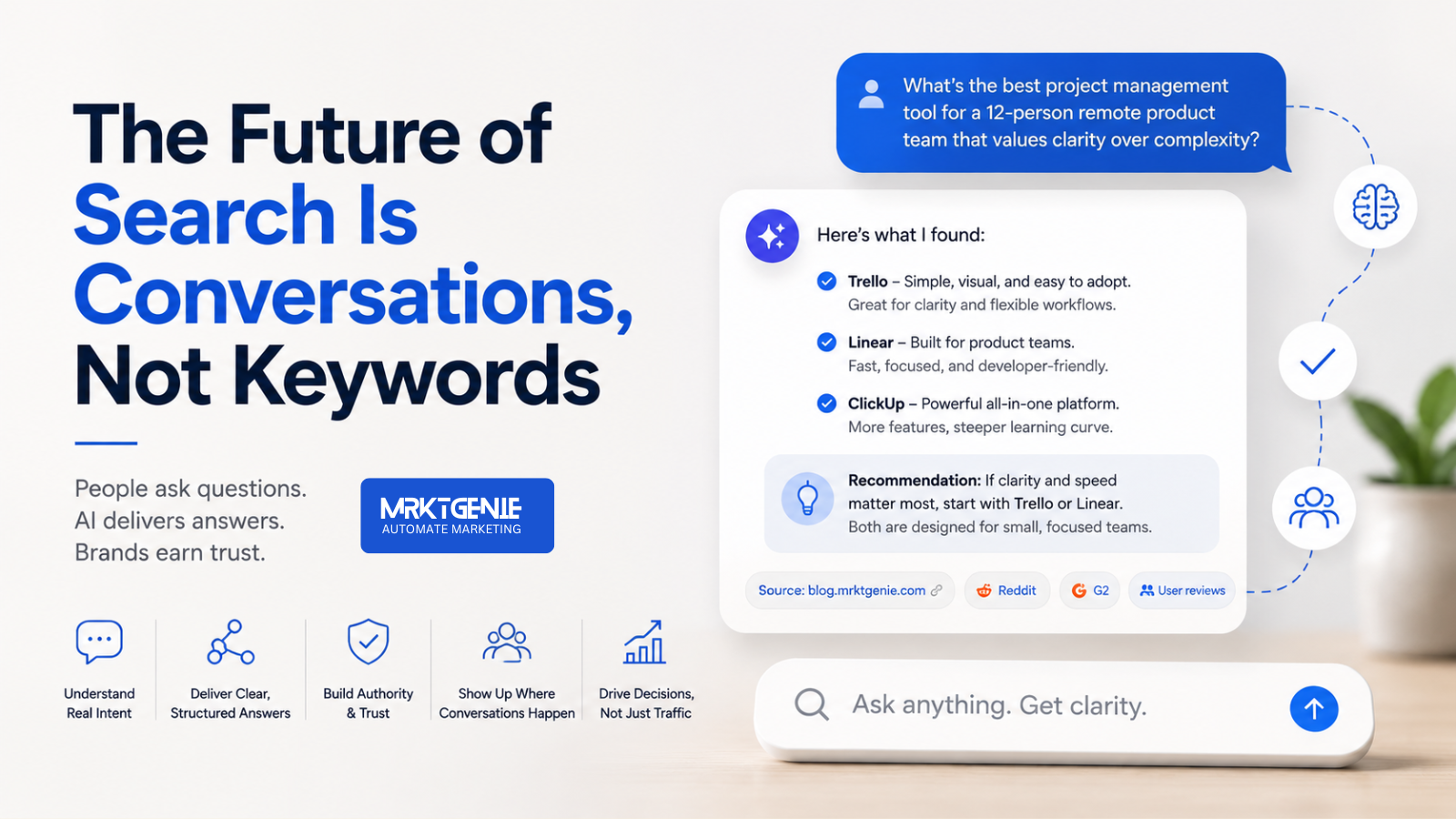
Think about how people used to search for software. They would type something stiff like “best project management tool for remote teams” and then open six tabs they never wanted to read in the first place.
Now they ask: “We’re a 12-person remote product team drowning in Slack. What tool should we use if we care more about clarity than customisation?"
That is not a keyword. That is a situation.
And situations are where AI assistants shine. They take messy human context and turn it into a recommendation. That matters because buyers do not experience their problems in keyword form. They experience them in moments of frustration: missed deadlines, confusing handoffs, bloated workflows, budget pressure, and team conflict.
The old search model rewarded pages designed around phrases. The new one increasingly rewards content designed around lived intent.
This is why many brands still feel invisible even when they have “SEO content". They answered the phrase, but not the person behind it.
A good test is simple: if someone read your article out loud in a sales call, would it sound like it understands the buyer, or would it sound like it was written to satisfy a keyword tool?
If it is the second one, AI systems may still crawl it. But they are less likely to trust it, cite it, or use it as a strong answer.
Semantic intent matters more than exact-match phrasing
One of the biggest misconceptions in content strategy is that visibility comes from repeating the “right words". That worked better when search engines needed more explicit signals. But conversational systems are built to infer meaning.
Here is the shift: users ask broad, layered questions, and AI tries to identify what they really mean.
For example, someone asking, “How do I get more demo requests for my SaaS without spending on ads?” may actually be asking five things at once:
- How do I improve organic traffic?
- How do I sharpen my messaging?
- How do I build trust?
- What channels work for early-stage growth?
- What should I stop wasting time on?
If your content only targets “get more demo requests” as a phrase, you miss the deeper semantic layer. If it addresses the real cluster of needs, it becomes much more useful in both human and AI-led discovery.
This is also why surface-level listicles are losing power. They often mention a topic without resolving the underlying decision. AI assistants are not just fetching pages. They are trying to complete tasks for the user.
A founder once showed me a blog post titled “10 Tips to Improve SaaS Conversion Rates.” Traffic was decent. Conversions were weak. When we looked closely, the article was full of generic advice and almost no situational nuance. It did not speak to whether the company had low-intent traffic, poor homepage clarity, weak proof, or pricing friction. It was technically relevant and emotionally useless.
That is the trap.
If you want to adapt, build content around intent layers:
- The explicit question being asked
- The hidden fear behind the question
- The decision the reader is trying to make
- The evidence they need before acting
If you need a stronger framework for mapping content to actual buyer stages, this guide to building an intent map for B2B SaaS is especially useful.
Brand authority becomes the filter when answers are abundant
Here is the uncomfortable truth: when AI can generate a decent summary of almost anything, average content becomes a commodity fast.
So what survives?
Authority.
Not authority in the inflated corporate sense. Real authority. The kind built when your perspective is specific, your examples are grounded, and your name keeps appearing in credible places.
Imagine two brands publishing on the same topic: customer onboarding. One produces a polished article with broad advice. The other includes screenshots, implementation mistakes, lessons from failed onboarding experiments, and a founder explaining what changed after 30 customer calls. Which one feels more cite-worthy? Which one feels harder to fake?
AI systems are increasingly influenced by the same things people are: consistency, references, reputation, and repeated association with a topic.
This is why founder visibility matters more than many teams want to admit. In a conversational search environment, faceless brands often lose to recognizable voices. People trust people. Machines notice the patterns people trust.
That is part of why founder-led visibility is rising so quickly. It is not vanity. It is discoverability insurance.
Another way to think about it: in keyword search, you could sometimes win by being well-optimized. In conversational search, you increasingly win by being the source an assistant would feel safe repeating.
That changes the content brief. You are not just asking, “Can this rank?” You are asking, “Would an intelligent system trust this enough to summarize it for someone else?”
Structured content is no longer optional
A lot of teams hear “conversational search” and assume the answer is to write in a more casual tone. That helps, but it is not enough.
You also need structure.
AI assistants are constantly extracting, comparing, summarizing, and recombining information. Content that is easy to parse has an advantage. That means clear headings, explicit claims, sharp examples, concise definitions where necessary, and clean page architecture.
Think of it like packing a suitcase. Some brands throw all their knowledge into one messy bag and hope the reader finds what they need. Structured content folds things neatly: problem, context, example, recommendation, proof.
The irony is that many “SEO-optimized” articles are actually badly structured for both humans and machines. They are bloated, repetitive, and padded to hit arbitrary word counts. They rank poorly, read poorly, and get cited poorly.
Better structure does not mean robotic writing. It means making your thinking legible.
Practical examples of structured content that works better in AI-assisted discovery:
- Comparison pages that clearly explain who each option is for
- FAQ sections that answer actual buyer objections
- Case studies with explicit before-and-after outcomes
- How-to articles broken into decision steps
- Glossaries and concept pages connected to deeper use cases
If your site still treats content as isolated blog posts rather than an organized knowledge system, you are making life harder for both search engines and buyers. Building topic clusters around product and customer pain is one of the simplest ways to fix that.
Community visibility is becoming part of search visibility
One of the most underappreciated changes in discovery is this: people do not just want answers. They want socially validated answers.
That is why Reddit threads, LinkedIn comments, YouTube explainers, Slack communities, and niche forums keep showing up in search behavior. Even when users ask AI assistants a question, they often follow up with some version of: “What are real people saying?”
Search is becoming part answer engine, part reputation engine.
I have seen small startups beat larger competitors not because they had more content, but because they had more presence where trust was formed. Their founder answered questions in communities. Their customers mentioned them unprompted. Their insights appeared in comment sections, podcasts, and peer conversations. When AI looked across the web for signals, that brand felt alive.
This is where many teams make another costly mistake: they think visibility is something that happens only on their website. It does not. Your website is where people verify. Your reputation is often built elsewhere.
If you have ever wondered why a competitor with a weaker product keeps getting mentioned, this may be the reason. They are not just publishing. They are circulating.
A practical place to start is comment participation. Not spam. Not performative engagement. Useful, specific contributions in relevant conversations. Strategic comment marketing is one of the simplest ways to build repeated exposure and authority signals without pretending to be an influencer.
And if your brand still has no real community footprint, community-led growth is more than a retention strategy. It is increasingly a discoverability strategy too.
SEO is not dying. It is growing up.
Every time search changes, people rush to declare SEO dead. Usually what died was a lazy version of it.
Old SEO often treated content like bait: find phrase, write article, rank page, collect click. New SEO has to think more like a product strategist: understand user context, reduce uncertainty, structure information well, build authority, and create assets worth referencing.
That is a much higher bar. But it is also a healthier one.
The brands that will win are not the ones producing the most content. They are the ones producing the clearest, most credible, most reusable understanding.
In practice, SEO is evolving in six important ways:
1. From keywords to scenarios
Do not just ask what people search. Ask what situation triggers the search. “CRM for startups” is a phrase. “We keep losing leads because follow-up is chaotic” is the real use case.
2. From volume to decision value
High-volume topics are tempting, but many low-volume questions carry stronger buying intent. A page that helps someone choose is often more valuable than one that merely attracts.
3. From content quantity to content reliability
When AI can generate endless summaries, weak content gets buried in sameness. Originality, proof, and firsthand experience matter more.
4. From rankings to citations and mentions
Being linked is still valuable. But being quoted, referenced, and recommended across ecosystems is becoming just as important.
5. From isolated posts to connected knowledge
Your best content should reinforce itself. A homepage claim should connect to a case study. A feature page should connect to a use-case article. A blog post should connect to a comparison page.
6. From traffic obsession to trust obsession
Traffic without trust is noise. Discovery without credibility does not convert. This is why so many founders use SEO incorrectly: they chase visits before they earn belief.
What founders and marketers should do now
If this shift feels overwhelming, it helps to translate it into practical moves.
Here is the simplest operating model I would use today:
- Audit your existing content for real intent coverage, not just keyword alignment
- Rewrite weak articles to include clearer scenarios, objections, examples, and proof
- Organize content into clusters around customer problems and product use cases
- Publish more comparison, decision-support, and implementation content
- Invest in founder voice and expert bylines where trust matters
- Build visibility off-site through communities, comments, podcasts, and partnerships
- Track not just rankings, but mentions, citations, branded search, and assisted conversions
One founder I worked with stopped publishing four generic posts a week and instead published one deeply useful article every ten days, then distributed its ideas across LinkedIn, niche communities, customer emails, and sales enablement. Traffic grew more slowly. Pipeline grew faster. Why? Because the content started doing the job buyers actually needed: reducing uncertainty.
That is the heart of conversational search. People are not looking for more information. They are looking for help making sense of information.
The real shift is psychological, not technical
Most discussions about AI search focus on algorithms, models, and search interfaces. Those matter. But the deeper change is psychological.
Users are outsourcing first-pass judgment.
They are asking machines to narrow options, summarize tradeoffs, and recommend next steps. That means your brand is increasingly judged before someone visits your site. The decision architecture is moving upstream.
So the winning question is no longer just, “How do we rank?”
It is, “When someone asks for help in our category, do we show up as a credible answer?”
That answer will depend on more than metadata. It will depend on whether your content sounds like it came from people who understand the problem, whether your brand appears in trusted conversations, and whether your expertise is structured in a way both humans and machines can reuse.
Search is becoming less like a library catalog and more like asking the smartest person in the room. If you want to be discovered in that world, stop writing pages that merely contain keywords.
Start creating answers worth repeating.