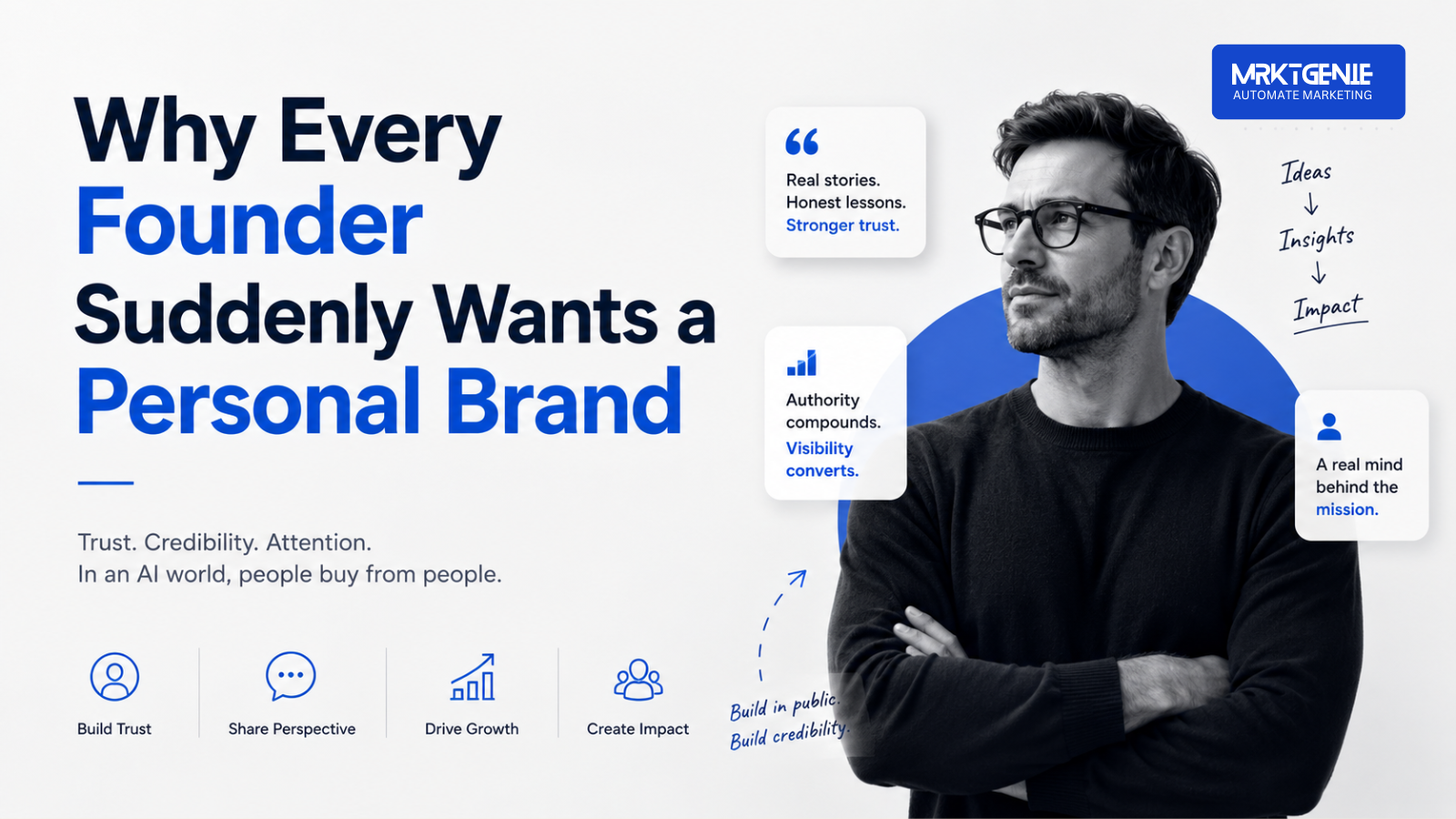
Six months ago, a founder could still hide behind a polished homepage, a tidy logo, and a few product screenshots. Now that same founder opens LinkedIn and sees competitors posting build-in-public threads, customer breakdowns, hot takes on AI workflows, and behind-the-scenes decisions that somehow attract demos while their own company page gets five likes from employees.
That shift is not vanity. It is survival.
The uncomfortable truth is that AI has made content cheaper, faster, and more abundant. Which means the internet is filling up with competent-looking marketing that nobody trusts. When every startup can produce clean copy, decent visuals, and SEO articles at scale, the thing buyers start looking for is not polish. It is proof of a real mind behind the message. That is why every founder suddenly wants a personal brand.
The reader this article is really for
If you are building a startup, especially in B2B or AI, you are probably trying to solve a painfully specific problem: how to get attention and trust before you have a giant brand, giant budget, or giant customer list.
Your recurring frustration is familiar. You ship features. You refine the product. You pay for design. You rewrite the website. And still, strangers do not care enough. Or worse, they say the market is “crowded,” even when your product is meaningfully better.
The misconception many founders still carry is this: if the product is strong enough, the company brand should do the talking. But early on, logos rarely do the talking. People do.
The costly mistake is waiting too long to become visible, then trying to compensate with more landing pages, more generic content, or more spend.
The outcome you want is simple: steady trust, warm inbound, stronger authority, and a market that understands not just what you built, but why you are worth listening to.
We are living in a trust economy, not just an attention economy
Founders often say they need more reach. Usually, they need more credibility.
Think about how a buyer behaves now. They see your product. Then they search your name. They check your LinkedIn. They scan your posts. They look for signs that you understand the problem beyond the homepage headline. They want evidence that there is an actual operator behind the company, not a content machine wearing startup clothes.
This is even more true in the AI era. Buyers have learned to be suspicious. They have seen too many wrappers, too many inflated claims, too many “AI-powered” tools that collapse under one follow-up question.
So what becomes persuasive? A founder who can explain tradeoffs. A founder who can say, “We tried this, it failed, here is what we learned.” A founder who sounds like they have sat in the mess with customers.
That is trust. And trust now converts where branding alone does not.
There is a reason personality-driven content is outperforming faceless company messaging. The new attention economy rewards personality because personality signals risk reduction. Buyers infer competence from specificity, consistency, and point of view.
A logo cannot answer objections in real time. A founder can.
Why logos no longer convert the way they used to
There was a time when looking established was enough to get a meeting. Clean website. Sharp brand identity. A few abstract words like “platform,” “transformation,” and “efficiency.”
That playbook is aging badly.
Today, logos are often too optimized to feel believable. Founders spend weeks perfecting visual identity while the messaging still sounds like it was assembled by committee. The result is a site that looks expensive and says nothing.
I have seen this happen repeatedly. A startup launches with a premium homepage. Gradient background. Product mockups. Big claims. But when you ask, “Why this founder? Why now? Why does this team understand the problem better than anyone else?” the site goes quiet.
Meanwhile, a less polished competitor posts a thread breaking down three mistakes teams make when implementing AI support agents. The post gets shared by operators. Prospects DM. Sales calls become easier because the founder has already taught the market how to think.
The logo did not lose because it looked bad. It lost because it had no pulse.
This is also why many startup websites fail so quickly. They are visually competent but psychologically weak. If your site is not converting, the issue may not just be design. It may be lack of clarity, proof, and human trust signals. Why most startup websites fail in 5 seconds breaks that dynamic down well.
Founder visibility is not a trend. It is a distribution advantage.
Some founders still treat personal branding like a side hobby for people who enjoy posting selfies with productivity captions. That misunderstanding causes them to miss what is actually happening.
Founder visibility is distribution.
It shortens trust-building cycles. It lowers customer acquisition costs. It improves recruiting. It sharpens messaging. It creates familiarity before the first call. It gives the market repeated chances to understand your expertise in context.
One founder I know built a niche B2B AI workflow tool. For months, the company account posted product updates and feature clips. Almost no traction. Then the founder started posting short observations from sales calls:
- why buyers kept confusing automation with intelligence
- the exact objection security teams raised
- where pilots got stuck after week two
Nothing flashy. Just pattern recognition from the field. Within a quarter, those posts were driving warmer conversations than paid campaigns. Not because the founder became an influencer. Because the founder became legible.
That is the real purpose of a personal brand for founders: not fame, but legibility.
People buy faster when they can place you in their heads. “She understands RevOps complexity.” “He has actually implemented this.” “They are opinionated, but grounded.” Those shortcuts matter.
What founder-led marketing looks like in practice
It rarely starts with a grand strategy. It usually starts with one founder noticing that the market responds more to a lived opinion than to a polished announcement.
Example 1: The technical founder who stopped sounding technical
A deeply technical founder kept posting architecture insights about his AI infrastructure tool. Smart content. Almost no engagement. Then he changed one thing. Instead of explaining the system, he explained the customer pain.
He wrote a post about a CTO who thought model costs were the main problem, only to discover that QA overhead and workflow friction were quietly killing ROI. That post landed because it mirrored what buyers were already experiencing.
He did not become less intelligent. He became more translatable.
Example 2: The founder who used public thinking as market research
Another founder began posting rough ideas about onboarding friction in vertical SaaS. Prospects corrected her, expanded on the issue, and shared stories from their own teams. Those comments became product inputs, sales objections, and future content topics.
Her personal brand was not just marketing. It was a live customer intelligence loop.
If you want a useful reminder here, turning customer interviews into a content engine is one of the most practical ways to avoid saying empty things online.
Example 3: The founder who stopped trying to sound “like a company”
One of the fastest improvements I have seen came from a founder who abandoned the corporate tone entirely. Instead of “We are excited to announce,” he started writing things like, “We made the wrong assumption about user onboarding, and it cost us three weeks.”
That sentence did more for credibility than ten polished launch posts.
Why? Because honesty is memorable. Specificity is believable. And mistakes, when framed well, signal real experience.
The AI era made average content abundant, which made real perspective scarce
This is the contradiction founders need to understand.
AI did not kill content marketing. It commoditized undifferentiated content.
Anyone can now generate a decent blog post, a competent email sequence, or a social thread with passable structure. So the market is becoming less impressed by content volume and more responsive to content fingerprints.
What is a content fingerprint? It is the set of traits that make your thinking recognizably yours: your pattern recognition, your tradeoffs, your language, your scars, your examples, your standards.
That is why founder-led marketing is rising alongside AI, not in spite of it. The more machine-generated content floods the feed, the more buyers crave signs of lived judgment.
This is also why copying another startup’s content strategy often backfires. Context matters. Stage matters. Founder strengths matter. Buyer sophistication matters. Most startup growth advice is context-dependent, and personal branding is no exception.
The best founder content systems are boring behind the scenes
Here is where many founders get discouraged. They assume visible founders are constantly inspired, chronically online, or naturally charismatic.
Usually, they just have a system.
The public output may feel spontaneous. The backend rarely is.
A sustainable founder content system often looks like this:
- Capture raw thoughts from sales calls, customer interviews, product debates, and objections.
- Group those thoughts into repeatable themes: misconceptions, mistakes, lessons, trends, case studies.
- Turn one strong idea into multiple formats: a post, a short article, a customer email, a founder note, a sales asset.
- Publish consistently enough to be remembered, not constantly enough to become exhausted.
One founder I worked with kept a simple note titled “Things prospects keep getting wrong.” Every week, he added bullets after calls. By the end of the month, he had twelve post ideas, three newsletter angles, two webinar topics, and sharper website copy.
That is how founder-led marketing becomes manageable. You stop inventing content and start documenting reality.
If consistency feels impossible, this guide to building startup visibility without becoming chronically online is worth reading. And if you want to multiply one good idea instead of starting from zero every time, turning one piece of content into 20 distribution assets is the kind of system that saves founder sanity.
Authority is not built by sounding impressive. It is built by reducing uncertainty.
This is where many founders get personal branding wrong.
They think authority means looking polished, posting big opinions, or acting more certain than they really are. But buyers are not looking for a performance of expertise. They are looking for someone who helps them make sense of a messy decision.
Authority is what happens when your content repeatedly reduces uncertainty.
For example:
- You explain which use cases are overhyped and which are quietly valuable.
- You show what implementation actually looks like after the demo.
- You name the tradeoffs buyers will face before they discover them the hard way.
- You articulate the problem more clearly than the buyer has been able to articulate it internally.
When that happens, you stop feeling like “a founder who posts content” and start feeling like a category guide.
A useful test is this: after someone reads your content, do they feel more informed, more understood, or more equipped to make a decision? If not, you may be posting for visibility while missing authority.
Why founder personal brands convert better than company pages early on
There is also a platform reality here. Personal profiles tend to outperform company pages because people are wired to respond to people.
A company page says, “Here is what we want you to know.”
A founder post says, “Here is what I have seen, what I got wrong, and what I think matters.”
The second form creates asymmetry. It feels less filtered. More human. More discussable.
And in B2B, discussable often beats polished.
Buyers share posts that help them signal intelligence to peers. They forward practical founder takes into Slack channels. They remember the founder who articulated a hidden problem. They rarely forward a generic company announcement unless the company is already famous.
This is why many founders feel like their LinkedIn posts disappear when they write in brand-safe language. If that sounds familiar, why your LinkedIn posts get ignored will likely feel uncomfortably accurate.
A simple content framework for founders who do not want to “be a creator”
You do not need to become a full-time content personality. You need a repeatable way to turn your operating reality into market-facing trust.
Use this five-bucket framework:
1. Misconceptions
What does the market keep getting wrong?
Example: “Most teams do not fail with AI because the model is weak. They fail because the workflow around the model is brittle.”
2. Field notes
What are you seeing in calls, onboarding, implementation, or retention?
Example: “The biggest onboarding drop-off happens after internal handoff, not initial setup.”
3. Decisions and tradeoffs
What did you choose not to do, and why?
Example: “We removed a feature prospects loved in demos because it created confusion in real usage.”
4. Customer language
What exact phrases do customers use when they describe pain?
That language is gold. It sharpens positioning, SEO, sales, and content all at once. If your messaging still feels vague, how to explain your startup in one sentence can help tighten it.
5. Point of view
What do you believe that your category still underestimates?
This is where authority compounds. Not from being loud, but from being clear.
How to avoid cringe founder branding
This is the fear underneath most founder hesitation.
They do not mind being visible. They mind being embarrassing.
Fair. The internet is full of performance disguised as insight.
So here is the distinction: cringe branding is not caused by self-promotion. It is caused by misalignment between image and substance.
It feels off when:
- the confidence is higher than the experience
- the storytelling is detached from real customer truth
- the tone sounds borrowed from bigger founders
- every post tries to sound profound instead of useful
The antidote is simple, though not always easy.
- Be specific instead of inspirational.
- Teach from scars, not slogans.
- Share observations before conclusions.
- Use your natural voice, slightly sharpened, not a synthetic “thought leader” voice.
- Earn authority through clarity, not posture.
A good rule: if a post could have been written by any ambitious founder in any category, it is too generic. If it could only have come from someone who has lived your customer problem closely, you are getting warmer.
The best founder brand does not make people think, “This person is famous.” It makes them think, “This person gets it.”
The deeper reason founders are leaning into personal brands now
Yes, it helps with reach. Yes, it helps with trust. Yes, it lowers CAC.
But there is something deeper happening.
Markets are becoming more skeptical, more crowded, and more algorithmically flattened. More products look similar at first glance. More websites sound interchangeable. More content is technically correct and emotionally empty.
In that environment, the founder becomes one of the last unfair advantages that cannot be fully copied.
Your background. Your obsessions. Your standards. Your way of seeing the problem. Your willingness to name what others avoid. That is differentiation the market can feel.
Not every founder needs to become highly visible. But most early-stage founders need to become more knowable.
What to do this week if you want to build a founder brand without making it your whole life
- Write down the five questions prospects ask most often.
- List three things your market misunderstands.
- Review recent customer calls and pull exact phrases people used.
- Post one lesson from a mistake, one customer pattern, and one strong point of view this week.
- Measure not just likes, but replies, profile visits, inbound conversations, and sales-call familiarity.
Do that for eight weeks and you will likely notice something subtle but important. People stop encountering your company as a cold object. They start encountering it through a trusted mind.
The real shift
Every founder suddenly wants a personal brand because the old shortcuts are weakening.
Brand without belief is decoration. Content without perspective is wallpaper. SEO without trust is traffic that hesitates. AI has accelerated all of this.
So the question is no longer whether founder-led marketing is real. It is whether you are willing to let the market know the human intelligence behind the product.
Because in an era of infinite polished output, the scarcest thing is not content.
It is conviction people can trust.