You can spend months polishing a homepage, tweaking your onboarding, and posting on LinkedIn every morning at 8:17 a.m. And still hear the same quiet objection from prospects: “Looks interesting… but who else is using this?”
That sentence has killed more startup momentum than bad design ever will. Not because your product is weak. Because trust is missing. And when you’re a new startup, trust is the product before the product gets a chance to prove itself.
This is the part founders rarely say out loud: strangers do not evaluate startups fairly. They don’t compare your promise to your effort. They compare your risk to their reputation, budget, and time. If buying from you feels like a gamble, they hesitate. If it feels safe, they move.
So if you’re wondering how to build trust around a new startup fast, the answer is not “get more traffic.” It’s reduce perceived risk everywhere people encounter you.
Why trust matters more than traffic
Early-stage founders often think they have an awareness problem. Sometimes they do. But just as often, they have a credibility problem disguised as a traffic problem.
I’ve seen this happen with founders who proudly say, “We got 5,000 visitors this month,” then whisper, “But no one booked a demo.” The instinct is to chase more reach. More posts. More ads. More SEO. But if your site, messaging, and presence don’t answer the trust question, extra traffic just means more people bouncing with the same doubt.
Think about how people buy from unknown companies. They are not asking, “Is this startup excited about its mission?” They are asking:
- Is this real?
- Can these people actually deliver?
- Will I regret attaching my name to this?
- Has anyone like me trusted them before?
That’s why a startup with modest traffic but strong credibility often outsells a louder startup with a weak trust layer.
This is also why blindly copying advice from larger companies backfires. Big brands can afford polished vagueness because their logo already does half the work. Unknown startups cannot. If that sounds familiar, read why big startup growth advice won’t work for you and why most startup growth advice is context-dependent.
The uncomfortable truth: people trust signals, not intentions
A founder once told me, “But we really care about customers.” I believed him. His prospects didn’t, because the website had no customer names, no founder presence, no product screenshots, no implementation detail, and no proof that anyone had succeeded with it.
Good intentions are invisible. Trust signals are visible.
If your startup is new, you are not trying to look big. You are trying to look believable.
Social proof is borrowed trust
When you have no brand history, you need to borrow credibility from people, communities, and outcomes your audience already trusts.
That is what social proof really is: borrowed trust.
Most founders make this too narrow. They think social proof means “logos on a homepage.” It can. But social proof is broader than that:
- Customer testimonials
- User-generated praise
- Expert endorsements
- Public product feedback
- Waitlist numbers with context
- Community mentions
- Investor or advisor credibility, used sparingly
- Specific implementation examples
What weak social proof looks like
“Our users love us.”
That line is nearly useless.
Who are the users? Why do they love you? What changed for them? What did they try before? What specific fear did you remove?
Vague praise feels manufactured because it usually is.
What strong social proof looks like
“We replaced three manual reporting steps with this tool and cut weekly ops time from 6 hours to 90 minutes in the first month.”
Now the reader can picture themselves in the story. Trust rises because the claim is concrete.
One SaaS founder I know had only four paying customers. Not forty. Four. But instead of hiding that fact, she turned each customer into a detailed mini-story: the problem they had, the messy workaround they were using before, what made them skeptical, and what happened after onboarding. Those four stories closed more deals than her previous six months of generic content.
Why? Because specificity beats volume.
Fast social proof strategies for unknown startups
Ask early users for outcome-based testimonials, not compliments. Prompt them with questions like: What problem were you trying to solve? What almost stopped you from signing up? What changed after using us?
Turn support wins into proof. If a customer says, “This saved me two hours,” ask permission to publish it.
Show product reality. Screenshots, workflow examples, before-and-after states, and implementation notes often build more trust than polished brand copy.
Use “building with” instead of “building for.” Publicly share how early customers are shaping the roadmap.
If you are pre-revenue, use validation proof. Interviews completed, pilots started, expert feedback, or credible design partners all count if presented honestly.
And if your homepage still feels thin, it may not be a traffic issue at all. It may be a trust architecture issue. This is closely related to why most startup websites fail in 5 seconds.
Founder-led branding works because people trust people before they trust companies
Here’s a pattern you’ve probably seen: two startups offer similar products. One posts polished brand content from a faceless company page. The other has a founder openly sharing lessons, tradeoffs, mistakes, customer insights, and product decisions. Guess which one feels safer to buy from?
The second one almost always does.
Not because founder-led branding is trendy. Because accountability feels visible.
When buyers can see the person behind the product, trust becomes easier. They can observe how you think, how you respond to criticism, whether you understand the problem deeply, and whether you sound like someone who will still be around after the invoice is paid.
A founder story people actually believe
A cybersecurity founder once told me his best-performing post was not a feature announcement. It was a short story about the moment he realized his old employer’s compliance workflow was held together by Slack messages, spreadsheets, and panic. Prospects responded because the post didn’t sound like marketing. It sounded like lived experience.
That is the real power of founder-led branding: not visibility for its own sake, but credibility through pattern recognition. Your audience thinks, “This person gets my world.”
If your content feels ignored, the problem may not be consistency. It may be that your posts say polished things instead of true things. See why LinkedIn posts get ignored and why the attention economy now rewards personality.
What to share if you want trust, not vanity metrics
Why you started the company, with the unglamorous version included
Customer misconceptions you keep seeing
Tradeoffs you made in the product and why
Mistakes from early sales calls or onboarding
Sharp opinions about the problem space, backed by examples
Lessons from talking to real users
The key is this: don’t perform expertise. Demonstrate proximity.
People trust founders who sound like they have been in the room where the problem happens.
Community participation beats self-promotion
Many founders join communities with the subtle energy of someone handing out flyers outside their own party. Everyone can feel it.
They comment only when they have something to sell. They drop links too early. They treat communities like acquisition channels instead of trust environments.
That approach usually fails.
The faster path is quieter: become useful before becoming visible.
Why communities create trust faster than cold reach
In a community, people can watch you over time. They see whether your advice is thoughtful, whether you answer questions generously, whether you understand edge cases, whether customers vouch for you without being prompted.
Trust compounds when people witness you repeatedly being helpful in public.
That is far more persuasive than a paid impression.
One founder in the RevOps space spent three months answering detailed questions in niche Slack groups. No pitch. No “book a demo.” Just practical help. By month four, members started tagging him when new people asked for tool recommendations. He became the default answer before he became the obvious vendor.
That is what community does at its best. It turns visibility into reputation.
If this channel fits your market, community-led growth is one of the most underrated startup strategies.
How to participate without looking transactional
Answer real questions with specifics, not broad advice.
Share frameworks people can use without buying from you.
Post lessons from failed experiments, not just wins.
Recommend alternatives when they are a better fit than your product.
Stay present long enough for familiarity to form.
A useful test: if you removed every mention of your startup, would your contributions still help people? If the answer is no, trust will be slow.
Case studies and testimonials should reduce fear, not just decorate the page
Most testimonials are written like wall art. Pleasant. Polished. Forgettable.
“Great team.”
“Amazing platform.”
“Highly recommend.”
None of these address the anxiety of buying from a new startup.
Your case studies should do one job above all else: remove the next buyer’s fear.
The best case studies answer the objections prospects won’t say directly
Think about the hidden objections in a buyer’s head:
- Will onboarding be a mess?
- Will my team actually use this?
- What if this startup disappears in six months?
- Will implementation drain internal time?
- Is this only for companies bigger than ours?
A strong case study answers these without sounding defensive.
For example, instead of writing:
“Client X improved productivity using our platform.”
Write:
“Before switching, the operations team tracked requests across email and spreadsheets. They worried implementation would create even more chaos, so we onboarded one workflow first, trained two team leads, and had the process running in five days. Within three weeks, response time dropped by 42%.”
That works because it mirrors the buyer’s fear, then resolves it.
A simple trust-building case study structure
Who the customer is
What messy problem they had before
Why they hesitated
What convinced them to try
What changed, with numbers or concrete observations
What surprised them most
If you’re early and don’t yet have polished case studies, start smaller. A screenshot of a customer email with permission. A short quote with context. A founder note explaining the customer’s before-and-after workflow. Raw proof is often more believable than overproduced proof.
Transparency is not weakness. It is a trust accelerant.
Founders often assume transparency will make them look small. In practice, selective transparency usually makes them look serious.
People do not expect early-stage startups to have everything figured out. They expect honesty about what is ready, what is changing, and what happens if something breaks.
Opacity creates suspicion. Transparency creates confidence.
What transparency looks like in real life
It looks like saying:
“This feature is in beta, and here’s what it does well today.”
“We’re a small team, which means support comes directly from the people building the product.”
“This product is best for companies with this workflow, and probably not a fit if you need these enterprise controls yet.”
“Here’s our security documentation, uptime history, and onboarding process.”
Counterintuitively, honest constraints can increase conversions. When you clearly state who the product is for and not for, people trust the rest of your claims more.
I once watched a founder close a skeptical prospect by saying, “We’re not the right fit if you need a deeply customizable setup in week one. Our advantage is speed and simplicity.” That sentence did more for trust than twenty slides of positioning. It sounded expensive to say, which is why it sounded true.
Transparency as a growth system
Transparency is not just a tone. It can be operationalized:
Publish clear pricing or at least pricing logic
Explain onboarding steps before the sale
Share product roadmap themes
Document security, compliance, and reliability basics
Respond publicly and calmly to product issues
Show what you learned from customer feedback
When trust is low, ambiguity is expensive.
A practical framework: build trust at every point of contact
If you want a simple way to audit your startup, stop asking, “Does this look good?” Start asking, “Does this reduce uncertainty?”
Use this five-point trust check across your website, sales process, and content:
1. Clarity
Can someone understand what you do in one sentence without jargon? If not, uncertainty starts immediately. This is where explaining your startup in one sentence becomes more than a messaging exercise. It becomes a credibility exercise.
2. Specificity
Do you make concrete claims or broad promises? Specificity signals reality.
3. Proximity
Can prospects see the founder, team, customers, or product in action? Distance lowers trust. Proximity raises it.
4. Proof
What evidence supports your claims? Testimonials, examples, numbers, screenshots, customer stories, and community reputation all help.
5. Honesty
Do you clearly state limitations, fit, and process? Honesty reduces the fear of hidden surprises.
If one of these is weak, trust slows down.
The fastest way to build trust is to make risk feel smaller
That is the real principle underneath all of this.
People do not buy from new startups because they are impressed by ambition. They buy when the risk feels manageable.
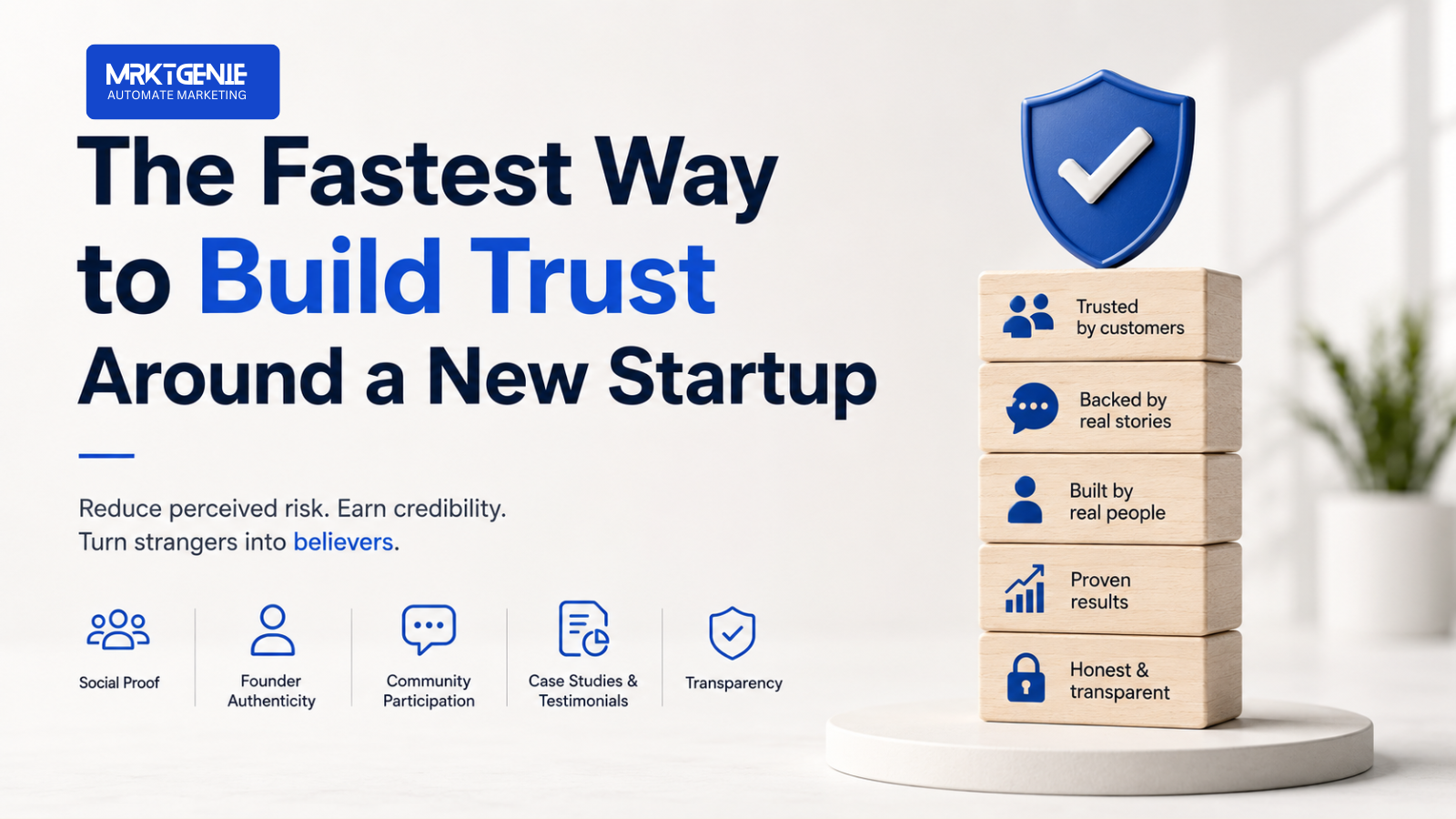
Social proof says, “Others have gone first.”
Founder-led branding says, “There are real people here who understand this problem.”
Community participation says, “We show up consistently and help before we ask.”
Case studies say, “This worked in a situation that looks like yours.”
Transparency says, “You won’t discover the truth after you’ve committed.”
Put differently: trust is not built by claiming credibility. It is built by removing reasons to doubt you.
So if your startup feels stuck, don’t just ask how to get seen. Ask a harder question: what would make a smart, skeptical buyer feel safe moving forward with us this week?
Answer that well, in public, repeatedly, and trust will grow faster than most founders expect.