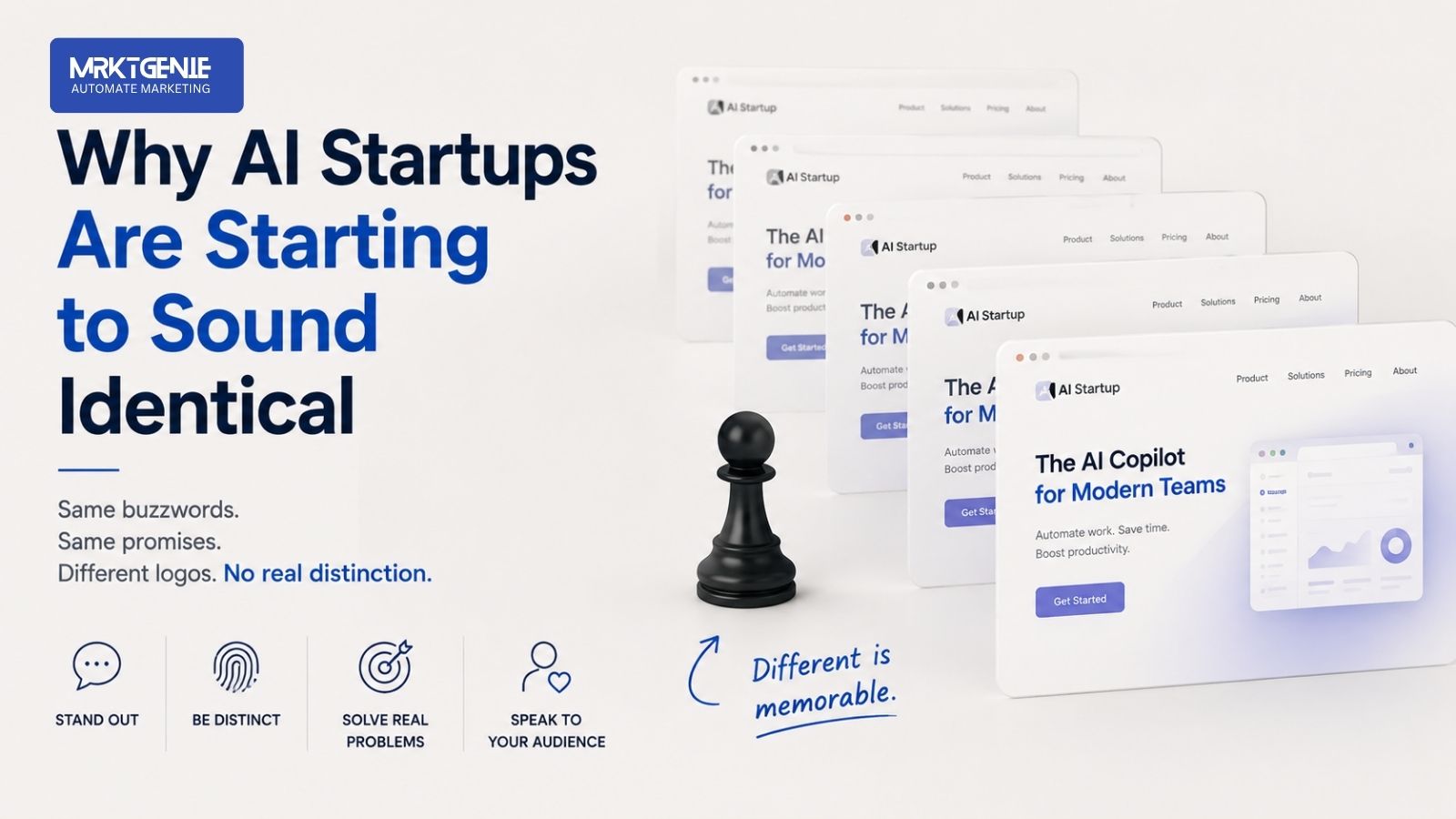
Three AI startup homepages in a row. Same blue gradient. Same glowing dashboard. Same promise: automate work, save time, transform productivity.
By the fourth one, you are no longer evaluating products. You are playing a bleak little guessing game: is this the sales copilot, the legal copilot, or the meeting copilot? The words blur. The claims flatten. The companies disappear into each other.
If you are a founder or marketer building an AI startup, this probably feels uncomfortably familiar. You did not set out to sound generic. You probably chose your wording because it felt clear, investor-friendly, category-legible. But somewhere between "AI-powered" and "copilot for X," your company started sounding like everyone else. And the expensive part is not just that people yawn. It is that they stop being able to remember why you exist.
The problem is not that AI startups lack innovation. The problem is that too many of them describe genuinely different products with the same tired sentence structure, the same abstract benefits, and the same borrowed confidence. Messaging has become a costume party where everyone showed up wearing the same outfit.
The reader this article is for
This is for the founder who knows the product is stronger than the homepage makes it sound. It is for the marketer who has rewritten the hero section twelve times and still feels it could belong to five competitors. It is for the startup team hearing polite reactions on demos, getting traffic but low conversion, or watching prospects ask, "Wait, how are you different from the others?"
The recurring frustration is not lack of effort. It is that the more you try to sound credible in AI, the more you accidentally sand off the details that make you credible.
The misconception is subtle: many teams believe broad language sounds bigger, safer, and more scalable. In reality, vague messaging usually signals weak understanding or low confidence. The costly mistake is trying to appeal to everyone in the category instead of becoming instantly obvious to the right buyer.
And the outcome you want is simple: a product story that sounds unmistakably like you, attracts the right customer, and survives first contact with a crowded market.
The “copilot for X” trap is more damaging than it looks
For a while, calling yourself a "copilot for X" was useful shorthand. It helped people place a new product inside a familiar mental box. Investors understood it. Users understood it. Journalists understood it.
Then everyone used it.
Now it often works like a cheap Halloween label. You can attach it quickly, but it tells you almost nothing meaningful about what is inside.
Imagine two startups.
The first says: "We are an AI copilot for customer support teams."
The second says: "We help support teams resolve refund and policy tickets 40% faster by drafting replies directly from your company policies, past tickets, and order history."
One sounds category-compliant. The other sounds buyable.
This is the core issue. "Copilot for X" explains the shelf you belong on. It does not explain why someone should pick your box.
I have seen teams cling to the phrase because it feels efficient. But efficient for whom? Usually for the startup, not the buyer. It saves you from doing the harder work of precise positioning. It asks the customer to fill in the blanks.
And customers rarely do that generously.
They assume the blank is empty.
If you are still using category shorthand, use it as a bridge, not the destination. A familiar reference can help orient people, but it must be followed immediately by specificity: what workflow, what user, what moment, what pain, what proof.
This is also why so many generic claims get ignored. Buyers have learned to tune them out. If that sounds familiar, why users ignore generic startup claims breaks down the psychology behind that reflex.
Messaging saturation is not a writing problem. It is a market-perception problem.
Founders often think the issue is copy quality. Better verbs. Sharper headlines. More polished design.
That helps. But it is not the root problem.
The deeper issue is saturation. Buyers have now seen hundreds of AI products making nearly identical promises: faster work, less manual effort, smarter decisions, seamless automation. After a while, the words stop landing because they no longer create contrast.
This is what happens in crowded cities with street performers. A great musician can still stop people. But if every corner has someone playing at full volume, attention starts filtering aggressively. Only the unusual gets through.
AI startup messaging is in that phase now.
A VP of Operations visits your site after already seeing six vendors that week. All six claim to streamline workflows. All six claim enterprise-grade security. All six claim easy integration. All six claim better efficiency through AI. By the time they reach your homepage, they are not asking, "Is this impressive?" They are asking, "Is this different enough to deserve another tab in my brain?"
Most startups answer with more abstraction.
That is why so much AI messaging feels dead on arrival. Not because it is false, but because it is interchangeable.
This is part of a broader shift in startup marketing. In an internet flooded with AI-generated sameness, trust and specificity are becoming scarce assets. Startup marketing in an AI-generated internet explores why that changes how buyers evaluate brands.
Why smart founders keep making the same messaging mistake
Here is the uncomfortable truth: many AI startups do not sound identical by accident. They sound identical because they are optimizing for approval from the wrong audience.
They write for investors, peers, and tech Twitter before they write for users.
That is how you get homepage copy that sounds polished in a seed deck and useless in a buying decision.
A founder once showed me a headline that read something like: "The intelligent orchestration layer for modern knowledge work." It sounded expensive. It also sounded like absolutely nothing. When I asked what the product actually did, he gave a far better answer in ten seconds: "It stops account managers from losing renewal risks buried in Slack, email, and call notes."
There it was. The real pain. The real use case. The real stakes.
But that sentence had been buried because it felt smaller than the grand category story.
This happens constantly. Founders mistake specificity for narrowness. They worry that if they speak too concretely, they will undersell the vision. In reality, concrete messaging is what makes the vision believable.
People do not trust ambition without grip.
They trust a company that seems to understand the exact mess they are living in.
If your messaging feels vague, the problem may not be writing skill. It may be that you are too far from raw customer language. A better approach is to mine real objections, frustrations, and buying triggers directly from customers, then build messaging from there. That is the same principle behind turning customer pain points into growth content.
How to differentiate when everyone claims speed, automation, and intelligence
Differentiation does not start with adjectives. It starts with choosing what kind of distinctness you want to own.
Here are five ways AI startups can sound meaningfully different.
1. Differentiate by problem moment, not broad category
Do not describe the whole department. Describe the painful moment inside the department.
Bad: "AI for finance teams."
Better: "We help finance teams close monthly books without chasing missing inputs across five systems."
The second version creates a scene. A buyer can see themselves in it.
2. Differentiate by consequence
What goes wrong if this problem is not solved?
One startup says it automates compliance reviews. Another says it helps compliance teams catch policy drift before it turns into failed audits and legal exposure. Same neighborhood. Very different urgency.
Consequence sharpens attention because buyers care less about features than about avoiding expensive pain.
3. Differentiate by input or method
Many AI tools sound similar at the outcome level. They become more distinct when you explain what unique data, workflow, or mechanism makes the outcome possible.
For example: "Unlike generic writing assistants, our system drafts proposals using your past winning bids, pricing logic, and procurement requirements."
Now the buyer understands why your output might be better than a general model with a prettier UI.
This is especially useful if you are fighting the "just another wrapper" perception. If that concern comes up often, the AI wrapper debate and what it means for founders is worth reading.
4. Differentiate by who should not use you
This sounds counterintuitive, but exclusion is clarifying.
A founder I know changed his messaging from "AI meeting assistant for teams" to "Built for customer-facing teams with high-stakes follow-up; not for internal standups or casual notes." Conversions improved. Why? Because the right buyers felt seen, and the wrong buyers stopped wandering in.
Clear rejection often creates stronger attraction than broad inclusion.
5. Differentiate by proof
Specific proof beats inflated language every time.
Not "improve sales productivity."
Try: "Cuts rep prep time from 45 minutes to 8 by pulling account history, objections, and next-step suggestions into one brief before every call."
Proof can be metrics, customer stories, implementation speed, workflow depth, or even constraints. Anything concrete is stronger than self-congratulation.
Brand personality is not decoration. It is memorability.
Many AI startups treat brand personality like frosting. A nice extra for later, once the product and growth are sorted out.
That is backward.
In a market where products increasingly make similar claims, personality becomes part of comprehension. It helps people remember what they saw and how it felt.
Think about the difference between a doctor who speaks in generic brochure language and one who says, "Here is where patients usually get stuck, and here is how we handle that." Same expertise, different trust experience.
Brand personality works the same way. It is not about being quirky for its own sake. It is about developing a recognizable tone, point of view, and emotional texture.
Some AI brands sound sterile because they are terrified of seeming unserious. So they overcorrect into corporate anesthesia. The result is copy that sounds like it was approved by twelve people and believed by none of them.
Personality can show up in several ways:
A sharper point of view about the market
A more candid voice about customer pain
A tone that matches the user's environment, whether stressed, technical, skeptical, or ambitious
A willingness to sound human instead of institutionally polished
One of the clearest shifts in modern startup growth is that personality is no longer optional background noise. It is increasingly a competitive asset. The new attention economy rewards personality explains why this matters more now than it did a few years ago.
Clear positioning beats clever wording
Founders often spend weeks hunting for the perfect phrase when the real issue is that the company has not made enough positioning decisions.
Copy cannot rescue strategic blur.
If your messaging keeps drifting toward generic language, ask these six questions:
Who is the primary buyer?
What exact problem do they urgently want solved?
When does that problem become painful enough to buy?
What alternatives are they using now?
Why is your approach better for this use case?
What proof can you offer in the first 10 seconds?
If your team cannot answer those clearly, your homepage will almost certainly default to category clichés.
This is why strong positioning often sounds simple. It is not simplistic. It is compressed clarity.
A useful test: can someone repeat your product story after one read without accidentally describing a competitor instead?
If not, you do not have a wording problem. You have a distinctness problem.
For teams struggling with this, a practical place to start is learning how to explain your startup in one sentence. Not because one sentence solves everything, but because it forces strategic clarity.
Six examples of AI startup messaging that sound stronger
Let us make this concrete.
Example 1: Sales AI
Weak: "AI copilot for modern revenue teams."
Stronger: "We help account executives prepare for enterprise calls in under 10 minutes by turning CRM history, emails, and product usage data into a single account brief."
Why it works: clear user, clear task, clear speed benefit, clear mechanism.
Example 2: HR AI
Weak: "Automate hiring with intelligent workflows."
Stronger: "Screen high-volume support applicants using job-specific scorecards, then generate interview summaries your hiring managers will actually read."
Why it works: this sounds like it was built for a real hiring mess, not a conference slide.
Example 3: Legal AI
Weak: "Transform contract review with AI."
Stronger: "Flag non-standard indemnity and payment terms before redlines leave legal, using your approved fallback language and past negotiation patterns."
Why it works: specific risk, specific workflow, specific source of trust.
Example 4: Customer support AI
Weak: "Deliver faster support with automation."
Stronger: "Resolve order, refund, and policy questions instantly by generating replies from your help center, Shopify data, and previous resolved tickets."
Why it works: category-specific, data-specific, use-case-specific.
Example 5: Internal knowledge AI
Weak: "Your company knowledge assistant."
Stronger: "Give new hires one place to ask how things actually work, without digging through outdated Notion pages, Slack threads, and drive folders."
Why it works: relatable pain beats broad abstraction.
Example 6: Security AI
Weak: "AI-powered threat intelligence for modern teams."
Stronger: "Help lean security teams investigate suspicious alerts faster by connecting identity logs, cloud events, and past incident patterns into one timeline."
Why it works: it respects the buyer's real environment instead of hiding behind impressive-sounding fog.
A practical framework for fixing AI startup messaging
If your current messaging sounds too similar to the market, here is a simple reset.
Step 1: Collect raw customer language
Pull phrases from sales calls, demos, onboarding, support chats, and churn interviews. Look for repeated wording around frustration, risk, delay, and desired outcomes.
Pay special attention to phrases customers say emotionally, not just descriptively. "We keep dropping the ball after calls" is stronger than "follow-up inefficiency."
Step 2: Identify the triggering moment
What event makes the problem impossible to ignore? A missed renewal? A failed audit? A hiring backlog? A support queue spike?
Messaging gets sharper when attached to a moment of pain.
Step 3: Name the workflow, not just the category
Replace broad labels with concrete actions. Drafting. Reviewing. Routing. Summarizing. Investigating. Escalating. Reconciling.
Workflows feel real. Categories feel distant.
Step 4: Add proof or mechanism
What data do you use? What systems do you connect? What speed do you create? What accuracy do you improve? What risk do you reduce?
Do not just promise the result. Explain why your product can credibly produce it.
Step 5: Remove every phrase a competitor could copy-paste
This is the harsh but useful test. If a rival can steal your headline without changing anything, it is not positioning. It is wallpaper.
A good homepage does not merely sound polished. It makes the right buyer feel embarrassingly understood.
The real goal is not to sound unique. It is to be easy to choose.
This is where many teams get lost. They chase originality like a branding exercise, when the real objective is buyer clarity.
You do not need messaging that wins awards for cleverness. You need messaging that helps a busy, skeptical person quickly understand three things:
Is this for me?
Does it solve a problem I actually care about?
Why this product instead of the others?
That is it.
The startups that keep sounding identical usually try to look impressive from a distance. The startups that stand out tend to do something less glamorous and far more effective: they get painfully specific about the mess they solve.
And that specificity does more than improve conversion. It changes how the company is perceived. It signals maturity. It signals confidence. It signals that someone inside the building has spent time with real customers instead of just recycling market language.
So if your AI startup messaging feels repetitive, do not start by asking, "How can we sound smarter?"
Ask the better question:
"What would we say if we were forced to prove we understand the customer's day better than anyone else?"
That is usually where the real message begins.