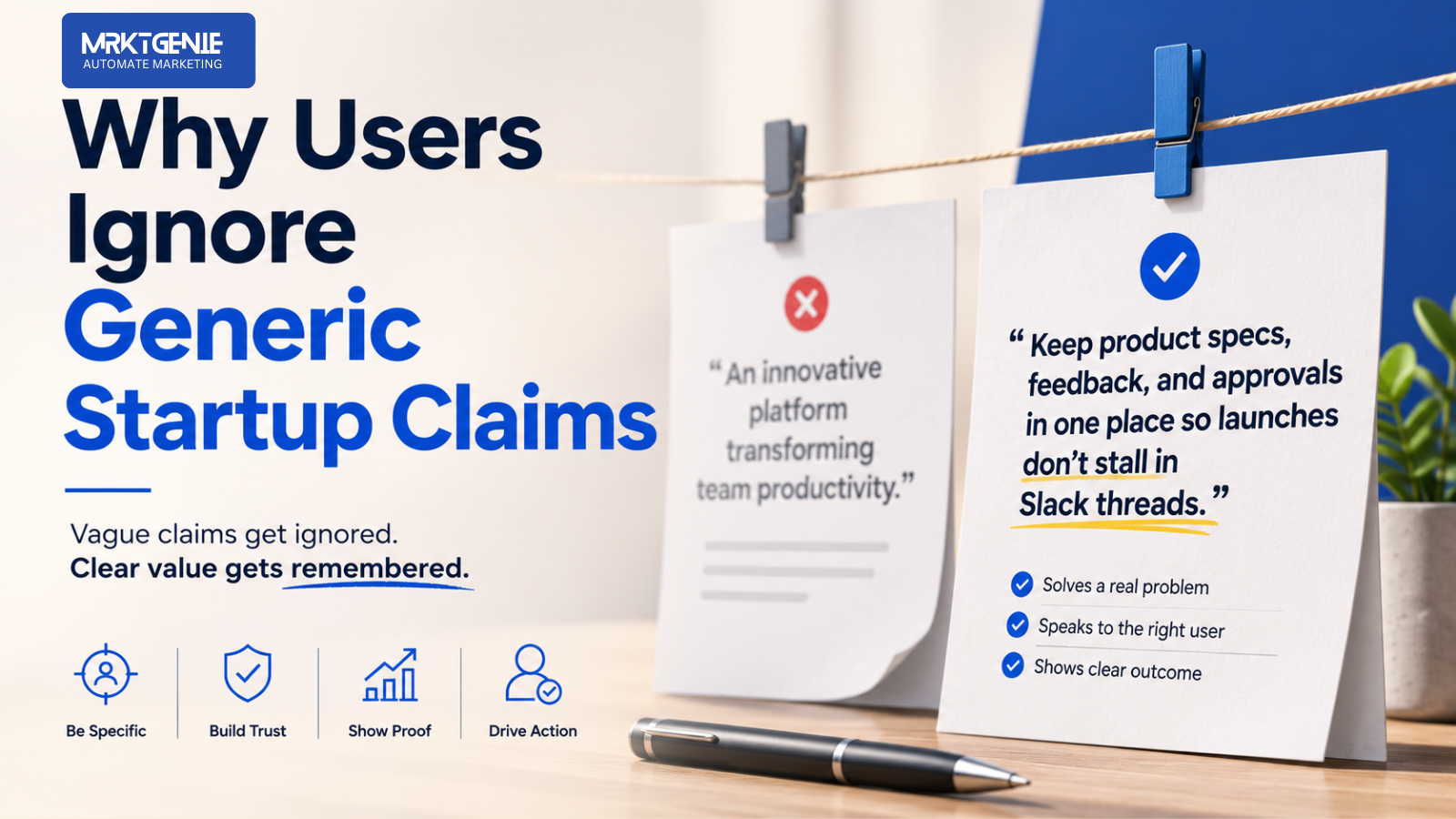
The founder had done what founders are told to do. Tight logo. Sharp gradient. Headline in bold: “An innovative platform transforming team productivity.” He hit publish, sent traffic to the homepage, and watched the session recordings later that night.
People landed. Paused. Scrolled a little. Left.
If that scene feels uncomfortably familiar, this article is for you. Not because your product is weak. Often the opposite is true. The product may be thoughtful, useful, even painfully hard-won. But the way it is described sounds like every other startup trying to sound important. And users have learned to ignore that language the way city residents ignore car alarms: not because nothing is happening, but because too many false signals trained them to stop caring.
The painful part is that founders usually misread the problem. They assume users are not interested enough. Or the market is too crowded. Or they need better design. Sometimes yes. But often the real issue is simpler: your copy is making big claims before it has earned basic belief.
Who this is really for
This is for the early-stage founder, product marketer, or startup operator staring at a homepage, landing page, pitch deck, or LinkedIn post that sounds polished but converts badly.
You are trying to solve a messaging problem. You need strangers to quickly understand what your product does, why it matters, and why they should trust you.
The frustration that keeps repeating is brutal: you know the product is useful when people finally see it, but getting them to care in the first place feels like dragging a heavy object uphill.
The misconception? That stronger adjectives create stronger positioning.
The costly mistake? Writing copy that tries to sound impressive instead of making the value obvious.
The outcome you want is not applause. It is recognition. You want the right user to read one sentence and think, “This is exactly what I need.”
Buzzword fatigue is real, and users are more cynical than founders think
There was a period when startup language still had novelty. “Disrupting,” “reimagining,” “next-generation,” “AI-powered,” “category-defining.” Those phrases once signaled ambition. Now they mostly signal evasion.
Users have been overexposed to claims with no weight behind them. Every tool promises speed. Every app promises simplicity. Every SaaS product claims to “streamline workflows.” After hearing the same promise 500 times, people stop processing it as information. It becomes wallpaper.
Think about how people browse startup websites now. They are not reading generously. They are scanning defensively. They are asking silent questions:
- What does this actually do?
- Is this for someone like me?
- How is it different from the six tools I already know?
- Can I trust this claim?
Generic startup claims fail because they answer none of those questions.
A founder once told me, “We say we help teams collaborate seamlessly.” I asked what the product actually did. He said, “It pulls client feedback from email, Slack, and Figma into one review thread so agencies stop losing approvals.” That second sentence was ten times stronger. Not because it sounded smarter. Because it sounded real.
This is the hidden tax of vague copy: it forces the reader to do interpretation work. And people almost never do extra work for a company they just met.
If your broader startup marketing already feels harder than it used to, this is part of the reason. Attention is fragmented, skepticism is high, and generic language gets filtered out fast. That dynamic is explored further in why startup marketing feels harder than ever.
The specificity advantage: details create belief
Specificity does something generic language cannot do: it creates a mental picture.
Compare these two lines:
“We help revenue teams work more efficiently.”
“We show sales managers which deals have gone silent for 14+ days so reps can follow up before the quarter slips.”
One sounds marketable. The other sounds usable.
Users trust what they can picture. That is the real power of specificity. It reduces ambiguity, and ambiguity is where skepticism grows.
Specific copy also signals competence. If you can describe the problem in concrete terms, users assume you understand it deeply. If you stay abstract, they assume you are either hiding weakness or copying category language.
There is a useful analogy here. Imagine a doctor saying, “We improve patient wellness.” You would immediately want another doctor. But if they said, “Your blood pressure has been climbing for six months, your sleep is fragmented, and your caffeine intake is masking fatigue,” you would listen. Precision creates authority.
This is why boring startups often outperform flashy ones. They speak in the language of painful, specific problems rather than grand identity claims. If that resonates, read why boring startups often win.
How to make your copy more specific
- Name the user, not “everyone.”
- Name the moment of pain, not just the category problem.
- Name the workflow, not the aspiration.
- Name what changes after using the product.
For example, instead of “AI tools for better hiring,” try: “Screen inbound applicants and flag the top 20 based on your team’s real scorecards.”
Instead of “a better CRM experience,” try: “See which leads opened your proposal, replied, and then disappeared.”
The test is simple: can a prospect imagine using it on a Tuesday afternoon?
Proof-driven messaging beats confidence theater
One of the strangest habits in startup copy is acting certain when the buyer is uncertain.
Founders write as if conviction alone will carry the sale. It rarely does. Users do not borrow your confidence. They look for evidence.
This is where proof-driven messaging matters. A claim without proof feels like self-promotion. A claim with proof feels like lowered risk.
Proof can take many forms:
- Customer outcomes
- Specific numbers
- Recognizable use cases
- Screenshots
- Short case studies
- Testimonials with context
- Transparent explanations of how the product works
Notice that none of these require hype. They require substance.
A B2B startup I advised once used the headline: “The smartest way to manage vendor security reviews.” It sounded fine. It also sounded like everyone else. We changed the supporting copy to: “Cut questionnaire turnaround from 9 days to 2 by reusing approved answers across security forms.” Demo requests increased because the promise became measurable.
That is the difference between sounding strong and being credible.
If trust is your bottleneck, not traffic, this is worth reading next: the fastest way to build trust around a new startup.
What proof does psychologically
Proof reduces three fears that sit beneath almost every buying decision:
- “This won’t work for my situation.”
- “This team is overselling.”
- “I’ll regret choosing this.”
Good messaging does not just describe a product. It manages perceived risk.
That is why messaging is increasingly a psychology problem, not just a copywriting problem. More on that in why startup growth is becoming more psychological than technical.
Clear outcomes matter more than impressive features
Founders are often too close to the machine. They know the architecture, the integrations, the model quality, the workflow logic. So they describe what the product is made of.
Users care more about what their day looks like after using it.
This sounds obvious until you look at most startup websites.
You will see phrases like:
- Advanced analytics dashboard
- Customizable automation engine
- Unified collaboration suite
But what does the buyer want?
- To stop manually exporting reports every Friday
- To stop missing follow-ups
- To stop answering the same support question 40 times
- To stop chasing approvals across five tools
Features explain the machine. Outcomes explain the relief.
A helpful question is: what annoying thing disappears when your product works well?
That question usually produces stronger copy than “What are our key capabilities?”
For example:
Weak: “AI-powered note capture for customer conversations.”
Better: “Turn sales calls into CRM updates and follow-up tasks without reps doing admin at 6 p.m.”
Weak: “Centralized compliance workflow management.”
Better: “Know which policies are overdue, who owns them, and what is blocking sign-off.”
The strongest startup messaging often sounds less grand and more useful.
If you are struggling to compress value into a simple, believable line, how to explain your startup in one sentence offers a practical framework.
Why weak copy survives inside startups
Here is the uncomfortable truth: generic claims often survive not because they work, but because they offend no one internally.
They are committee-safe.
“Innovative platform for modern teams” sounds polished enough for investors, broad enough for sales, and vague enough that nobody has to argue over what it excludes. That is exactly why it is dangerous. It protects internal comfort by sacrificing external clarity.
I have seen this happen in messaging meetings. Someone suggests a clear line like, “For finance teams drowning in spreadsheet approvals.” Another person worries it sounds too narrow. Then the group backs into a phrase like, “A comprehensive solution for operational efficiency.” Everyone nods. Conversion drops. No one can trace the damage to that one moment.
But the damage is real.
Strong messaging requires choosing. Weak messaging tries to keep every option open.
This is also why messaging drift becomes such a problem as startups grow. Different teams soften language, widen claims, and slowly blur the original value story. If that sounds familiar, this guide on messaging drift is worth your time.
How to rewrite weak startup claims
If your homepage sounds like a hundred others, do not start by brainstorming better adjectives. Start by stripping the claim down to observable reality.
A simple rewrite framework
- Who is it for?
- What specific problem are they dealing with?
- What does your product help them do?
- What concrete result happens faster, cheaper, or with less pain?
- What proof can you attach to that claim?
Now let’s turn that into copy.
Example 1: From vague ambition to usable clarity
Weak: “An innovative workspace for modern teams.”
Stronger: “Keep product specs, feedback, and approvals in one place so launches do not stall in Slack threads.”
Why it works: it names the user context, the pain, and the outcome.
Example 2: From category jargon to buyer language
Weak: “Next-generation customer intelligence platform.”
Stronger: “See which accounts are visiting pricing, reading case studies, and going quiet before churn hits.”
Why it works: it shifts from market-speak to a scenario a revenue leader recognizes instantly.
Example 3: From feature list to relief
Weak: “Automated onboarding orchestration for enterprise teams.”
Stronger: “Launch new clients with prebuilt checklists, owner reminders, and status tracking so onboarding stops living in spreadsheets.”
Why it works: it describes what changes in the user’s working life.
Example 4: From inflated promise to believable value
Weak: “Transform your hiring with AI.”
Stronger: “Review 300 applicants in under an hour and spot the ones that match your team’s actual criteria.”
Why it works: the claim is concrete enough to test mentally.
Examples of why users ignore generic startup claims
Let’s make this even more practical.
Scenario 1: The founder who sounds like everyone else
A SaaS founder writes: “We help businesses streamline operations through intelligent automation.” It feels polished. It also says almost nothing. A COO reading it cannot tell whether the product handles invoicing, support tickets, procurement, or warehouse routing. The brain does not know where to place it, so it moves on.
Now compare: “Automate invoice follow-ups and payment reminders so finance teams spend less time chasing overdue accounts.” Same category family. Completely different clarity.
Scenario 2: The product team that leads with architecture
An AI startup says: “Built on a proprietary multi-agent reasoning engine.” Maybe true. Maybe technically impressive. But most buyers are not shopping for architecture. They are shopping for outcomes and certainty.
Try this instead: “Draft first-pass security responses from your approved knowledge base so your team stops rewriting the same answers.” Suddenly the product has a job.
Scenario 3: The startup that confuses confidence with trust
A founder posts on LinkedIn: “We are building the future of creator monetization.” People scroll past because there is nothing to grab onto. But if the post says, “Most creators do not need more followers. They need a better way to turn 500 loyal subscribers into recurring revenue,” people stop. Not because it is louder. Because it understands something specific.
If your social content has this same problem, why your LinkedIn posts get ignored breaks down the pattern in detail.
A practical messaging test: if removed from your site, could any competitor reuse it?
This is one of the fastest filters I know.
Take your headline, subheadline, and top three benefit bullets. Remove your logo. Ask: could this sit on a competitor’s site without anyone noticing?
If yes, your messaging is too generic.
Another test is even harsher: would a customer repeat your wording in a conversation? Nobody says, “I really need a robust end-to-end solution.” They say, “I’m tired of chasing approvals,” or “I need a faster way to sort inbound leads,” or “I keep losing track of what changed.”
The closer your copy gets to how the buyer thinks, the less it needs to shout.
What strong startup messaging actually sounds like
Strong messaging is not flashy. It is legible.
It does not try to sound like a press release. It sounds like someone who understands the mess the user is in and can explain, plainly, how to improve it.
It usually has five qualities:
- Specific user
- Specific problem
- Specific mechanism
- Specific outcome
- Some form of proof or credibility
That combination is far more persuasive than brand theater.
And here is the contrarian part: the more genuinely useful your product is, the less you should need inflated language. Great products can afford plain English.
Conclusion: users are not ignoring you because they do not care
Often, they are ignoring you because they cannot tell whether your claim deserves attention.
That is a fixable problem.
When users see generic startup claims, they assume one of two things: either you do not understand their problem well enough to describe it, or you are trying to sound bigger than you are. Neither creates trust.
But when your messaging gets concrete, proof-driven, and outcome-focused, something changes. The copy stops performing and starts communicating. The right users feel recognized. Skepticism drops. Curiosity rises.
So before rewriting your homepage again, ask a better question.
Not “How do we sound more impressive?”
Ask: “How do we make the right person feel immediately understood?”
That is the line users stop scrolling for.