The founder had done everything the advice said to do. Faster onboarding. Cleaner UI. More integrations. Better pricing page. He had the screenshots, the product updates, the release notes, the confidence of someone who knew the product was objectively better.
And still, the slower competitor kept winning deals.
If you have ever stared at that contradiction long enough, you know how maddening it is. You improve the thing. They improve the story. You polish the engine. They make buyers feel safe getting in the car. One startup grows because it is better built. Another grows because it is better believed.
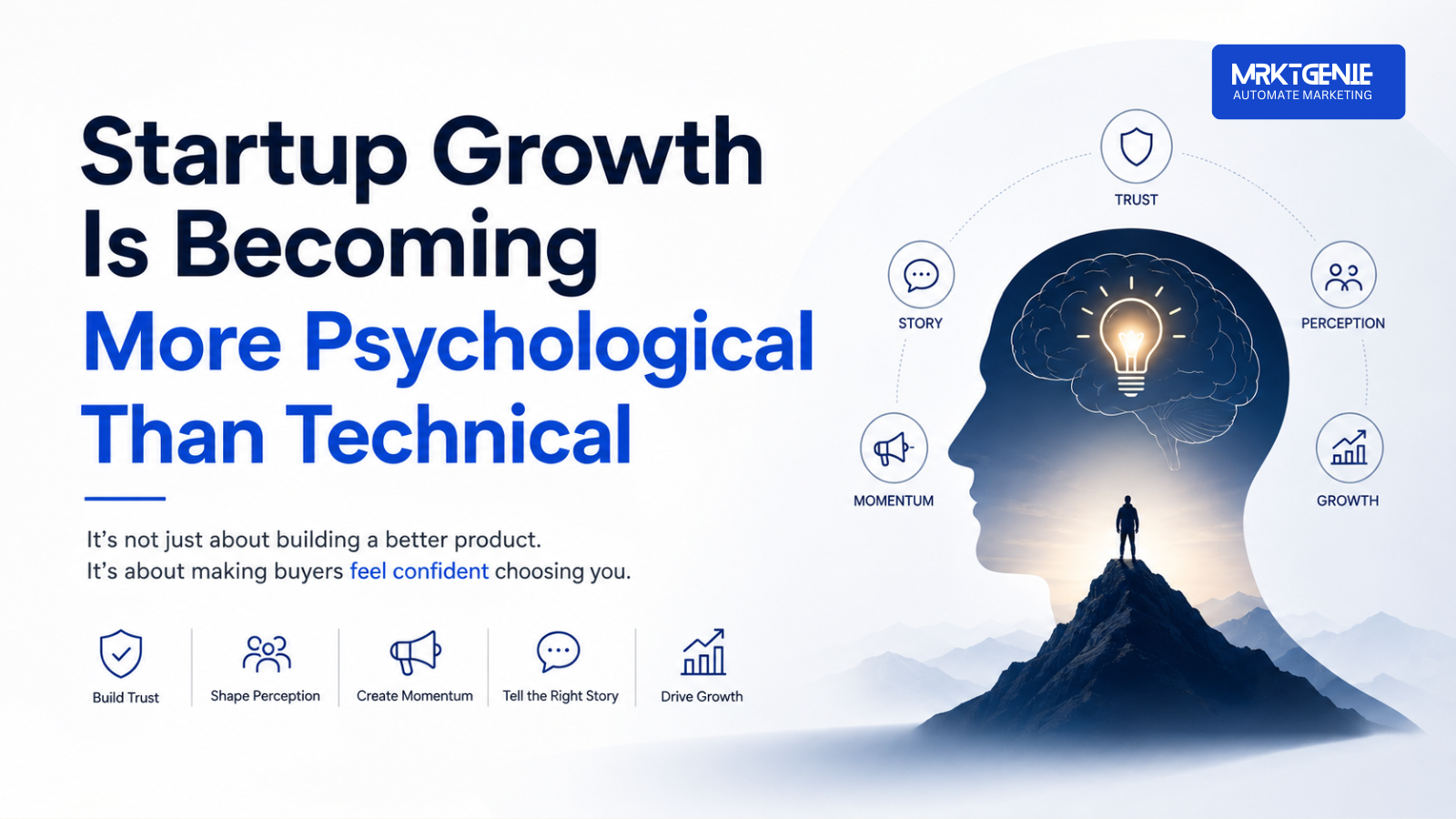
That is the uncomfortable shift many founders are running into: startup growth is becoming more psychological than technical. Not because product quality stopped mattering. It matters enormously. But because once products become “good enough,” growth is increasingly decided by messaging, trust, perceived fit, and the emotional experience of choosing.
The reader this matters to is usually an early-stage founder, operator, or growth lead with a decent product and inconsistent traction. They are trying to solve a painful question: why does a product people like still struggle to convert? The recurring frustration is that users say, “This looks interesting,” then disappear. The misconception is that better features automatically create better growth. The costly mistake is treating growth like a distribution or engineering problem when it is often a buyer psychology problem. What they want is not vanity attention. They want trust, traction, and momentum that compounds.
If that sounds familiar, this article is for you.
Emotional buying decisions happen even in rational markets
Founders love to imagine buyers as spreadsheets with pulse rates. Especially in B2B. We tell ourselves customers compare features, calculate ROI, and make cleanly rational decisions.
Then a buyer chooses the tool with the weaker feature set because “it just feels more established.”
That sentence has killed more founder optimism than most competitors ever will.
I once watched two SaaS products pitch the same prospect. Product A had deeper functionality and a more flexible workflow. Product B had a calmer website, clearer language, stronger customer logos, and a founder who explained the problem in one sentence without sounding desperate. Product B won. Not because the buyer was careless, but because buying is never just an evaluation of utility. It is also an evaluation of risk, identity, and anticipated regret.
People do not just buy software. They buy confidence in the decision.
This is why a founder can spend six months building a feature users requested and still see no meaningful lift in conversions. The feature answered a product need. It did not answer the buyer’s emotional question: “Can I trust this enough to stake my reputation on it?”
In many categories, your real competition is not another product. It is hesitation.
That is also why weak messaging quietly sabotages strong products. If your positioning is vague, the buyer has to do the cognitive labor of understanding you. Most will not. As explained in this guide to messaging validation for founders, inability to explain your product clearly is often not a copy problem. It is a market understanding problem.
The practical lesson is simple: stop asking only, “What does our product do better?” Start asking, “What does choosing us feel like?”
Trust signals now carry more weight than feature lists
There is a reason founders obsess over homepage copy, testimonials, customer logos, case studies, and founder credibility. These are not cosmetic details. They are trust shortcuts.
Imagine you are hiring a surgeon. One has a technically superior website architecture and a list of equipment. The other shows years of experience, clear outcomes, recognizable institutions, and calm confidence. Which one feels safer?
Software buyers make a milder version of that decision every day.
Trust signals work because they reduce perceived risk. And in crowded markets, perceived risk is often the real bottleneck. A prospect may believe your product works. They are still asking quieter questions:
- Will this team still exist in 12 months?
- Will onboarding be painful?
- Will I look foolish if this fails internally?
- Do people like me already use this?
- Does this company understand my situation?
Most startup websites answer none of these questions directly. They talk about “AI-powered workflows” and “streamlined efficiency” while the buyer is trying to figure out whether this is a smart career move.
This is why so many sites fail in seconds. Not because the design is ugly, but because the page does not create confidence fast enough. This breakdown of why startup websites fail in 5 seconds gets at the core issue: clarity and credibility have to appear immediately, not eventually.
A practical example: saying “Automate sales operations with intelligent orchestration” is technically polished and psychologically weak. Saying “Used by RevOps teams to cut manual pipeline cleanup from 6 hours a week to 30 minutes” is psychologically stronger. It feels specific. Testable. Safer.
Trust is not built by sounding advanced. It is built by sounding believable.
Perception shapes reality more than founders want to admit
Here is the part many technical founders resist: in markets, perception is not a superficial layer on top of reality. Perception often becomes reality.
If buyers perceive your product as niche, they will use it narrowly. If they perceive it as immature, they will scrutinize every bug as proof. If they perceive it as premium, they will interpret the same feature set through a different lens.
The same restaurant meal tastes different when served on paper plates versus ceramic. The food may be identical. The mind is not.
Startups run into this constantly. A founder ships a rough-looking site because “the product matters more.” Technically true. Commercially dangerous. The roughness does not just affect aesthetics. It changes what users expect from onboarding, support, reliability, and long-term viability.
That does not mean founders should fake scale or manufacture polish they cannot support. It means they should understand that every visible signal teaches the market how to interpret the product.
Perception also affects pricing. Many startups underprice themselves, thinking low cost reduces friction. Sometimes it does the opposite. Buyers infer lower reliability, weaker support, or lower strategic value. The cheaper option can feel riskier, not easier.
This is one reason blindly copying tactics from larger startups often backfires. Their perception scaffolding is already built. They can get away with messaging shortcuts because the market already knows who they are. Early-stage founders cannot. This article on why big startup growth advice fails smaller companies is worth reading if you have ever wondered why proven tactics seem to work for everyone except you.
The question to ask is not just, “What are we saying?” It is, “What are people inferring?”
Momentum psychology changes how buyers judge you
People trust motion.
Not always consciously. But they do.
A startup that looks active, discussed, adopted, and responsive feels safer than one that looks static, even if the static one has a stronger product under the hood. Momentum acts like social proof with velocity.
You can see this everywhere. An investor gets interested after hearing the same company name three times in two weeks. A buyer replies after seeing your founder posts repeatedly. A partnership closes after enough signals accumulate that “these people seem to be everywhere lately.”
This is not just awareness. It is momentum psychology. Humans use movement as evidence of relevance.
I have seen founders make a damaging mistake here: they disappear while building, then expect a launch to compress months of trust formation into one announcement. It rarely works. Not because the product is bad, but because the market has no narrative memory of them.
That is why consistent visibility matters, especially founder-led visibility. Not performative posting. Not empty thought leadership. Repeated proof that you understand the problem space and are becoming a credible node within it. This guide to organic growth without paid ads lays out why sustained trust-building often beats sporadic bursts of promotion.
There is also a subtle compounding effect. Momentum makes future momentum easier. A product with active customer stories attracts more curiosity. More curiosity creates more conversations. More conversations create more examples, more language, more confidence, more referrals. Buyers interpret that flywheel as market validation.
In other words, growth is not only about acquiring users. It is also about creating the feeling that choosing you is increasingly normal.
Narrative framing often beats raw information
Most founders present information. The best founders frame meaning.
That difference sounds semantic until you watch it change conversion rates.
Say you built an AI note-taking tool for sales calls. You could describe it as “automatic meeting transcription with CRM sync.” Accurate, but forgettable. Or you could frame it as: “Your reps should be listening, not typing. We capture the call, update the CRM, and save managers from chasing incomplete notes.” Same product. Different story. One describes features. The other stages the buyer’s pain and relief.
Narrative framing matters because customers do not remember bullet points as well as they remember tension. What problem is getting worse? What friction is wasting time? What embarrassment is happening behind the scenes? What future identity becomes possible if they choose this?
A strong startup narrative usually does three things:
- Names a frustration the buyer already feels
- Explains why existing approaches are failing
- Positions the product as the logical next move
This is why some of the best startup messaging feels almost eerie. It sounds like the company has been sitting in your meetings, reading your Slack threads, and watching where work actually breaks.
If you want a practical way to sharpen this, study your customer interviews for emotional language, not just feature requests. The sentence “I keep fixing the same reporting mess every Monday” is more valuable than a vague request for “better analytics.” One gives you a story. The other gives you a category.
Turning customer interviews into a content engine is one of the most underused ways to build stronger messaging because it gives you real buyer language instead of founder assumptions.
The best framing does not manipulate. It clarifies. It gives shape to a problem buyers already struggle to articulate internally.
Behavioral insights can explain why growth stalls
Sometimes a startup is not losing because the product is weak. It is losing because it accidentally creates too much mental friction.
Behavioral psychology is useful here because it helps explain the small, invisible reasons people do not act.
Too many choices create hesitation
A pricing page with four plans, nine toggles, and fifteen feature comparisons can look thorough to the founder and exhausting to the buyer. Choice overload does not feel like overload. It feels like “I’ll come back later,” which often means never.
When in doubt, reduce decisions.
Ambiguity lowers trust
If a visitor cannot tell who your product is for within seconds, they assume it is not for them. Ambiguous messaging rarely creates curiosity. It usually creates abandonment. This is exactly why founders benefit from pressure-testing clarity before launch. These three free messaging tests are useful because they expose whether your value proposition survives contact with real human attention.
People avoid regret more than they pursue gain
Founders often pitch upside: save time, move faster, increase output. Buyers are frequently more motivated by downside prevention: avoid mistakes, reduce risk, stop losing leads, prevent internal chaos. The emotional force of “stop the bleeding” is often stronger than “reach a better future.”
A founder I know changed one line on a landing page from “Improve team productivity” to “Stop losing hours to manual handoffs.” Demo requests increased. Same core promise. Different psychological trigger.
People follow social proof when uncertain
The earlier your startup is, the more uncertainty surrounds it. That means social proof matters disproportionately. A niche customer quote can outperform a polished brand slogan because it answers the buyer’s hidden question: “Has someone like me already taken this risk?”
Familiarity creates preference
Repeated exposure breeds trust. This is one reason founder content, niche SEO, and consistent distribution matter so much. Not because every piece converts directly, but because familiarity lowers perceived risk over time. If your startup keeps showing up with useful, specific insight, the market begins to feel like it knows you.
That is also why SEO still matters when used properly. Not as a traffic vanity project, but as a way to meet buyer intent repeatedly at the moments questions arise. This article on why founders use SEO wrong explains the difference between publishing for volume and publishing for trust-building relevance.
What founders should do differently now
If growth is becoming more psychological than technical, the implication is not “care less about product.” It is “stop assuming product quality explains growth by itself.”
Here is the more useful operating model:
- Your product creates actual value
- Your messaging helps buyers understand that value quickly
- Your trust signals reduce the fear of choosing you
- Your narrative frames the problem in a way that feels urgent and familiar
- Your visibility creates momentum and familiarity over time
When one of those layers is weak, growth slows in ways that feel mysterious. Founders then compensate with more features, more channels, more experiments, more motion. Sometimes what they really need is fewer words, clearer proof, and a better understanding of what the buyer is emotionally trying to avoid.
A helpful weekly question for any founder or growth lead is this: where are prospects hesitating, and what emotion is underneath that hesitation?
Not what objection they stated. What emotion is underneath it?
“We need to think about it” may mean confusion. “We’re comparing options” may mean low trust. “This is interesting, but not right now” may mean the pain was not framed sharply enough. If you only hear the surface-level objection, you keep solving the wrong problem.
The real edge is making people feel safe, seen, and certain
The startups that win the next decade will not just build useful products. They will understand the psychology of being chosen.
They will know that buyers want competence, but they also want reassurance. They want speed, but they also want certainty. They want innovation, but they still need to explain the decision to a boss, a team, or themselves.
That is why growth increasingly belongs to companies that can do three things at once: solve a real problem, explain it with precision, and make the buyer feel smart for saying yes.
Technical superiority may get you into the conversation. Psychological clarity is often what gets you picked.
And if your startup is not growing the way the product deserves, that does not automatically mean the market is irrational or your distribution is broken. Sometimes it means your buyer is standing at the edge of a decision, quietly asking a question your product cannot answer on its own:
Why should I trust this now?
The founder who learns to answer that well usually stops sounding like a startup and starts sounding like the obvious choice.