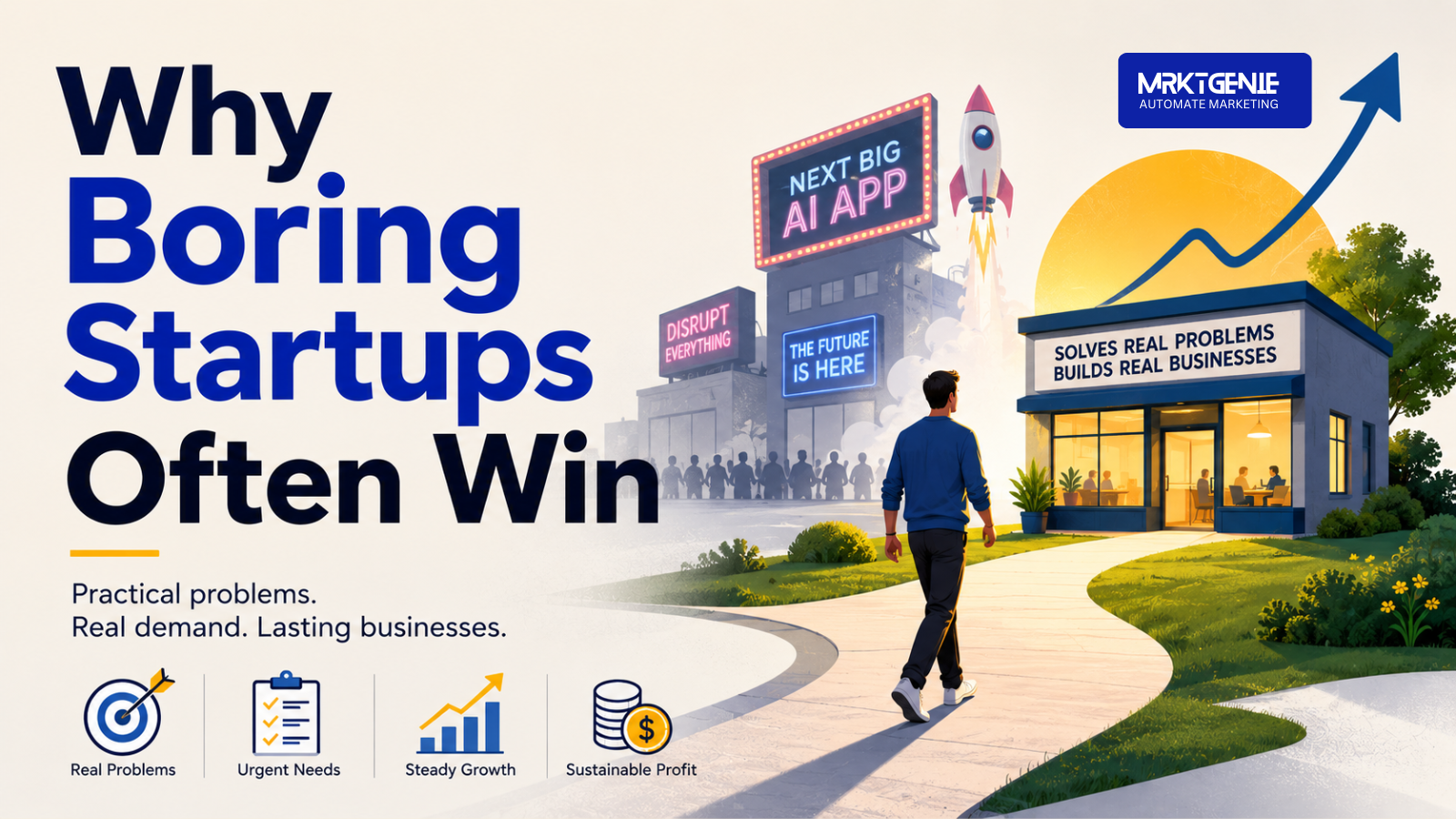
The startup ideas people brag about at dinner parties are rarely the ones that quietly mint cash.
You have probably seen this up close. One founder spends a year building an AI app with a slick landing page, a cinematic demo, and a big story about changing the future of work. Another builds scheduling software for pest control companies, invoicing tools for freight brokers, or compliance software for dental clinics. Nobody calls it visionary. Nobody reposts it with fire emojis. And yet, six months later, the second founder has paying customers, renewals, referrals, and a business that behaves like a business.
That pattern bothers a lot of ambitious founders because it collides with what they have been taught to admire. We are surrounded by startup culture that rewards novelty, status, and story. So many founders end up chasing ideas that sound impressive instead of problems that hurt enough for someone to pay to make them go away.
That is why boring startups often win. Not because they are more noble. Not because excitement is bad. But because practical businesses tend to sit closer to demand, closer to urgency, and closer to money.
The reader this article is really for
This is for the founder who keeps getting pulled toward “interesting” ideas but keeps running into the same wall: polite feedback, weak traction, vague interest, and no real buying urgency.
You are not lazy. You are not incapable. You may simply be optimizing for the wrong signal.
The recurring frustration is familiar: people say your product is cool, but they do not use it, do not buy it, and do not miss it when they leave. The misconception underneath it is costly: if an idea feels innovative, the market will eventually catch up. The mistake is building around your own excitement rather than around someone else’s pain. And the outcome you actually want is not applause. It is pull. Clear demand. Customers who say, “How soon can we start?”
Market demand does not care how impressive your idea sounds
A founder once told me, almost defensively, “The product gets amazing reactions in demos.” Then he paused and admitted the real problem: no one was converting after the demo.
That sentence explains a huge percentage of startup failure.
Interest is not demand. Compliments are not demand. “That’s super interesting” is often the most expensive sentence a founder can hear, because it creates false hope without creating revenue.
Boring startups usually begin in less flattering territory. They do not start with, “Wouldn’t it be cool if…” They start with, “Why is this still so broken?” Payroll for niche contractors. Software for waste management routes. Inventory systems for auto repair shops. None of these ideas sparkle. But the demand is already there because the pain is already there.
This is what many founders miss: markets do not reward creativity in the abstract. They reward relevance. A practical startup often enters a market where buyers are already searching, budgeting, complaining, and cobbling together ugly workarounds. That means you are not trying to manufacture desire from scratch. You are stepping into existing demand.
If you are still trying to figure out whether demand is real before sinking months into building, this guide to validating a startup without spending months building is worth reading. It can save you from falling in love with a market that does not love you back.
Painful problems create faster buying decisions
People delay buying things that are merely interesting. They move fast on things that make an existing headache smaller.
Think about the difference between a meditation app for “better focus” and software that stops a clinic from losing insurance reimbursements due to billing errors. One is nice to have. The other is a leak in the roof.
When a problem is painful, the sales conversation changes. Buyers do not ask, “Can we revisit this next quarter?” They ask, “How long does implementation take?”
This is why boring startups often have an invisible advantage: they sell into operational pain. Operational pain is not glamorous, but it is expensive. It creates urgency. It has owners. It has budgets. It has consequences when ignored.
A founder building a dispatch tool for local service businesses once described his product as “basically admin aspirin.” That is a better business category than most founders realize. Aspirin sells because the pain already exists. Vitamins require belief, education, and patience. Startups that act like aspirin usually grow faster than startups that act like vitamins.
If your startup is struggling to gain traction, there is a good chance the issue is not just product quality but weak alignment between the problem, the buyer, and the message. This article on the hidden reason startups do not grow breaks that down well.
Less competition than you think, because most founders chase status markets
There is a strange herd behavior in startups. Founders say they want differentiation, then all sprint toward the same fashionable categories.
AI assistants. Creator tools. Social apps. Wellness platforms. The labels change, but the pattern does not. Large numbers of smart people compete in crowded markets because the market itself feels exciting. They would rather fight 500 startups in a sexy category than be the best software provider for commercial laundry operators.
That is not strategy. That is ego wearing a strategy costume.
Boring startups benefit from a kind of social neglect. They are often ignored by prestige-seeking founders, overlooked by trend-chasing media, and underestimated by investors who prefer bigger narratives. But neglect can be a gift. It leaves room to own a niche deeply.
Imagine two founders. One enters a crowded market for AI note-taking. The other builds software for funeral home operations. Which one gets more likes on launch day? Easy answer. Which one might face fewer competitors, clearer workflows, and stickier customer needs? Also easy.
This is one reason copying visible startups is so dangerous. The businesses you see everywhere are not necessarily the businesses you should build. Why copying big startups backfires is a useful reminder that what looks successful from the outside is often context-specific and hard to replicate.
Consistent revenue usually comes from unsexy repetition
Cool ideas often depend on spikes of attention. Boring businesses often depend on recurring necessity.
That difference matters more than founders admit.
If you sell a novelty, you are always re-earning interest. If you solve a persistent workflow problem, you become part of the customer’s operating system. And once you are embedded in how a business functions, revenue gets steadier.
Consider a company that helps restaurants manage food safety logs. Nobody wakes up excited to buy that software. But the need repeats. Staff turns over. Regulations remain. Audits happen. The software becomes part of the weekly rhythm of the business. That is the kind of boring that pays salaries.
Founders often underestimate how psychologically valuable predictable revenue is. It changes everything. It reduces desperation. It buys strategic patience. It lets you hire more carefully, market more rationally, and build without theatrical urgency.
A lot of startup suffering comes from choosing businesses that are exciting to announce but exhausting to sustain.
Founder misconceptions that keep people chasing the wrong ideas
Misconception 1: If it feels exciting to build, it will be exciting to buy
Usually false.
Founders confuse creator excitement with buyer urgency all the time. The buyer does not care how elegant your architecture is or how futuristic your concept sounds. They care whether it saves time, makes money, reduces risk, or removes pain.
Misconception 2: Big markets are always better markets
A large market with weak urgency can be worse than a narrow market with intense pain. A founder serving 2,000 highly motivated businesses can outperform a founder chasing 2 million mildly interested consumers.
Small markets also teach faster. You can get closer to customers, hear the same pain repeatedly, and sharpen positioning. If you struggle to explain what your startup actually does, learning to explain your startup in one sentence becomes especially important in these niche markets, where clarity beats cleverness.
Misconception 3: A startup needs to look disruptive to become valuable
Many valuable companies simply make old processes less painful. They are not overthrowing an industry. They are removing friction from one ugly corner of it.
That may sound less cinematic. It is also how a lot of real businesses are built.
Misconception 4: If no one is talking about the market, it is probably too small
Sometimes nobody is talking about the market because the people in it are busy working, not posting. Silence on social media is not the same as absence of demand.
This is one of the biggest traps for online founders. We mistake visible attention for economic value. We assume the markets we hear about most are the markets worth entering. They are often just the markets with the loudest participants.
The costly mistake: optimizing for admiration instead of purchase intent
There is a version of startup ambition that is really just performance.
The founder wants a story that sounds smart. A category that signals taste. A product friends will admire. Something that earns nods from other founders. This is understandable. Building a company is emotionally brutal, and identity sneaks into the process.
But admiration is a terrible substitute for purchase intent.
One of the hardest founder lessons is this: the market does not reward what flatters your self-image. It rewards what solves a problem people are already trying to escape.
That is why so many practical founders look “less visionary” early and much smarter later. They are not trying to impress observers. They are trying to become necessary to buyers.
If your startup keeps hearing “interesting” but not “where do I sign,” your issue may be less about features and more about psychology, trust, and framing. This piece on why startup growth is becoming more psychological than technical explains that shift clearly.
Real examples of boring startups that became very good businesses
1. The software nobody bragged about at first
Plenty of successful SaaS businesses started by handling back-office drudgery: payroll, invoicing, compliance, scheduling, procurement, document workflows. They did not spread because people found them inspiring. They spread because teams needed them every week.
The founder advantage here is simple: if your product lives near money movement, regulation, staffing, or operational bottlenecks, customers feel the value faster.
2. The niche service business that became software
A classic path is the founder who first runs a service business, notices repetitive chaos, then builds tools for that exact chaos. Maybe it is a cleaning company owner who builds workforce scheduling software. Maybe it is a logistics operator who builds route planning tools. These businesses look boring from the outside because they emerge from routine pain. That is precisely why they work.
The founder is not guessing at demand. They have lived it.
3. The compliance product people hate paying for and keep renewing anyway
Compliance is a famously unglamorous category. But boring categories tied to legal risk often produce sticky revenue. Nobody loves buying audit software. They love fines even less.
This is a useful founder question: is your product competing with “do nothing,” or is it competing with a painful consequence? The second category is usually stronger.
How to tell if a boring startup is actually a great opportunity
Not every dull-sounding idea is good. Some are just dull. The point is not to fetishize boring. The point is to recognize when low glamour hides high demand.
Here is a simple filter.
Look for recurring pain
If the problem happens every week, every month, or every billing cycle, you may have the foundation for recurring revenue.
Look for expensive workarounds
Are customers using spreadsheets, email chains, manual handoffs, or extra staff to patch the problem? Ugly workarounds are often market validation in disguise.
Look for urgency, not enthusiasm
Would the customer prioritize solving this now, even if they do not sound emotionally excited about it? That matters more than whether they smile during the demo.
Look for a clear buyer
If a problem is painful but nobody owns it, sales get messy. Great boring businesses often have obvious economic buyers: operations managers, finance leads, compliance officers, practice owners.
Look for low-status problems with high-cost consequences
These are often the best opportunities. Scheduling failures. Reporting errors. Missed invoices. Broken handoffs. Nobody celebrates fixing them, but businesses absolutely pay for it.
What ambitious founders should do differently
If you tend to chase elegant ideas, do not kill that instinct. Just discipline it.
Before building, ask:
What painful problem is this replacing?
Who feels that pain often enough to pay?
What happens if they do nothing?
Are they already spending money, time, or stress on a workaround?
Would I still build this if nobody thought it sounded impressive?
That last question is brutal. It is also clarifying.
Because the founders who win with boring startups are often the ones who stop seeking external validation and start seeking undeniable utility. They trade storytelling fantasies for customer reality. They stop asking, “Will people think this is big?” and start asking, “Will people pay for this repeatedly?”
The real reason boring startups often win
Boring startups often win because they are built around human behavior as it actually is, not as founders wish it were.
People procrastinate on aspirations. They act on pain.
Businesses delay experiments. They fund necessities.
Markets do not reward what sounds futuristic. They reward what removes friction from real life.
That is the uncomfortable truth beneath the startup glamour machine. A company can be deeply unsexy and commercially brilliant at the same time.
So if you are torn between a flashy idea that gets compliments and a practical one that solves a costly headache, do not ignore the quiet option just because it lacks social sparkle.
The startup that sounds boring in conversation may be the one that lets you sleep at night.