Three founders ship AI products in the same week.
The first gets mocked on X: “Just another wrapper.” The second quietly hits $40k MRR solving one painfully specific workflow for insurance brokers. The third has better technology than both of them and still dies because nobody knew it existed.
That is the part of the AI wrapper debate people keep skipping. Founders are arguing about architecture while customers are trying to finish their work before dinner.
If you are building in AI right now, you have probably felt this whiplash yourself. One minute, it feels like the market is wide open. The next, someone tells you your company is fragile because it sits on top of a model API you do not control. You start second-guessing the whole thing. Is this a real business, or am I just renting intelligence from someone else until they crush me?
It is a fair fear. It is also often the wrong framing.
The reader this debate is really about
The real reader here is not a casual tech observer. It is the founder, operator, or early product lead building an AI product and trying to answer a brutal question: should I keep going, or am I building on sand?
The recurring frustration is familiar. You talk to users who clearly want the outcome. You can see usage. You can see relief in the demo when a task that used to take 45 minutes now takes 6. But then the internet reduces your work to one dismissive phrase: wrapper.
The misconception many founders absorb is that infrastructure depth automatically equals startup quality. If you are not training your own models, building custom chips, or publishing benchmark charts, maybe you are not building anything durable.
The costly mistake that follows is predictable: founders over-invest in technical novelty and under-invest in distribution, workflow fit, trust, onboarding, and customer-specific value. They build something impressive to other builders instead of something indispensable to buyers.
What they actually want is simpler. They want to build a company that survives model shifts, wins customers honestly, and creates real leverage beyond API access.
That is what this debate should be about.
What AI wrappers really are, once you leave Twitter
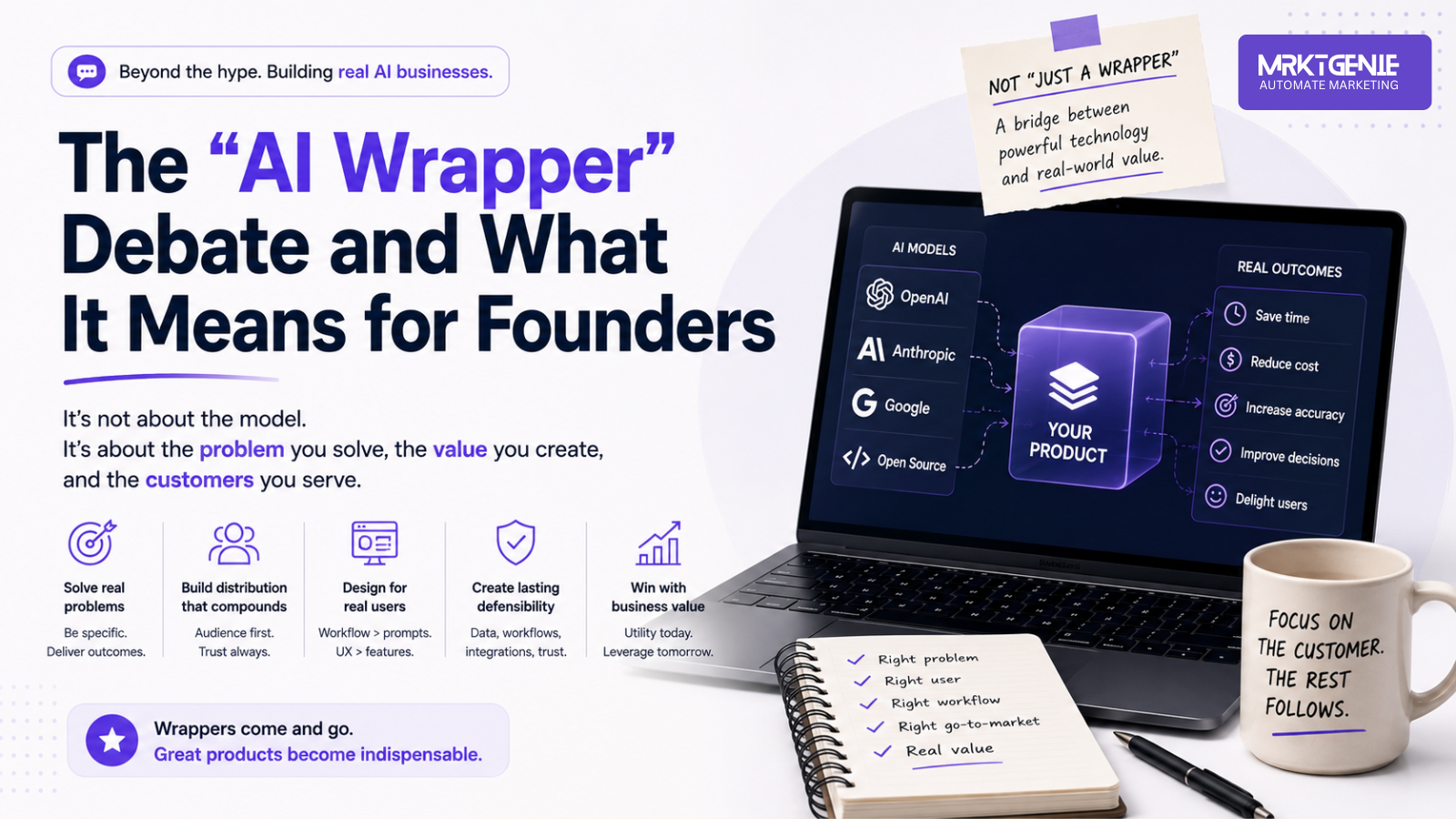
Most “AI wrappers” are products that use foundation models from companies like OpenAI, Anthropic, Google, or open-source providers, then package them into a more useful experience for a specific user or job.
But that description is too sterile to be useful.
Here is what it looks like in practice.
A recruiter does not want “access to a large language model.” She wants to turn 600 inbound applications into a shortlist without violating hiring policy or missing strong candidates.
A sales manager does not want “state-of-the-art inference.” He wants call summaries pushed into the CRM in the right format, with next steps, objections, and follow-up drafts that match how his team actually sells.
A lawyer does not want a chatbot. She wants a system that can pull clauses from prior agreements, flag risk, preserve citation trails, and avoid hallucinating in ways that create liability.
That packaging layer, the one people dismiss as “just a wrapper,” is often where the business value lives.
Think of it this way. Flour is a commodity. Restaurants still exist.
The fact that many companies can access the same raw ingredient does not mean they create the same outcome. Ingredients matter. So do recipes, timing, service, trust, and whether the customer leaves thinking, “That solved my problem better than the alternative.”
And yes, some wrappers are shallow. Some are little more than a prompt box with a landing page. Those deserve skepticism. But the existence of weak AI products does not prove the category is weak. It proves barriers to entry are low at the surface level.
Surface-level ease and business-level defensibility are not the same thing.
The criticism is not wrong, just incomplete
The criticism usually comes in four versions.
You do not control the core intelligence.
Your margins can get squeezed by API costs.
The model provider can copy your features.
Switching costs are low if your product is thin.
All true. None sufficient.
Imagine saying Shopify is “just a wrapper” around payments, hosting, templates, and logistics partners. Or saying a vertical SaaS company is “just a wrapper” around databases, cloud infrastructure, and workflow rules. It sounds ridiculous because we understand that assembling technology into an opinionated product for a real buyer is the work.
The stronger critique is not “you depend on upstream providers.” Almost every modern software company depends on upstream providers. The stronger critique is: do you add enough proprietary value that users would care if the underlying model changed?
That is the test.
One founder I spoke with built an AI writing assistant for agencies. Early traction looked promising. But users churned fast. Why? Because the product mostly helped them generate text. The moment ChatGPT improved, the agencies went back to using a general-purpose tool plus a few saved prompts.
Another founder built AI software for commercial real estate underwriting. Same dependency on third-party models. Very different result. Why? Because the product was not selling generation. It was selling a complete underwriting workflow: document ingestion, field extraction, error checks, team collaboration, auditability, and integration into existing deal review processes. If the underlying model changed, the customer still needed the system.
That is the difference between renting excitement and building utility.
Distribution is not a side issue. It is the business.
One of the strangest habits in startup discourse is treating distribution like a consolation prize.
Founders will spend six months improving model orchestration by 11 percent and zero months asking why the right buyers never hear about them.
In AI, distribution matters even more because feature advantages decay fast. What compounds is trust, attention, audience access, community presence, and channel fit.
This is why two nearly identical products can have wildly different outcomes. One founder has spent a year building relationships in a niche Slack community, posting teardown content, speaking the customer’s language, and collecting use cases before launch. The other launches on Product Hunt, tweets “we built the future,” and waits.
You already know who gets the customers.
If this sounds uncomfortably familiar, it is because many founders still underestimate how much early traction is downstream of visibility. Build it and they will come is still one of the fastest ways to kill a startup, and AI has not changed that. If anything, it has made the problem worse because the supply of products has exploded.
There is a reason audience-first founders often look luckier than product-first founders. They are not luckier. They are easier to discover, easier to trust, and easier to remember. Building an audience before the product is finished is not vanity in this market. It is insulation.
And distribution is not only content. It can be embedded partnerships, domain communities, consultants who bring you into client accounts, workflow integrations, founder reputation, or niche search intent. Sometimes the best growth channel is the one founders ignore because it does not look glamorous.
In other words: if your moat is not the model, your path may be the market.
UX is where generic models become specific products
Most customers do not experience your architecture. They experience your interface at 4:47 p.m. when they are tired, behind schedule, and slightly annoyed.
This is where a surprising number of AI founders lose perspective. They obsess over what the model can do in theory and ignore what the user can do without confusion.
Consider the difference between these two products:
Product A gives you a big input box and says, “Ask anything.”
Product B knows you are a claims adjuster, asks for the exact file types you already use, extracts the fields you repeatedly need, flags ambiguities, and produces an output that matches your internal reporting template.
Same model family, maybe. Completely different user experience.
The second product feels intelligent in a more important way. It understands context.
That context can show up through workflow design, memory, integrations, guardrails, templates, role-based permissions, review states, compliance logic, collaboration flows, or simply better defaults. None of that is glamorous in a benchmark thread. All of it matters in a buying decision.
I once watched a team demo an AI meeting assistant to a head of operations. The founders kept talking about transcription quality and summarization accuracy. The buyer kept asking one question in different forms: “Will my managers actually use it?”
That was the whole sale. Not whether the model was brilliant. Whether the product fit behavior.
This is why startup growth is becoming more psychological than technical. People adopt products that reduce friction, lower anxiety, and fit existing habits. A lot of “AI differentiation” is really behavioral design wearing a technical costume.
Defensibility is built in layers, not slogans
When founders ask, “Is this defensible?” they often mean, “Can a giant crush me?”
The uncomfortable answer is yes, a giant can crush almost anyone in theory. That has always been true. The more useful question is: what makes your product harder to replace than it appears from the outside?
Defensibility in AI products usually comes from stacking advantages, not from one magical moat.
Workflow depth
If your product becomes part of how work gets done, not just a novelty someone tests, replacement becomes more painful. The deeper you sit inside recurring processes, the more resilient you are.
For example, an AI tool that generates ad copy is vulnerable. An AI system embedded into campaign planning, approvals, brand governance, experimentation history, and reporting is much harder to swap casually.
Proprietary data and feedback loops
Not “we have data” in the abstract. Actual data advantages: labeled outcomes, customer-specific knowledge, historical decisions, edge-case corrections, and usage patterns that improve performance over time.
A healthcare documentation product that learns from provider edits, specialty-specific vocabulary, and accepted note structures is building more than a wrapper. It is building a compounding system.
Distribution channels you own or influence
If you have direct access to your market through community, brand, partnerships, or founder trust, you are less exposed than a product that relies entirely on paid acquisition and platform luck. Trust is often the fastest moat available to a new startup, especially when buyers are skeptical of AI claims.
Switching costs created by adoption
Integrations, team usage, stored workflows, training, internal playbooks, and embedded outputs all matter. Customers do not switch just because alternatives exist. They switch when the pain of staying exceeds the pain of moving.
Brand credibility in a noisy market
In an AI-generated internet, people are increasingly suspicious of vague promises. The founders who win often sound less impressive at first and more believable over time. Generic startup claims get ignored because buyers have heard them too many times. Specificity is not just better messaging. It is defensive positioning.
So yes, dependency risk is real. But many founders underestimate how much defensibility can be created above the model layer if the product becomes trusted, embedded, and behaviorally sticky.
The market does not reward purity. It rewards problem-solving.
There is a fantasy that circulates in technical circles: the “real” AI company is the one doing hard science, while everyone else is ornamental.
Markets do not care about this hierarchy nearly as much as builders do.
Customers rarely ask, “Did you train the model from scratch?” They ask questions like:
Will this save my team time?
Can I trust the output?
Will this fit how we already work?
What happens when it makes a mistake?
Can my team adopt this without weeks of chaos?
That is why some of the best AI businesses will look boring from the outside. They may not dominate headlines, but they solve expensive, repetitive, high-friction problems inside industries where buyers care more about reliability than novelty. This is the same reason boring startups often win: the pain is real, budgets exist, and customers reward usefulness over coolness.
One founder built a flashy general-purpose AI assistant and struggled to monetize. Another built a narrow AI product that helps freight brokers classify emails, extract shipment details, and trigger next actions in their TMS. Guess which one had clearer ROI by month three.
The market is not grading your originality as a technologist. It is grading your value as a business.
How founders should evaluate an AI idea now
If you are worried your product might be “just a wrapper,” do not ask that question in the abstract. Use a harder set of filters.
1. If the model got better tomorrow, would your product become more valuable or less necessary?
If a better upstream model makes your experience stronger because you own the workflow, that is good. If it erases your entire value proposition, you are standing too close to the raw capability.
2. Are you selling output, or are you selling an outcome?
Output is “generate text,” “summarize calls,” “answer questions.” Outcome is “reduce underwriting time by 70 percent,” “increase collections without hiring,” or “cut support backlog by half.” Output gets copied. Outcome is harder to commoditize because it requires system design.
3. Do you understand the user’s environment well enough to remove friction they cannot articulate?
The best products often solve the annoying second-order problems users forgot to mention: formatting, approvals, handoffs, exceptions, compliance, versioning, and trust. That is where wrapper jokes start to sound naive.
4. How will people hear about you, trust you, and choose you?
If your answer is still “we will launch and see what happens,” you do not have a growth strategy. You have hope.
5. What compounds as you grow?
Data, workflows, integrations, reputation, partnerships, user-generated assets, team collaboration, domain-specific tuning, and customer knowledge all compound. A landing page on top of an API does not.
The real market reality: many wrappers will die, and that proves nothing
This is where the debate gets distorted.
Yes, many AI wrappers will fail. So will many AI infrastructure companies. So will many open-source tools, marketplaces, and vertical SaaS startups. High failure rates do not reveal a category truth. They reveal startup math.
Bad AI wrappers die for familiar reasons:
No real problem beneath the demo.
No distribution.
No retention.
No workflow lock-in.
No trust.
No reason to exist once the model improves.
But strong AI application companies can become excellent businesses precisely because model access is becoming widespread. When raw intelligence becomes more accessible, the premium shifts to taste, packaging, trust, domain specificity, and go-to-market execution.
That should sound familiar. When content became easier to produce, distribution and credibility mattered more. When software infrastructure became easier to rent, product design and market access mattered more. When AI generation became easier to access, the same pattern emerged.
The scarce thing moved up the stack.
What this means for founders right now
If you are building an AI startup, the goal is not to win an argument about whether your architecture is pure enough. The goal is to become the obvious choice for a specific customer with a painful problem.
That means:
Get painfully specific about the workflow you improve.
Design for trust, not just capability.
Build distribution early, before you think you need it.
Create value that survives model improvements.
Collect proprietary context through usage, feedback, and integrations.
Position around outcomes, not AI theater.
The founders who struggle most in this market are often not the least technical. They are the ones who confuse access to intelligence with a company.
Access is not the business.
What you do with it might be.
So the next time someone dismisses a startup as “just an AI wrapper,” pause before internalizing it. Sometimes that phrase is a sharp critique. Sometimes it is lazy shorthand from people who understand models better than markets.
The better question is not whether you are wrapping AI.
It is whether you are wrapping it around a problem people will pay to make disappear.