Most startups do not die because the founders were lazy or the product was terrible.
They die because a small group of smart people built something in private, got emotionally attached to it, and then walked into the market expecting applause. What they got instead was silence. A few polite likes. Maybe a couple of demo calls. Then the slow, humiliating realization: nobody was waiting for this.
If that feels uncomfortably familiar, you are probably the reader for this article. You are not trying to build “content.” You are trying to reduce the odds of spending six months building the wrong thing. You are trying to avoid launching into a void. And you are probably carrying one expensive misconception: that audience-building is a marketing activity you do after the product is ready.
For many early-stage startups, that sequence is backward.
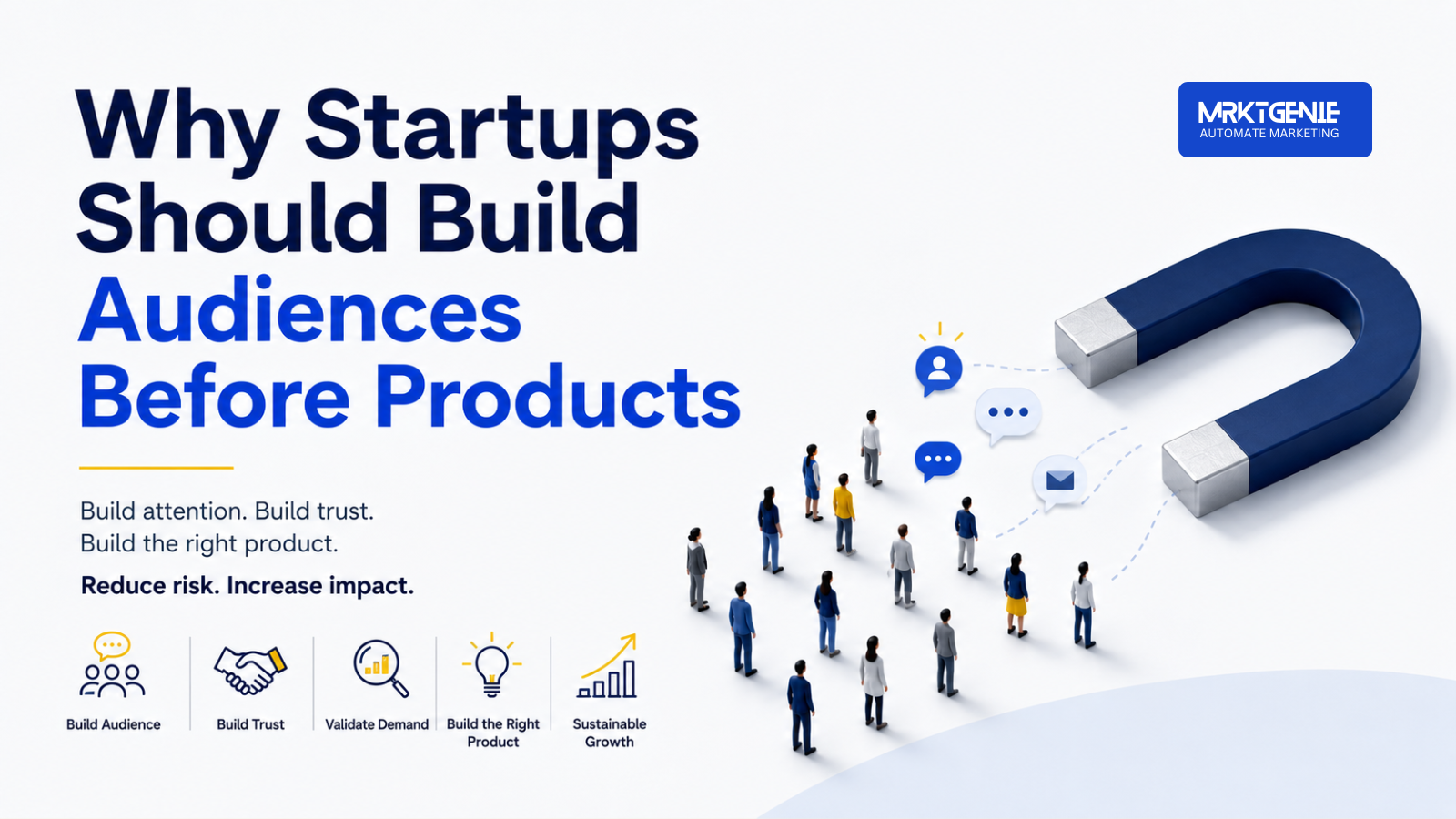
The more effective order is often this: build attention, build trust, build understanding, then build the product with that signal in hand.
Not because audience matters more than product. It does not. But because in the earliest stage, audience gives you something product alone cannot: proof that real people care enough to listen, respond, ask, and eventually buy.
The real problem founders are trying to solve
Founders usually say they are trying to build a product.
That is rarely the full truth.
What they are actually trying to build is certainty. Certainty that the problem is painful. Certainty that the positioning makes sense. Certainty that the market exists. Certainty that launch day will not feel like throwing a bottle into the ocean.
That is why audience-first startup building is gaining traction. It is not a vanity play. It is a risk-reduction strategy.
A founder I know spent eight months building a workflow automation tool for agencies. The product was polished. The onboarding was smooth. The branding looked expensive. But when he launched, the response was weak. Not because agencies did not have the problem. They did. The problem was that he had guessed wrong about which part of the workflow hurt enough to pay for. He built around reporting. The market cared more about client approvals.
If he had spent those months building an audience of agency operators first, posting observations, collecting replies, running interviews, and teaching around operational bottlenecks, the mistake would have surfaced much earlier and much cheaper.
That is the painful pattern audience-first building helps prevent.
Demand validation happens before code, not after launch
One of the most dangerous founder habits is using product development as a substitute for demand validation.
Building feels productive. Shipping screens feels like momentum. But a product can be beautifully built and still commercially irrelevant.
An audience gives you a live testing environment before you commit heavily.
Attention is an early signal of pain
Imagine two founders.
The first disappears for five months and emerges with a “smart scheduling platform for consultants.”
The second spends five months writing sharp posts about why consultants lose revenue in back-and-forth scheduling, shares teardown videos of broken booking flows, interviews operators, and builds a small newsletter of 2,000 consultants who keep replying with their own frustrations.
Which founder knows more about the market?
Which founder has more message clarity?
Which founder is more likely to get immediate demos, referrals, and feedback when a beta goes live?
The second founder has not just built an audience. They have built evidence.
This is why validating a startup without spending months building is often less about clever surveys and more about repeated proof that people lean in when you talk about the problem.
What to validate before building heavily
Do people stop scrolling when you describe the problem?
Do they respond with “this is exactly what is happening to us”?
Do they ask how you currently solve it?
Do they volunteer stories without being bribed?
Do they join a waitlist, newsletter, or private group around the issue?
Do they pay for a manual version, audit, service, or prototype?
Notice what is missing from that list: feature requests.
Founders often obsess over features too early because features are easier to discuss than pain. But pain is where demand lives.
Community insight beats founder imagination
Many startup mistakes are not technical mistakes. They are interpretation mistakes.
The founder sees the market through their own logic and assumes users think the same way. They usually do not.
An audience corrects that distortion.
Your future customers will tell you what they actually mean
One SaaS founder kept describing his product as a “knowledge orchestration layer.” He thought it sounded sophisticated. His audience thought it sounded vague. Their replies kept using different language: “searching across scattered docs,” “finding the latest version,” “stopping repeat questions in Slack.”
That language was gold.
It did more than improve copy. It changed the roadmap. He stopped building abstract AI features and focused on retrieval, version clarity, and team workflows. Signups improved because the product started mirroring the buyer’s mental model instead of the founder’s ego.
If you have ever struggled to explain what you do, the issue may not be branding. It may be a validation gap. This is why messaging validation matters as much as product validation in the early stage.
Audience feedback is not the same as feature voting
There is a trap here.
Audience-first does not mean letting the crowd design your product. That creates Frankenstein software.
What you want is not democratic product management. You want pattern recognition.
Listen for:
Repeated complaints
Repeated language
Repeated workarounds
Repeated buying objections
Repeated moments of urgency
When ten people describe the same painful moment in slightly different words, that is signal. When one loud person asks for an obscure integration, that is noise.
A good founder does not obey the audience. A good founder studies the audience until the right product becomes harder to miss.
Launches get easier when people are already paying attention
Here is an uncomfortable truth: many “bad launches” are not launch problems. They are pre-launch neglect.
Founders spend months polishing the product and two days thinking about distribution. Then they act surprised when the launch underperforms.
That is like opening a restaurant on a side street with no sign, no regulars, no local reputation, and no invitation list, then blaming the menu.
Warm audiences change the emotional math of launching
A cold launch feels like begging strangers to care.
A warm launch feels like continuing a conversation.
That difference matters more than most founders realize.
When people have already seen your thinking, watched you refine the idea, disagreed with your takes, answered your polls, and joined your email list, the launch is no longer your introduction. It is your next chapter.
This is one reason founder-led visibility keeps rising. Buyers trust people before they trust products, especially when the product is new. Why founders are suddenly investing in personal brand has less to do with vanity and more to do with reducing buyer uncertainty.
A practical pre-launch example
Suppose you are building software for finance teams to close the books faster.
Audience-first does not mean posting “coming soon” graphics for three months.
It means publishing observations like:
Why month-end close still breaks in spreadsheet-heavy teams
The hidden cost of approval bottlenecks in finance ops
Three manual reconciliation steps teams pretend are fine
Then you collect comments, interview respondents, build a waitlist, run a webinar, maybe offer a paid spreadsheet template or audit first. By launch day, you do not need to invent urgency. You have already been documenting it.
If your startup has ever felt invisible, it is worth reading why nobody cares about your startup yet. The answer is usually not “build more features.”
Distribution is not a later problem. It is the startup.
Some founders still treat distribution like packaging. Build the product first, then market it.
That logic made more sense when attention was cheaper and channels were less crowded. It makes less sense now.
Today, a startup without distribution is like a band practicing in a soundproof garage. They may be talented. They may even be brilliant. But brilliance unheard does not compound.
Audience is a distribution asset that appreciates
An email list, a niche community, a trusted LinkedIn following, a podcast audience, a YouTube subscriber base, a respected founder voice in a category, these are not side projects.
They are strategic assets.
They lower customer acquisition cost. They improve feedback loops. They increase referral potential. They make launches cheaper. They make partnerships easier. They give you retargetable attention that does not disappear because an ad budget got cut.
This is especially important when startup marketing feels more difficult than founders expected. Attention is fragmented, trust is lower, and content is endless. Startup marketing feels harder than ever partly because relying on product quality alone no longer creates enough visibility.
Distribution compounds while stealth does not
Stealth mode flatters the founder. Distribution compounds for the company.
Every useful post, interview, newsletter, teardown, or niche resource can keep attracting the right people long after it is published. Every conversation can sharpen the next one. Every piece of audience trust makes the next ask easier.
Meanwhile, six months in stealth often produces one thing: six months of hidden assumptions.
That does not mean every startup should build in public theatrically. It means every startup should build in contact with the market.
Audience-first lets you test revenue before software is finished
This is where many skeptical founders finally pay attention.
Because growing an audience sounds soft until it starts revealing what people will actually pay for.
You can test willingness to pay in smaller, faster ways
Before the full product exists, you can often sell:
Consulting
Audits
Done-for-you services
Templates
Workshops
Pilots
Concierge versions of the workflow
This does two things at once. It validates demand and funds learning.
A founder building compliance software for small clinics started with a newsletter breaking down regulatory mistakes. That audience led to paid audits. The audits revealed recurring workflow pain. Those workflows became product requirements. By the time she started building software, she was not guessing about value. She had already been paid to solve slices of the problem manually.
That is a much healthier place to build from than “we think people will want this.”
Paid behavior beats enthusiastic feedback
Founders get trapped by compliments.
“This is cool.”
“I’d totally use this.”
“Keep me posted.”
None of that is validation. It is social lubrication.
Real validation has friction. Someone books the call. Replies with urgency. Introduces a teammate. Asks about price. Pays for a workaround. Gives up time, money, or reputation.
That is why audience-first building is so powerful when done correctly. It gives you a bridge from attention to transaction.
What founders get wrong about audience-first startups
The biggest misconception is that audience-first means becoming an influencer.
It does not.
You do not need dance videos, hot takes on everything, or a fake online persona. You need relevance. You need consistency. You need to become legible to the people you want to serve.
Audience-first is not vanity-first
A niche audience of 800 highly relevant people can be more valuable than 80,000 casual followers.
If you are building software for RevOps leaders, and 300 RevOps operators regularly read your posts, answer your questions, and trust your perspective, that is not a small asset. That is a strategic advantage.
Founders often dismiss this because they are still using consumer social media logic. They think audience value is measured by scale. Early-stage startup audience value is measured by proximity to pain.
You do not need to post constantly
Another myth: audience-building requires being online all day.
Not true.
Some of the best founder audiences are built through one strong weekly email, a few thoughtful posts, customer interviews turned into content, and consistent participation in a niche community. The key is not noise. It is signal.
If that sounds more manageable, building startup visibility without becoming chronically online is a much better model than trying to mimic full-time creators.
The risks of building an audience before a product
Audience-first is powerful. It is not magic. It has risks, and pretending otherwise creates a new kind of founder delusion.
Risk 1: Mistaking engagement for demand
People love content about problems they will never pay to solve.
Productivity content is full of this. So is AI commentary. So is startup advice itself.
You can build a large audience around interesting ideas and still have weak commercial intent. That is why founders must separate “people enjoyed this” from “people need this enough to buy.”
Ask harder questions. Run offers. Test pricing. Watch behavior.
Risk 2: Building for the audience, not the customer
Your content audience and your eventual buyers may overlap imperfectly.
A founder can attract other founders while actually trying to sell to HR teams. A marketer can gain traction with peers while building software for finance leaders. Attention can drift toward the easiest audience to please, not the right one to serve.
This is where discipline matters. Your content should attract adjacent curiosity, yes, but it must stay anchored to the buyer’s actual pain.
Risk 3: Hiding behind content instead of building
Some founders use audience-building as a sophisticated form of procrastination.
They keep posting, collecting opinions, and polishing their point of view because code feels risky. At some point, the market has told you enough. You have to decide. Audience-first should shorten the path to conviction, not become a substitute for it.
Risk 4: Overfitting to loud feedback
The most vocal people are not always the best customers. Sometimes they are hobbyists, consultants, or edge cases with unusual workflows.
Use audience insight to spot patterns, not to obey every request. The founder’s job is synthesis.
A simple framework for building audience before product
If you want to apply this without getting lost, keep it simple.
1. Pick a painful problem, not a broad category
Do not build an audience around “sales” or “AI” or “productivity.” Build around a sharp, recurring pain point.
Examples:
Why agency approvals delay delivery
Why RevOps dashboards still fail executives
Why finance teams cannot trust spreadsheet-based close processes
Specific pain attracts specific people.
2. Publish observations, not generic tips
Say something a real buyer would recognize from their own day.
Bad: “Efficiency matters for growing teams.”
Better: “The moment a team hires its third account manager, client handoffs usually get messier, not smoother, because everyone assumes someone else updated the source of truth.”
One sounds like content. The other sounds like experience.
3. Turn replies into research
Every comment, DM, call, and email is field data.
Track exact phrases. Look for repeated moments of friction. Notice where people get embarrassed, defensive, or unusually animated. Emotion is often pointing at expensive problems.
This is why many of the best content systems are built from customer conversations rather than brainstorming. Turning customer interviews into a content engine creates a much stronger loop between audience growth and product insight.
4. Test a lightweight offer before full software
Can you sell a service, workshop, audit, template, or pilot around the same pain?
If nobody will pay for a partial solution, be careful about assuming they will pay for a polished one.
5. Build only after patterns repeat
Do not build because three people were enthusiastic. Build because the same pain, same language, and same willingness to act keep showing up.
Repetition is the market’s way of removing your excuses.
Why this works especially well now
There was a time when distribution could be rented more easily. Buy ads, get attention, force the market to notice you.
That path is more expensive, noisier, and less forgiving now.
Trust has become a bigger variable. So has interpretation. Buyers are overwhelmed. They do not just need tools. They need confidence that the tool understands their problem in the first place.
That is why startup growth is increasingly psychological, not just technical. Clear narrative, repeated exposure, trust signals, and problem recognition all shape whether a product gets adopted. Startup growth is becoming more psychological than technical because markets are not evaluating features in a vacuum. They are evaluating belief, clarity, and credibility.
An audience helps you build all three before launch.
The deeper shift: you are not just building a product, you are building a market relationship
The founders who resist audience-first thinking often imagine a false tradeoff.
They think they must choose between building and talking.
The stronger founders understand that talking to the market is part of building.
Not performative talking. Not empty posting. Real contact. Real observation. Real interpretation. Real trust.
If you have ever built in isolation and then felt that awful drop in your stomach when the launch landed flat, this is the lesson worth keeping: the market usually gives warnings long before it gives rejection. Audience-first startup building simply helps you hear them sooner.
So before you spend the next six months building features, ask a harder question.
Who is already gathering around this problem?
If the answer is nobody, be careful.
If the answer is “I do not know,” start there.
And if the answer is “a small group keeps leaning in every time I talk about it,” you may have something more valuable than momentum.
You may have pull.