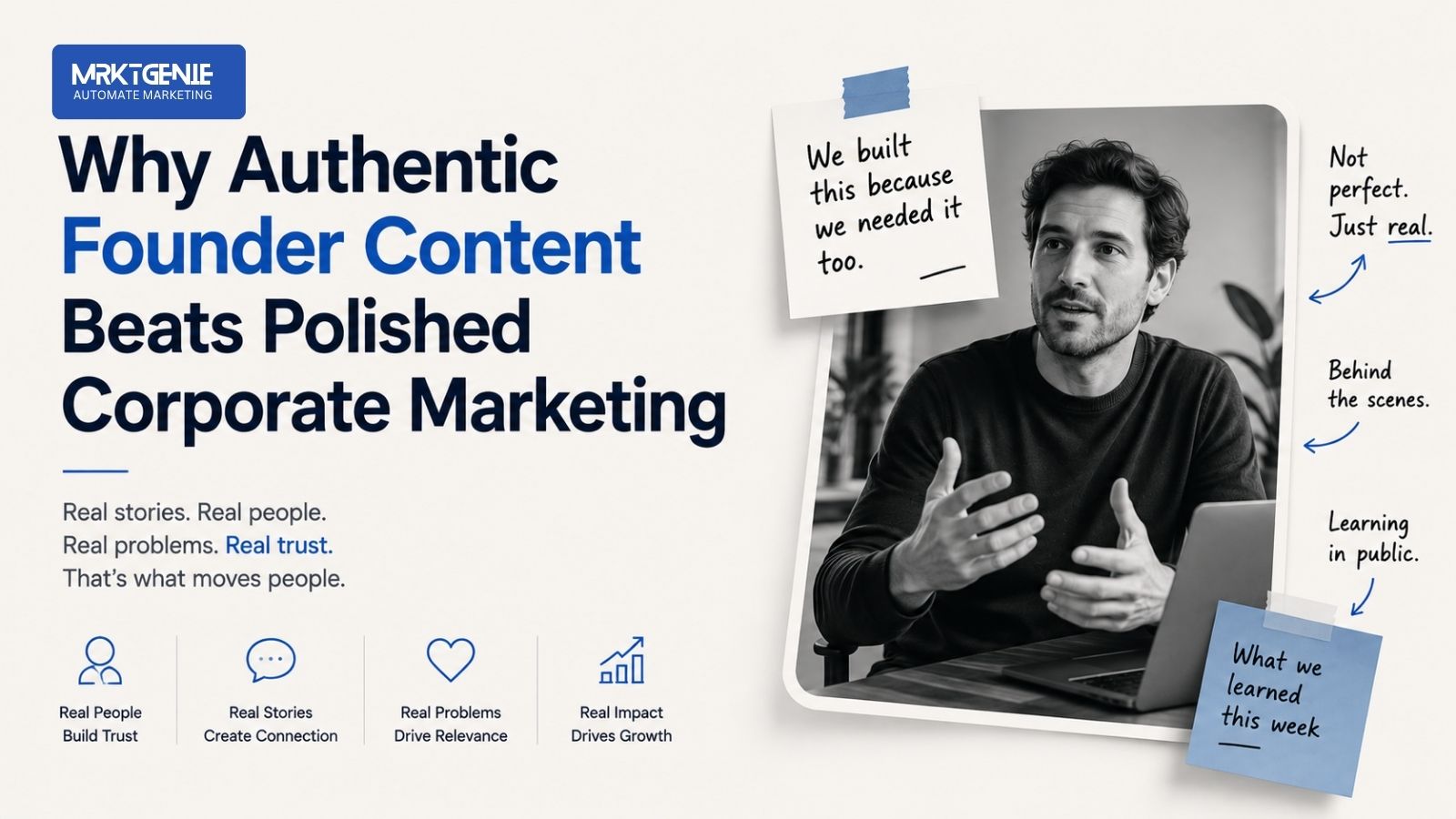
The founder had done everything “right.” New logo. Crisp landing page. Carefully designed brand colors. A polished product video with soft music and perfect transitions. Then they posted a raw, slightly awkward video shot on a laptop camera explaining why they built the product after losing weeks to the problem themselves.
The polished video got polite silence. The scrappy founder video brought demos, replies, and customers saying some version of: “I’ve had this exact problem.”
If that feels familiar, it’s because many founders are stuck in the same loop. They assume better marketing means looking bigger, cleaner, and more corporate. But the real problem is not aesthetics. It is trust. People do not buy from the brand that looks the most finished. They buy from the one that feels the most believable.
That is why authentic founder content keeps beating polished corporate marketing, especially for early-stage startups, service businesses, and AI products entering crowded markets. When every company can generate competent-looking copy and nice visuals, realness stops being a nice-to-have. It becomes a competitive advantage.
Most founders are solving the wrong marketing problem
The reader here is usually a founder, operator, or early marketing lead trying to get attention without sounding desperate. They are trying to solve a painful question: why does our marketing look good but fail to create trust, conversation, or demand?
The frustration keeps repeating. You publish brand-safe content. It says the right things. It even sounds smart. But nobody responds. Or worse, people “like” it without remembering it. The website reads professionally, yet prospects still ask basic trust questions on calls. LinkedIn posts disappear in the feed. Launches feel thinner than they should.
The misconception is subtle but expensive: many founders believe professionalism creates credibility. Sometimes it does. But in crowded markets, polish without proof often reads like distance. It feels rehearsed. It signals that a company wants to control perception more than reveal reality.
The costly mistake is outsourcing the voice of the company before the company has earned one. Founders hide behind generic brand language too early. They trade specificity for safety. They replace lived experience with messaging templates. Then they wonder why the audience feels nothing.
What they actually want is simple: trust, resonance, qualified attention, and the feeling that the right people finally “get” what they are building.
Trust is shifting away from institutions and toward identifiable humans
There was a time when looking corporate was the point. A glossy website suggested stability. Formal language implied competence. Distance looked professional.
Now it often has the opposite effect.
Why? Because audiences have been trained by years of inflated claims, vague positioning, paid hype, and AI-generated sameness. They have seen too many websites promise to “transform workflows” and “empower teams” without saying anything concrete. They have watched too many startups perform certainty while quietly figuring things out in the background.
So people adapt. They trust signals that are harder to fake.
A founder saying, “We shipped this feature because three customers were hacking it together with spreadsheets” is more persuasive than a homepage saying, “Built for modern efficiency.” One sounds observed. The other sounds assembled.
This is part of a broader pattern: trust is moving from institutions to individuals. Not because people suddenly love oversharing, but because identifiable humans create accountability. If a founder says something publicly, there is reputation attached to it. A logo has less to lose.
That is one reason founder-led visibility has become so powerful. It is not vanity. It is trust architecture.
What audiences really hear when your content sounds too polished
They do not think, “Impressive brand standards.”
They often think:
- What are they hiding?
- Did a marketer write this?
- Do they actually understand the problem?
- Is this another company trying to sound bigger than it is?
Harsh? Maybe. But honest.
Especially in B2B and startup buying, customers are not just evaluating product quality. They are evaluating risk. If your marketing feels manufactured, buyers assume your promises might be too.
Behind-the-scenes content works because it reduces uncertainty
One founder posts a feature announcement with perfect graphics and a line about innovation. Another posts: “We almost didn’t ship this this week. The onboarding flow broke in testing, two users got stuck at step three, and we realized our assumptions were wrong. Here’s what we changed.”
Which one feels more credible?
Behind-the-scenes content works because it lets people see the gears turning. It turns the startup from a polished facade into an operating reality. And reality is persuasive.
Think about a restaurant with an open kitchen. People do not love it because it is glamorous. They love it because seeing the process makes the experience feel more trustworthy. You can watch the work happen. Founder content does the same thing.
Useful behind-the-scenes content can include:
- Why a feature was prioritized
- What customer feedback changed your mind
- What failed in a launch
- Tradeoffs you made due to limited resources
- What you believed six months ago that you now think was wrong
That last one is especially powerful. Nothing builds credibility like visible learning.
This is also why so much “thought leadership” falls flat. It presents conclusions without the scars, confidence without the context, certainty without the mistakes. Readers do not just want ideas. They want evidence that the ideas came from contact with reality.
A quick example: the founder update that outperformed the launch post
A SaaS founder I know spent two weeks preparing a launch thread. It was clean, persuasive, and forgettable. A week later, they posted a short note: “Three prospects told us the product felt useful but not urgent. That stung. We realized our messaging was describing capability, not pain. Here’s how we rewrote the homepage.”
That post got shared by operators, commented on by buyers, and turned into multiple sales conversations.
Why? Because it exposed a real moment of calibration. It taught something. It felt expensive to learn. People trust expensive lessons.
Transparency is not weakness. It is proof of seriousness.
Many founders worry that transparency will make them look small, uncertain, or unfinished. But early-stage buyers already know you are unfinished. The attempt to appear fully formed is often what creates suspicion.
Transparency, done well, does not mean confessing every flaw. It means being honest about what is true, what is changing, and what you are learning.
There is a difference between saying, “We are still refining onboarding for teams larger than 50 users,” and pretending the product is perfect until churn teaches the lesson for you.
Transparency signals maturity because it shows you understand the buyer’s fear. They are not asking, “Is this startup flawless?” They are asking, “If something goes wrong, will these people tell the truth and fix it?”
That is why specificity beats slogans. If your messaging still leans on broad claims, this is worth reading: why users ignore generic startup claims. Vague language asks for trust without earning it. Transparent language earns trust by lowering ambiguity.
The misconception that keeps teams sounding fake
A common internal debate goes like this: “We cannot say that publicly. It might make us look bad.”
But often what makes you look bad is sounding like you are avoiding the obvious.
If your category is crowded, if your product is early, if your market is skeptical, then over-controlled messaging creates more risk than honesty. Audiences can feel when a company is speaking from a legal document instead of lived experience.
And here is the contrarian part: a little imperfection can increase persuasion. Not sloppy execution. Human texture.
A founder who says, “We got this wrong the first time” is easier to trust than a brand that acts like every move was strategic genius.
Founder accessibility changes the buyer psychology
When the founder is visible, buyers feel closer to the source of truth.
That matters more than many teams realize.
In early-stage companies, customers are not just buying software or services. They are buying responsiveness, speed, and confidence that their feedback might actually influence the roadmap. Founder accessibility changes the perceived relationship from transaction to collaboration.
This does not mean every founder needs to become an influencer. It means the market should be able to see a real person thinking clearly in public.
Sometimes that looks like replying thoughtfully in comments. Sometimes it is posting product decisions. Sometimes it is writing about mistakes in positioning. Sometimes it is showing up in niche communities instead of broadcasting to everyone.
This is one reason comment marketing can quietly outperform louder tactics. A founder leaving sharp, useful comments under relevant discussions often builds more trust than a week of polished branded posts. Why? Because it feels less like performance and more like participation.
Accessibility is not about being available to everyone
It is about being legible to the right people.
Your audience wants to know:
- Who is building this?
- Do they understand the problem from the inside?
- Will they listen?
- Can I trust their judgment when the product evolves?
Authentic founder content answers all four questions at once.
Audience connection comes from recognition, not reach
One of the biggest traps in startup content is optimizing for broad appeal. The result is content that offends nobody, helps nobody, and gets forgotten by everybody.
Real founder content works because it creates recognition. The reader sees their own mess in your words.
Not “businesses need efficiency.”
But: “You know that awkward moment when your team says they have a process, but it is actually five tabs, a Slack thread, and one operations person holding the whole thing together?”
That lands because it is observed. It shows contact with reality.
Recognition is what makes someone think, “They built this for people like me.” And that emotional click matters. Buyers move toward companies that make them feel accurately seen.
If your content has been getting ignored, the issue may not be consistency. It may be lack of specificity. This is closely related to why founder posts often disappear without engagement: they sound acceptable instead of unmistakable.
A practical test for audience connection
Before publishing, ask:
- Does this sound like something only we could say from experience?
- Would our ideal customer feel described, not targeted?
- Is there a concrete detail that proves we have seen the problem up close?
- Does this reveal judgment, not just information?
If the answer is no, the content is probably too polished and not personal enough.
Why polished corporate marketing still has a place, but usually later
This is where nuance matters.
Polished marketing is not bad. It becomes powerful when it sits on top of real trust instead of trying to substitute for it.
Once a company has traction, strong customer proof, category awareness, and a clearer market position, polish can amplify credibility. But early on, polish without intimacy often creates distance. It is like dressing a house before laying the foundation. It photographs well. It does not hold weight.
Founders often copy the communication style of larger companies without realizing those companies are borrowing trust from brand recognition, market share, and years of proof. If you are early stage, you do not have those assets yet. You need a different playbook.
That is why copying big startup growth advice often backfires. Their tone works in the context of established legitimacy. Yours has to earn legitimacy in public.
Examples of authentic founder content that outperform brand polish
1. The messy build-in-public update
A founder shares weekly progress: what shipped, what broke, what user insight changed priorities. It is not cinematic. But customers follow because they become invested in the process.
Why it works: people trust momentum they can see.
2. The brutally specific customer story
Instead of saying, “Teams save time with our platform,” a founder writes: “A customer was spending 90 minutes every Monday manually combining CSV exports before their team sync. We cut that to 8 minutes.”
Why it works: specificity collapses skepticism.
3. The belief-change post
A founder says, “I used to think our ICP was startups under 20 people. After 40 sales calls, I think that was wrong. The teams feeling this pain most sharply are agencies between 20 and 75 employees.”
Why it works: changing your mind in public signals that you are paying attention to reality, not defending your ego.
4. The accessible founder reply loop
A prospect comments on a post with a use-case question. The founder responds thoughtfully, asks a follow-up, and later turns that exchange into product content or documentation.
Why it works: the audience watches trust being built in real time.
How to create authentic founder content without oversharing or wasting time
A lot of founders hear “be authentic” and immediately picture chaotic posting, personal confessionals, or spending hours trying to sound profound. That is not the goal.
The goal is disciplined honesty.
Here is a simple framework:
Share tension, not trivia
Do not post random behind-the-scenes details. Share moments where something was unclear, difficult, surprising, or changed your thinking.
Good example: “We thought feature X would improve activation. User calls showed the real issue was onboarding anxiety, not missing functionality.”
Teach from fresh scars
The best founder content often comes from problems you solved recently, not lessons polished for six months.
If you need a stronger system for turning lived experience into useful content, turning customer interviews into a repeatable content engine is one of the smartest ways to stay grounded in real pain instead of generic ideas.
Use proof-rich language
Replace claims with observations.
- Not: “Users love the new dashboard.”
- Instead: “Three customers who never touched reports before are now checking the dashboard daily because we moved usage alerts to the homepage.”
Show your decision-making
People trust judgment. Explain why you chose one direction over another. Tradeoffs are interesting because they reveal how you think.
Stay close to customer language
If your audience says, “We are drowning in follow-up work,” do not translate that into “workflow optimization challenges.” Keep the original texture. That is where trust lives.
The deeper reason authentic founder content wins
It is not just because it feels nice. It wins because it matches how people make decisions under uncertainty.
When buyers lack complete information, they look for human signals:
- Does this person understand my problem?
- Do they sound like they have earned their opinion?
- Are they hiding behind abstractions?
- If I buy, will I regret trusting them?
Polished corporate marketing often answers none of these questions. Authentic founder content answers all of them indirectly.
That is the real shift. Marketing is becoming less about perfect presentation and more about believable proximity. People want to get closer to the source. Closer to the builder. Closer to the thinking. Closer to the truth.
And in a market full of auto-generated competence, truth has become unusually valuable.
What to do next if your marketing feels polished but ineffective
If your content looks professional but does not convert trust into conversation, do not start by redesigning everything. Start by asking harder questions.
- Where are we sounding safer than we are being useful?
- What have we learned recently that would genuinely help our audience?
- What customer tension are we avoiding because it feels too unpolished to say out loud?
- Where can the founder become more visible in a way that adds clarity, not noise?
Then make one practical shift this week: publish something that reveals how you think, what changed your mind, or what your customers are actually struggling with in their own words.
Not because authenticity is trendy. Because trust is scarce.
And when trust is scarce, the founder who sounds real often beats the company that sounds expensive.