A founder spends 20 minutes with ChatGPT, publishes a polished LinkedIn post, and gets six likes. Two are from other founders. One is from a former colleague being polite. No customers reply. No one remembers it tomorrow.
What makes this frustrating is not that the post was bad. It was fine. Clear enough. Grammatically clean. Mildly insightful. And completely forgettable.
That is the real AI content problem. AI rarely produces offensive content. It produces content with no fingerprints on it. Content that sounds competent but not lived-in. Content that says the right things without making anyone feel, “This person gets my exact problem.”
If you are a founder using AI for content, you are probably trying to solve a real constraint: you do not have enough time, enough creative energy, or enough marketing support to publish consistently. The recurring frustration is that the faster you create, the more you start sounding like everybody else. The misconception is that originality comes from writing everything manually. It does not. The costly mistake is asking AI to generate opinions before you have supplied experience. What you want is simpler: speed without losing your voice, scale without sounding synthetic, and content that actually builds trust.
The AI content problem is not volume. It is sameness.
Most founders think the internet has a content overload problem. It does. But that is not the part hurting you most. The deeper problem is pattern recognition.
Readers can now smell generated content faster than most writers can edit it. They may not say, “This was written by AI,” but they feel it. The rhythm is too smooth. The advice is too balanced. The language sounds like it came from someone who has read about the problem, not someone who has paid for the mistake.
Look at how many posts now follow the same formula:
Bold claim in line one
Three tidy lessons
Soft motivational ending
It is the content equivalent of stock photography. Technically usable. Emotionally disposable.
This is also why so much “thought leadership” falls flat. If you want a deeper breakdown of why polished but generic authority content keeps failing, read why thought leadership content usually fails.
One founder I know used AI to produce 30 days of posts in a weekend. He felt productive. Organized. Ahead of schedule. By week three, he hated his own content. Not because it was inaccurate, but because it sounded like a version of himself that had never met a customer. He had outsourced the most important thing without realizing it: his point of view.
That is the contradiction many founders run into. AI helps you publish faster, but speed magnifies weak inputs. If your raw material is generic, AI will industrialize generic.
Human insight beats generated fluff because buyers trust scars, not summaries
The internet does not need more summaries. It needs evidence of contact with reality.
When a founder writes, “Retention matters more than acquisition,” that is a generic statement. When a founder writes, “We spent $14,000 driving demos before realizing users churned in week two because onboarding assumed too much technical knowledge,” that is useful. One is a concept. The other is blood on the floor.
This matters because customers are not just evaluating information. They are evaluating whether you understand the texture of their problem.
Think about two product pages.
The first says: “We help teams streamline workflows and improve productivity.”
The second says: “Most ops teams are still chasing approvals across Slack, email, and spreadsheets. We built this after watching three customer teams lose hours every week to status-check ping-pong.”
The second one wins because it names the mess. It proves proximity. It sounds like it has been in the room.
This is also why generic startup claims get ignored so quickly. Buyers have learned to tune out vague adjectives and reward specificity. If that sounds painfully familiar, this piece on why users ignore generic startup claims is worth reading.
Here is the misconception to kill: authenticity is not about sounding unpolished. It is about being specific enough that a real person recognizes themselves in what you wrote.
People do not trust content because it sounds smart. They trust it because it sounds expensive to learn.
AI can help shape that kind of content. But it cannot invent it convincingly. Not for long.
Use AI as a multiplier, not a substitute for perspective
The best founder workflows use AI the same way a strong operator uses an assistant: not to think for them, but to speed up the parts that should not consume their best energy.
Here is where founders go wrong. They open a blank chat and type, “Write me a post about startup marketing.” That prompt is already a surrender. It asks AI to choose the angle, the examples, the voice, and the conviction. Of course the output sounds like everyone else. Everyone else asked the same lazy question.
A better workflow starts with raw founder material.
A practical AI-assisted workflow that does not flatten your voice
Capture real moments first: customer objections, surprising churn reasons, failed experiments, sales call phrases, onboarding friction, internal debates.
Write ugly notes before polished copy: bullet points, screenshots, voice memos, rough stories.
Use AI to organize, not originate: ask it to cluster themes, identify patterns, propose structures, or turn one insight into multiple formats.
Add your judgment back in: what do you disagree with, what did the model miss, what was emotionally true but hard to articulate?
Pressure-test for specificity: replace abstractions with scenes, numbers, objections, or consequences.
For example, instead of prompting:
“Write a blog post about why onboarding matters.”
Feed AI this:
Three customers said setup felt easy until they had to import data
One team abandoned because permissions were confusing
Activation improved when we added a template library
I think onboarding friction is often a messaging problem, not just a UX problem
Now the machine has something worth working with.
This is one reason many founders are rethinking content systems in an AI-heavy market. If you want the bigger strategic picture, startup marketing in an AI-generated internet explains why trust is becoming the scarce resource.
What AI should do for founders
Turn transcripts into draft outlines
Convert one article into email, social, and sales enablement assets
Surface recurring customer language from interviews
Suggest headline variations based on search intent
Help tighten structure and remove repetition
What AI should not do alone
Invent your opinion
Write founder stories it did not witness
Guess at customer psychology without source material
Replace your contrarian angle
Decide what is strategically true for your market
A useful test: if your competitor could publish the exact same piece with minor wording changes, AI did too much.
Your founder story is not a branding accessory. It is a trust shortcut.
Many founders resist storytelling because they think it means making themselves the hero. That is not the point. The point is to reveal how you learned what you know.
Customers do not just buy products. They buy confidence that you understand the edge cases, the frustrations, the hidden costs, the things that only become obvious after trying to solve the problem badly once.
Consider two ways a founder might talk about building an analytics tool.
Version one: “We believe data should be accessible to everyone.”
Version two: “We built this after watching a growth lead export CSVs at 11:40 p.m. every Friday because the team’s dashboards looked clean but never answered the one question leadership asked on Monday.”
Which one sounds real?
Founder storytelling works because it compresses credibility. It tells the reader, “I have seen this movie before.” In a market where everyone can produce decent content, lived experience becomes a ranking signal in the mind of the buyer.
That is also why founder-led content is rising. Logos are easy to ignore. A person with a clear point of view is harder to forget. This is explored well in why every founder suddenly wants a personal brand.
What makes a founder story worth telling
A mistake that changed how you think
A customer interaction that exposed a hidden truth
A failed assumption that forced a pivot
An industry norm you now disagree with
A moment when the market taught you something your spreadsheet did not
One of the best posts I saw from a SaaS founder was not a launch announcement. It was a short story about losing a deal after a prospect said, “Your product looks capable, but I still do not understand why this matters right now.” That sentence forced the founder to rewrite the homepage around urgency instead of features. The post worked because it contained embarrassment, insight, and consequence. Readers trust that combination.
Personalization is how you escape the AI average
Most AI-generated content aims for broad relevance. That is exactly why it feels weak. Strong content often gets narrower before it gets bigger.
Founders who stand out usually do one thing well: they write for a specific buyer, in a specific moment, with a specific tension.
Not “startup founders.”
More like: “technical B2B SaaS founders who know their product is strong but cannot explain it clearly to non-technical buyers.”
Now the content has gravity.
Personalization does not require creepy data or enterprise tooling. It requires sharper audience empathy.
Five ways to make AI-assisted content feel personal
Name the moment, not just the market. Example: “when a prospect likes the demo but ghosts after sharing it internally.”
Use customer language exactly as spoken. If buyers say “this feels manual,” do not rewrite it as “workflow inefficiency.”
Address stage-specific problems. The content for a pre-seed founder should not sound like advice for a Series B team.
Write from one side of the tension. Example: speed versus trust, polish versus honesty, reach versus resonance.
Add situational detail. Slack threads. Pricing calls. Demo fatigue. Friday reporting chaos. These details make people feel seen.
This is where many founders underestimate psychology. Buyers remember content that mirrors their internal monologue. If the reader thinks, “That happened in our team last week,” you have their attention.
And if your messaging keeps shifting from channel to channel, personalization breaks down fast. A useful companion here is how to keep your product story consistent across channels.
Content examples: generic AI output vs founder-led AI-assisted content
Let us make this concrete.
Example 1: LinkedIn post
Generic AI version:
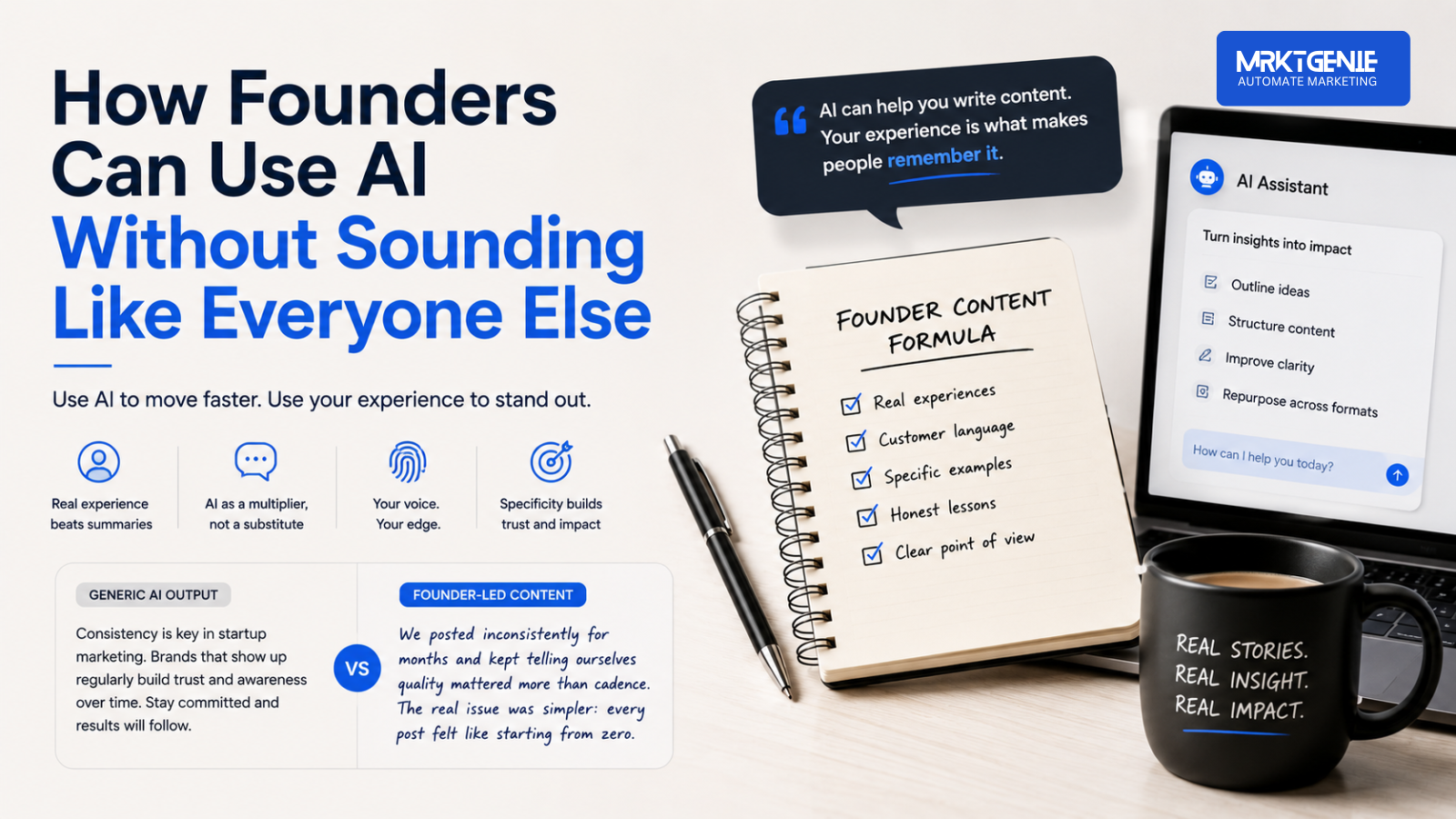
“Consistency is key in startup marketing. Brands that show up regularly build trust and awareness over time. Stay committed and results will follow.”
Founder-led AI-assisted version:
“We posted inconsistently for months and kept telling ourselves quality mattered more than cadence. The real issue was simpler: every post felt like starting from zero. Once we built a system from customer calls, feature questions, and sales objections, publishing stopped feeling creative and started feeling operational.”
The second version has a confession, a tension, and a lesson earned through friction.
Example 2: Website messaging
Generic AI version:
“Our platform helps teams save time, increase efficiency, and improve collaboration.”
Founder-led AI-assisted version:
“If your team is still chasing updates across Slack, Notion, and email, this gives you one place to see what is blocked, who owns it, and what needs attention before the weekly meeting turns into archaeology.”
The second version creates a scene. You can almost feel the meeting.
Example 3: Blog content
Generic AI version:
“Customer feedback is essential for product growth. Listening to users helps companies improve their offerings and stay competitive.”
Founder-led AI-assisted version:
“We used to ask customers what features they wanted. That gave us a wish list. Once we started asking what nearly made them quit during setup, we found the real roadmap.”
That line contains a strategic shift. It also shows the kind of insight AI can help phrase, but not discover on its own.
If you need a stronger process for sourcing content from reality instead of brainstorming into the void, read generate content ideas from real customer pain that you can prove.
A simple decision framework for founders using AI
Before publishing anything AI-assisted, ask four questions:
1. Could only we say this?
If the answer is no, the content is too generic.
2. What did we learn the hard way?
If nothing in the piece feels earned, add a mistake, surprise, or customer-specific observation.
3. Does this sound like a person or a panel discussion?
If every sentence sounds balanced and polished, it probably lacks conviction.
4. Would a buyer feel understood, or merely informed?
Information is abundant. Recognition is rare.
This framework matters because AI has shifted the content bar. Clean writing is no longer impressive. Distinct perception is.
The founders who win with AI will sound more human, not less
The irony is that AI is not making human voice less important. It is making it easier to notice when it is missing.
The founders who benefit most from AI will not be the ones who publish the most words. They will be the ones who feed the machine better raw material: sharper observations, real customer language, uncomfortable lessons, and stories with stakes.
Use AI to compress effort, not identity.
Let it help you structure the lesson. Do not let it replace the lesson.
Because in a feed full of competent content, the thing readers still stop for is not perfection. It is recognition. The feeling that someone has actually been where they are.
And if your content can do that, you will not sound like everyone else, even if AI helped you write it.