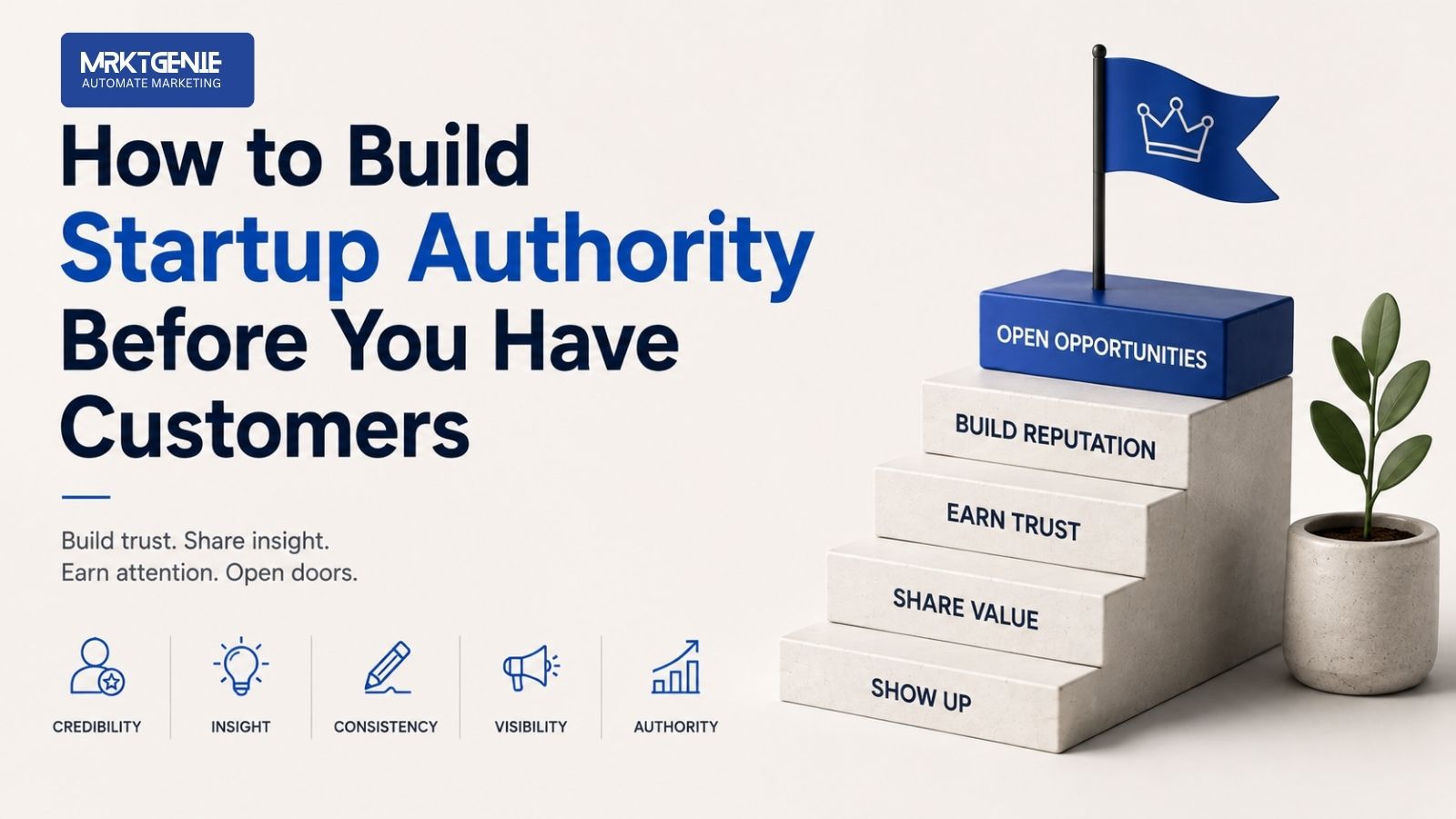
A founder I know spent four months polishing a product nobody had used, then opened LinkedIn and watched someone with a worse product, no revenue, and a half-finished landing page get invited onto podcasts, quoted in newsletters, and recommended in buyer communities.
That founder’s first reaction was the same one many early-stage founders have: “This is all fake. Authority is just performance.” The uncomfortable truth is harsher than that. Authority is not the same as traction, but before you have customers, it often determines whether anyone gives you the chance to earn traction.
If you are pre-customer, you are probably trying to solve a specific problem: how to look credible before the market has given you visible proof. You keep running into the same frustration. Every marketing tactic seems to require social proof you do not yet have. So you either stay quiet until you have results, or you overcompensate with vague claims about innovation, disruption, and vision. Neither works. The misconception is that authority begins after customer success. In reality, smart founders build authority from evidence adjacent to customers: insight, proximity, consistency, and signal. The costly mistake is waiting for permission to sound credible.
Here is how to build startup authority before you have customers, without pretending, inflating, or becoming unbearable online.
Borrowed credibility is not cheating. It is how trust starts.
When people do not know your company, they look for who or what they already trust. That is not cynicism. That is buyer psychology. A stranger saying “trust me” is weak. A respected operator, known brand, credible community, or recognized framework standing near you changes the equation.
I have seen this play out in tiny but powerful ways. A first-time B2B founder could not get replies when he pitched his startup directly. Then he changed the framing. Instead of “We built an AI tool for support teams,” he wrote, “After studying workflows used by support leaders at Stripe, Intercom, and Zapier, we noticed three repeated failure points in handoffs.” Same founder. Same product. Different trust architecture.
Borrowed credibility works because buyers use shortcuts. They ask themselves:
- Who else takes this founder seriously?
- What environments are they associated with?
- Do they seem close to the problem, or just loud about it?
Practical ways to do this early:
- Quote experts and practitioners in your niche, then add your interpretation.
- Publish insights from interviews with operators your audience respects.
- Partner with niche newsletters, podcasts, or communities before chasing mainstream attention.
- Advisors matter less as logos on a slide and more as visible intellectual association. If an advisor never appears in your thinking, their name does little.
- Reference credible data, workflows, and market observations instead of making unsupported claims.
The key is to borrow trust, not cosplay status. There is a difference between saying, “Backed by world-class operators” and saying, “In 17 interviews with RevOps leaders, we kept hearing the same complaint about reporting lag.” One sounds like decoration. The other sounds like evidence.
If your messaging keeps drifting into abstract claims, this is usually the real issue: you are trying to sound established instead of sounding specific. Why users ignore generic startup claims explains why broad credibility language gets filtered out so quickly.
Educational content is the fastest authority asset most founders underuse
Many founders think content is what you do after you have a growth team. That is backwards. Before you have customers, content is one of the few proof systems fully under your control.
But not all content builds authority. Posting “5 lessons from building in AI” after two weeks of experimenting is not authority. It is ambient noise.
Authority-building educational content does one thing well: it teaches something your buyer can use immediately, in a way that reveals you understand the problem at a painful level.
Think of it this way. Anyone can say they know the gym. The credible coach is the one who notices your squat form is collapsing because your ankles are stiff, not because you “need more motivation.” Precision creates trust.
For founders, that means publishing content like:
- Breakdowns of mistakes buyers are already making
- Comparisons between common workflows and better ones
- Decision frameworks for tools, systems, or tradeoffs
- Annotated teardown posts of bad processes in your market
- Field notes from customer interviews and problem discovery
A pre-revenue founder in compliance software once started posting short teardown threads on how startups mishandled vendor reviews. No product demos. No chest-thumping. Just clear, useful analysis. Within weeks, people began tagging her in compliance discussions as if she had been in the space for years. Why? Because useful specificity often beats tenure in public perception.
This is also why startup content should teach, not sell is more than a content preference. Teaching reduces buyer risk. Selling too early increases it.
If you are unsure what to write, stop trying to sound insightful and start documenting repeated pain. A simple rule helps: if your post could be written by someone who has never spoken to your market, do not publish it.
What educational authority looks like in practice
Instead of posting:
We are transforming onboarding with AI.
Post this:
We reviewed 23 onboarding checklists from SaaS teams. The biggest hidden failure was not missing steps. It was asking users to make high-effort configuration decisions before they saw any value. Here is a better sequence.
The second version does more than inform. It proves contact with reality.
If you need a stronger system for turning insight into content, generate content ideas from real customer pain is a much better starting point than random brainstorming.
Public experiments beat polished opinions
One of the biggest traps for early founders is acting like they need finished conclusions before they speak publicly. They do not. In fact, unfinished but disciplined thinking often earns more trust than polished certainty.
Why? Because public experiments signal two things buyers respect: seriousness and learning speed.
A founder building a cold outreach tool once shared a 30-day experiment: each week, he tested a different outbound sequence structure and published the reply rates, what changed, and what failed. He did not have customers yet. But by the end of the month, prospects were replying to him with, “We have been following your tests. Can we try this?” He built authority through visible iteration.
Public experiments work when they are concrete. Not “building in public” as theater. Not vague updates about grind and resilience. Actual experiments.
Examples:
- Testing 3 landing page headlines with different buyer segments
- Running 20 customer interviews and publishing pattern summaries
- Comparing manual versus automated workflows in your niche
- Sharing what happened when you changed onboarding order, pricing language, or outreach scripts
- Documenting the results of a micro-campaign in one channel
The magic is not in success. It is in visible rigor. A founder who says, “We tested this hypothesis, here is what broke,” sounds more credible than one who posts polished advice with no evidence trail.
This is where many founders accidentally become more interesting than larger companies. Big companies are careful. Early founders can be observant. That makes them worth following.
If you like the idea of public learning loops, startup marketing lessons from indie hackers shows why transparency and lean experimentation compound so well in the early stage.
Transparency is a trust accelerant, but only when it is useful
Founders hear “be transparent” and often interpret it as “share everything.” Then they post revenue screenshots nobody asked for, emotional updates with no lesson, or confessions that feel more therapeutic than useful.
That is not strategic transparency. It is unmanaged exposure.
Useful transparency answers the questions buyers and peers are already quietly asking:
- Do you understand the problem deeply?
- Are you learning fast?
- Can I trust your claims?
- Are you honest about tradeoffs, limitations, and what is still unresolved?
A good example is a founder who openly said, “Our first positioning was wrong. Teams did not want another dashboard. They wanted a way to reduce weekly reporting cleanup by 30 minutes.” That one sentence did more for credibility than ten polished product posts. It showed honesty, contact with users, and sharper understanding.
Transparency also lowers suspicion. In an internet full of synthetic confidence, candor stands out. Especially now. Buyers are increasingly sensitive to language that sounds generated, inflated, or strangely frictionless. That is one reason startup marketing in an AI-generated internet requires more proof and more personality, not less.
What to share publicly
- What assumptions turned out false
- What you learned from customer discovery
- Why you chose one market segment over another
- What did not work in acquisition or messaging
- What your product does not do well yet
Transparency, used well, makes you believable. Used poorly, it makes you look unstable. The filter is simple: does this help the reader make a better decision or understand the market more clearly?
Communities create authority faster than audience size does
A strange thing happens when founders obsess over follower counts. They become visible in public but absent where trust actually forms.
Most early authority is not built on a stage. It is built in rooms.
Niche Slack groups. Founder circles. Industry Discords. Private communities. Small events. Comment sections where the same serious people keep showing up. In those spaces, people notice pattern recognition, generosity, and consistency much faster than they notice polish.
I have watched founders with 800 followers become the default expert in a niche community simply because they answered questions with unusual clarity for six months. No viral posts. No brand theatrics. Just repeated usefulness.
The reason communities matter is simple: trust is easier to earn where context is shared. In a broad audience, people evaluate your style. In a focused community, they evaluate your substance.
So instead of asking, “How do I grow my audience?” ask, “Where do my future customers already gather when they are confused, comparing options, or venting about work?” Go there.
Then do the unglamorous work:
- Answer specific questions without immediately pitching
- Share templates, examples, and process improvements
- Summarize useful conversations for others
- Connect people to resources and peers
- Become known for clarity, not self-promotion
This is also why comment sections are underrated authority surfaces. Smart comments let you stand next to credible conversations without creating all the attention yourself. The hidden power of comment marketing breaks down why this works better than most founders expect.
And if you are still deciding where to invest your limited time, the best growth channel might be one you’re ignoring is often the niche place your competitors dismiss as too small.
Case studies can exist before customers, if you redefine what counts
This is where many founders get stuck. They hear “use case studies” and think, “I cannot. I do not have customers.” So they wait.
But a case study is not just a customer success story. At its core, it is structured proof around a problem, an intervention, and an outcome. Early on, you can create lighter versions of that proof.
For example:
- A manual pilot you ran for one team before product automation existed
- A consulting-style engagement that exposed repeat pain points
- A teardown of how one company solved a problem your product addresses
- An internal experiment where you replicated a customer workflow and improved it
- A design partner story, even if the product is unfinished
One founder building an analytics tool had no paying users, but she did have three design partners. Instead of hiding that, she turned each one into a mini case study: what reporting problem they faced, what spreadsheet workaround they used, what broke, what the prototype changed, and what happened next. Those stories were not fake customer proof. They were credible evidence of problem intimacy and solution movement.
The lesson is important: before you have market-scale proof, you need problem-scale proof.
A simple pre-customer case study structure
- The context: who had the problem?
- The pain: what was costly, slow, risky, or frustrating?
- The old workaround: what were they doing before?
- The intervention: what did you test, prototype, or change?
- The result: what improved, even if modestly?
- The insight: what does this reveal about the broader market?
That last part matters. A case study should not just say, “Here is what happened.” It should teach the reader how to think.
If you need a stronger trust framework overall, the fastest way to build trust around a new startup covers how founder visibility, proof, and social signals work together.
The real goal is not to look bigger. It is to reduce perceived risk.
Many founders secretly approach authority like costume design. Better words. Better visuals. Better optics. But buyers are not really asking, “Does this startup look impressive?” They are asking, “Is this a risky person to pay attention to?”
That is a different game.
Authority before customers comes from reducing uncertainty in small, repeated ways:
- You sound close to the problem.
- You teach with precision.
- You show your work.
- You admit what changed.
- You participate where serious people gather.
- You create proof from experiments, not just outcomes.
Founders often think they need a breakthrough moment to become credible. Usually they need a hundred small receipts.
That is the shift. Stop trying to appear established. Start becoming legible. When people can clearly see how you think, what you are learning, and why your perspective is earned, authority begins before customer count catches up.
And when customers finally do arrive, they are not meeting a stranger. They are meeting someone whose credibility has been compounding in public long before the invoice.