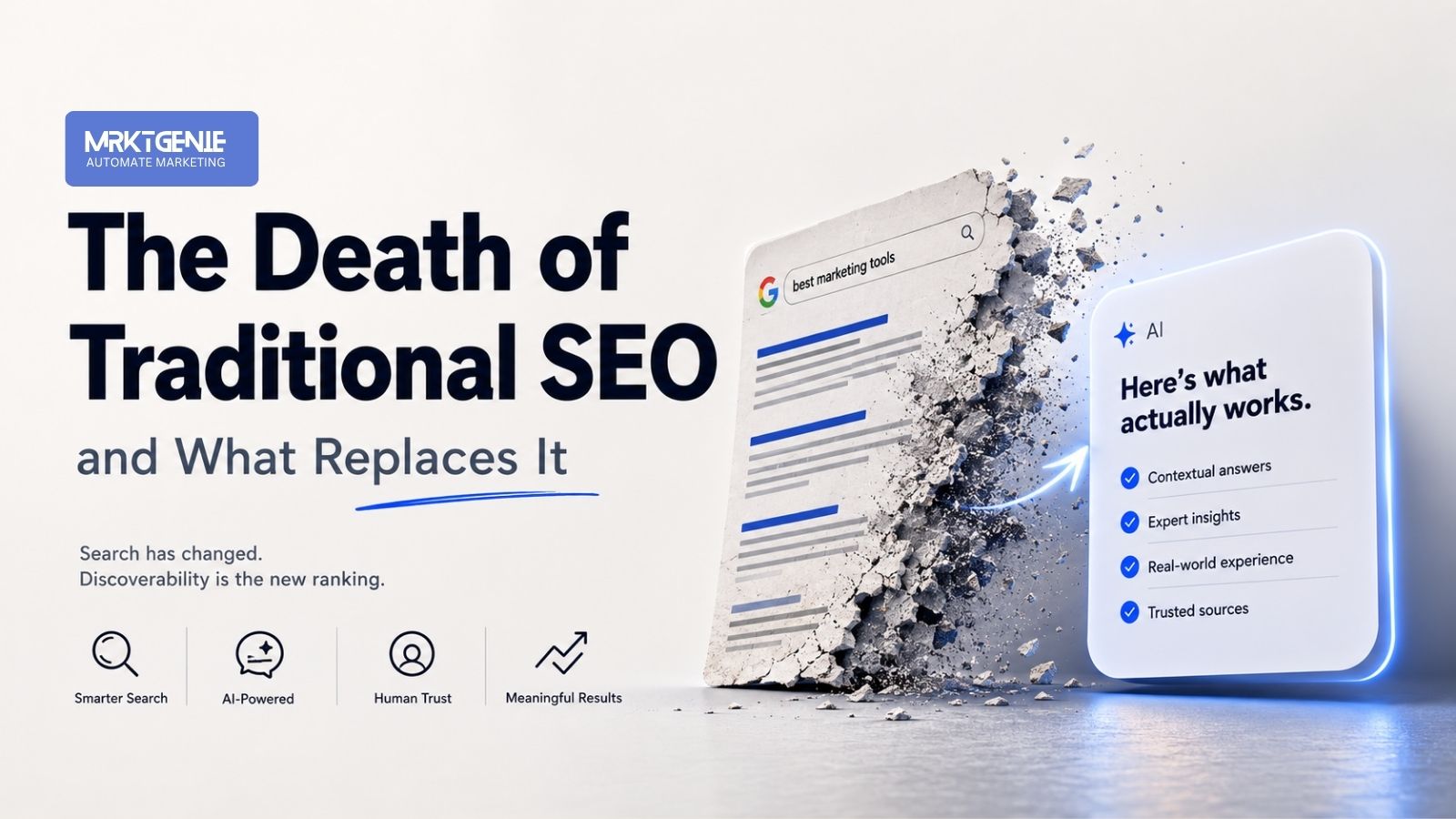
Three years ago, a founder could publish a decent blog post, sprinkle in the right keywords, collect a few backlinks, and watch qualified traffic arrive like clockwork. Now the same founder opens Search Console, sees impressions rising, clicks falling, and feels a very specific kind of anger: “We did everything right. Why is search sending less?”
If that sounds familiar, this article is for you. Not for the enterprise SEO team with a 40-page reporting deck. For the founder, content lead, or lean marketer who kept hearing that SEO compounds, only to discover that the rules changed halfway through the game. The painful truth is not that SEO died. It is that the version most people learned became obsolete while they were still optimizing title tags.
The real reader, and the real problem
The reader here is usually one of three people: a founder trying to grow without burning cash on ads, a startup marketer under pressure to prove organic ROI, or a content operator who built a traffic machine and now feels it slipping.
The problem is not “how do I rank higher?” The real problem is harsher: how do you stay discoverable when search engines increasingly answer the question themselves?
The recurring frustration is familiar. You publish useful content. It gets indexed. It may even rank. But fewer people click because the summary, the comparison, or the basic answer is already sitting above your result.
The misconception is that SEO is still mostly a keyword-ranking game. The costly mistake is producing interchangeable content for a search engine that no longer needs your page to answer simple queries.
What do you actually want? Not vanity traffic. You want qualified discovery, trust, and conversions from people who see you as the best answer, not just another blue link.
Search behavior changed before most teams noticed
Watch how people search now and the old playbook starts to look strange.
A founder researching “best CRM for small recruiting firm” does not behave like a user from 2018. She might start on Google, skim an AI Overview, open Reddit, ask ChatGPT to summarize tradeoffs, check YouTube for workflow demos, then search LinkedIn to see what operators actually recommend. That is not one search. That is a decision journey spread across answer engines, communities, and media formats.
This is why so many teams feel like their SEO “suddenly” stopped working. It did not stop. User behavior fragmented.
Traditional SEO assumed a mostly linear path: query, SERP, click, website. Modern discovery is messier. It looks more like assembling a jury. The buyer collects testimony from Google, AI assistants, forums, creators, product pages, and peers. Your website is one witness, not the whole case.
If you want a deeper look at this shift, The Future of Search Is Conversations, Not Keywords explains why discoverability increasingly depends on how well your brand can be retrieved in conversational environments, not just ranked in traditional search.
What this means in practice
- Fewer searches end in clicks for simple informational queries.
- More buyers validate information across multiple platforms before trusting it.
- Brand familiarity matters more because users often choose from summaries, not long result lists.
- Content must work as source material for humans and machines.
The old question was: “How do we rank for this keyword?” The better question now is: “Where does our audience form confidence, and are we visible there?”
AI Overviews did not kill content. They killed lazy content economics.
Here is the contradiction many teams still resist: AI search features are bad for low-effort publishers and good for genuinely useful experts.
Think about all the articles that used to win because they were merely organized well. “What is X?” “Top 10 Y tools.” “Benefits of Z.” Those pages often existed to capture clicks, not to contribute insight. AI Overviews are brutally efficient at compressing that kind of content into a paragraph. And honestly, users like that.
A content lead at a SaaS company once told me, “Our traffic dropped 28%, but demos did not.” That sounds alarming until you see what happened underneath. Their glossary posts got cannibalized by AI summaries. Their implementation guides, comparison pages, and experience-driven articles kept attracting serious buyers. They lost weak traffic and retained high-intent discovery.
That is the part many people miss. AI Overviews do not affect all content equally. They hit generic, top-of-funnel, low-novelty content hardest. They have less power over content with original data, lived experience, nuanced comparisons, product workflows, customer stories, or strong points of view.
A simple test for vulnerability
Ask this uncomfortable question about any page you publish: if an AI model read ten similar articles, could it produce a good enough answer without needing ours?
If the answer is yes, you are competing in the most fragile layer of SEO.
If the answer is no because your page contains field-tested insights, screenshots, failures, edge cases, customer language, or first-hand analysis, you are building something harder to compress.
This is also why Why “Thought Leadership” Content Usually Fails matters here. Most so-called thought leadership is just polished repetition. AI is exposing that weakness faster than any algorithm update ever did.
Topical authority is replacing keyword opportunism
There was a time when companies treated SEO like coupon clipping. Find a keyword with volume, low difficulty, and decent CPC. Write a post. Repeat. It worked, until it didn’t.
Answer engines reward a different pattern. They are more likely to trust sources that demonstrate repeated depth around a topic, not one-off participation. In other words, the future belongs less to the site that wrote one decent article on a subject and more to the site that has become unmistakably associated with that subject.
Imagine two companies selling product analytics software.
The first publishes scattered posts: “best productivity apps,” “startup growth hacks,” “how to write meeting notes,” and one article on event tracking.
The second publishes a structured library: event taxonomy design, instrumentation mistakes, warehouse-native analytics tradeoffs, implementation checklists, case studies, onboarding patterns, and side-by-side comparisons with screenshots and commentary.
Which one is more likely to become the source an AI system cites, summarizes, or learns to trust? Which one feels safer to a buyer?
Topical authority is not just an SEO concept anymore. It is a trust architecture.
How to build it without creating a content graveyard
- Pick a narrow territory your product can credibly own.
- Build clusters around real buyer questions, not random volume.
- Cover beginner, intermediate, comparison, and implementation intent.
- Update old pieces so your body of work feels coherent.
- Connect educational content to product-adjacent use cases.
For founders, one of the smartest approaches is to align content clusters with product reality. SEO for Founders: Build Topic Clusters That Map to Your Product Roadmap is a practical example of how to do this without publishing disconnected articles that never convert.
The key shift is simple: stop asking, “What keywords can we rank for?” Start asking, “What category of problems should we become the most trusted teacher on?”
Experience-driven content is becoming the new moat
Most teams still underestimate how obvious generic content has become.
You can feel it within seconds. The article says the right things, in the right order, with the right subheadings, but it has no fingerprints on it. No scars. No decisions. No tradeoffs. No evidence that a human actually learned something the hard way.
Readers notice. So do AI systems trained to detect patterns of expertise and source quality.
The content that survives this era is not necessarily longer. It is more lived-in.
A memorable example: one bootstrapped founder wrote a piece about migrating from one billing platform to another. Not a generic comparison. A real postmortem. What broke, which assumptions failed, how long reconciliation took, what the support experience was like, and what she would do differently. That article brought fewer visits than a broad “best billing tools” post would have. But the people who found it were exactly the right people, and several became customers because they trusted someone who had clearly done the work.
This is the same reason generic startup messaging gets ignored. Why Users Ignore Generic Startup Claims shows how specificity creates credibility. Search content now follows the same rule.
What experience-driven content looks like
- Original examples from your product, customers, or workflow.
- Failure stories and lessons learned.
- Screenshots, scenarios, and decision criteria.
- Comparisons with actual tradeoffs, not fake neutrality.
- Insights pulled from customer interviews, support tickets, and onboarding calls.
If you are wondering where to get material that does not sound machine-made, the answer is usually not “brainstorm harder.” It is “listen better.” Turn Customer Interviews Into a Content Engine is useful because it turns customer language and friction into content assets with much stronger search and conversion value.
Multi-platform discoverability is the new SEO layer most brands ignore
One of the most expensive mistakes in modern search is believing your blog is the entire discoverability strategy.
It is not.
Let’s say someone hears about your category for the first time. They search Google. Then they ask ChatGPT for alternatives. Then they add “Reddit” to the query because they want uncensored opinions. Then they watch a YouTube walkthrough because they do not trust static screenshots. Then they check LinkedIn to see whether real operators mention your company. If you only exist on your website, you look smaller than you are.
This is where traditional SEO teams can become dangerously narrow. They optimize pages while the market is evaluating reputation.
Discoverability now spans:
- Your website and knowledge base
- Review sites and comparison pages
- Reddit, Quora, niche communities, and forums
- YouTube demos and creator mentions
- LinkedIn posts, founder content, and comment presence
- Podcasts, newsletters, and third-party citations
A surprising number of brands are invisible in the places that shape buying confidence. They rank, but they do not resonate.
This is why founder-led visibility matters more than many SEO purists want to admit. Why Every Founder Suddenly Wants a Personal Brand is really about discoverability under new trust conditions. People trust people faster than they trust polished brand pages.
And if your team is over-fixated on the same crowded channels as everyone else, The Best Growth Channel Might Be One You’re Ignoring is a useful reminder that visibility often compounds faster in underpriced spaces than in saturated ones.
A practical reframing
SEO used to mean optimizing for search engines. Now it increasingly means optimizing for searchable presence.
That includes being cited, discussed, recommended, compared, and remembered across the web.
Future SEO strategies will look more like media strategy and product education
If traditional SEO was partly a technical discipline, future SEO is becoming a hybrid of editorial judgment, product marketing, customer research, and distribution.
The winners will not be the teams that publish the most. They will be the teams that make themselves easiest to trust and easiest to retrieve.
What replaces traditional SEO, practically
Build around problems, not just keywords. A keyword is a clue. A problem is a strategy.
Create source-worthy content. Publish material that a human or AI system would want to cite because it contains evidence, nuance, or original perspective.
Develop topic depth. Own a meaningful territory instead of scattering attention across unrelated terms.
Turn product knowledge into educational assets. Your implementation lessons, support patterns, and customer objections are content gold.
Design for multiple surfaces. A blog post should be adaptable into a LinkedIn post, a YouTube script, a founder comment, a sales asset, and an FAQ snippet.
Invest in entity and brand strength. The more often your brand appears in credible contexts, the more likely it is to be selected, recalled, and trusted.
Measure beyond clicks. Watch branded search, assisted conversions, direct traffic, demo quality, and mentions in sales calls.
There is a broader lesson here. Search is no longer rewarding content factories as reliably as it once did. It is rewarding companies that behave like useful publications and credible operators.
That shift can feel unfair if you were trained on the old system. But it is actually healthier. It pushes brands toward substance.
The founders who win will stop treating SEO like a loophole
Every era of marketing creates its own temptation. In one era, it was keyword stuffing. In another, it was backlink schemes. Then it became AI-scaled content volume. The underlying fantasy is always the same: maybe there is a shortcut that lets us appear authoritative without doing the slower work of becoming authoritative.
That fantasy is collapsing.
The replacement for traditional SEO is not one tactic. It is a posture.
Teach what you know. Document what you have seen. Answer what buyers are really worried about. Show your work. Be present where decisions are formed. Build a body of content that sounds like it came from someone who has been in the room, not someone summarizing from outside it.
Because that is what search is becoming: not a contest for who can publish the most pages, but a filter for who seems most worth trusting.
And if your traffic graph has been humbling lately, that does not necessarily mean you are losing. It may mean the internet is finally becoming less generous to generic answers.
Good. That creates room for better ones.