A founder spends six months building a product nobody quite understands, then posts, “We just launched on Product Hunt.” Twelve likes. Two pity comments. One signup from a friend.
Meanwhile, a YouTuber films a video called “I Wasted $10,000 Testing Morning Routines,” and within 48 hours, strangers are arguing in the comments, sharing clips, and waiting for the next upload.
If that contrast annoys you, good. It should.
Because most startup founders still believe attention follows merit. Build something useful, explain it rationally, and the market will reward you. But the market is not a judge. It is a distracted person with 17 tabs open, a Slack notification blinking, and no patience for your beautifully engineered feature set.
YouTubers understand this better than most founders do. Not because they are shallow, but because they are forced to confront reality every day. If people click away in 12 seconds, the video dies. If the title creates curiosity but the opening disappoints, the audience vanishes. If the pacing drags, retention drops. The feedback loop is brutal and immediate.
Founders need more of that brutality.
Especially early-stage founders who keep asking, “Why is nobody paying attention?” when the real question is, “Why would they?” If that sounds familiar, you’ll probably also recognize the deeper frustration: you know your product can help people, but your messaging feels flat, your content gets ignored, and every growth channel seems noisier than the last.
The costly mistake is thinking this is mainly a distribution problem. Often it is an attention design problem. And creators, especially YouTubers, have become some of the best attention designers on the internet.
Here’s what startup founders can learn from them.
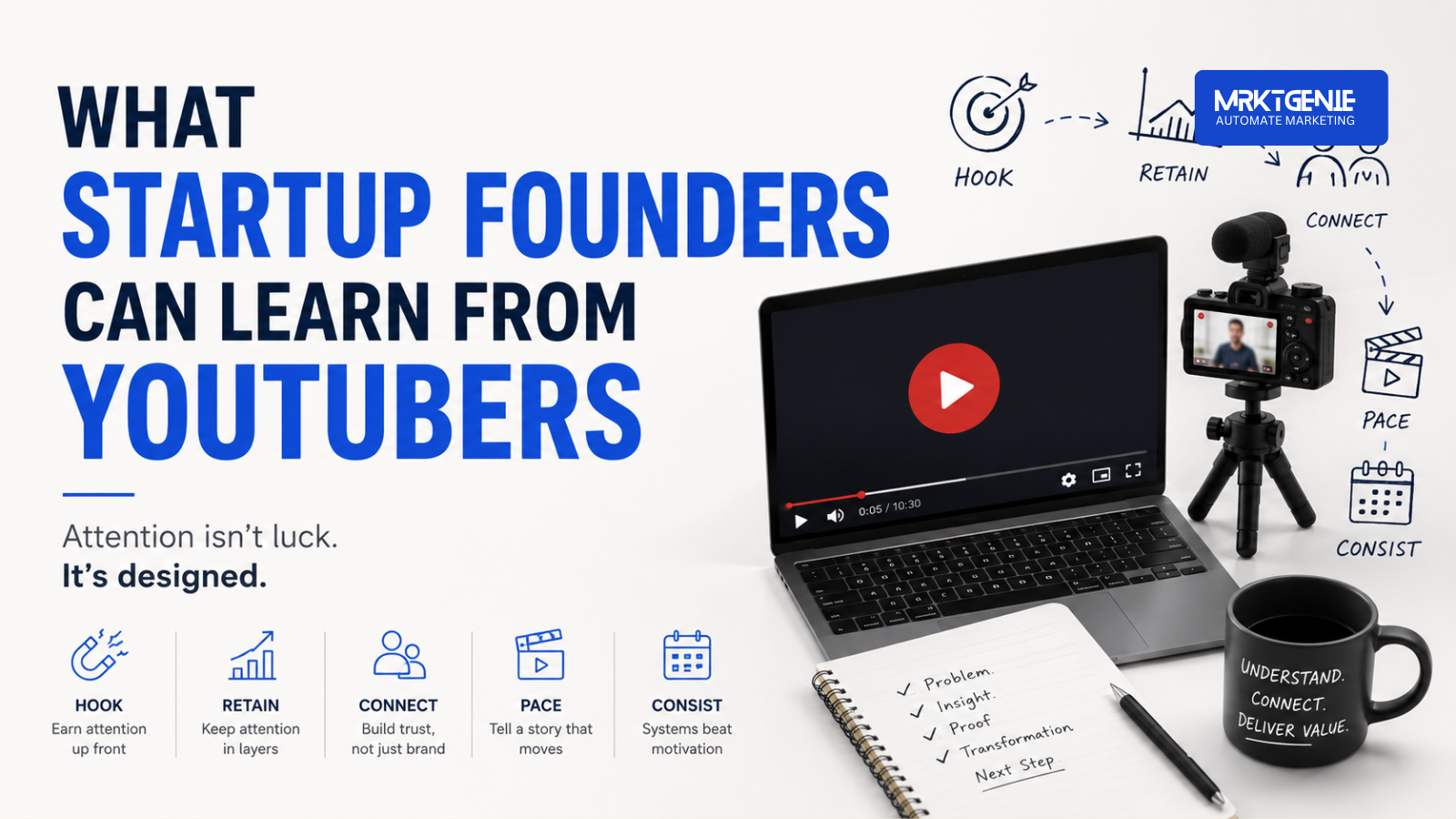
1. Hook mechanics: You do not earn attention up front
A common founder mistake is opening with context they think is necessary.
“We built an AI-powered workflow orchestration layer for modern RevOps teams...”
That sentence may be accurate. It is also the content equivalent of being handed a user manual at a party.
YouTubers know the first few seconds carry an unfair burden. They do not start by introducing themselves, thanking subscribers, and explaining the background in chronological order. The good ones begin with tension.
Something broke. Something surprising happened. A promise was made. A contradiction appeared.
Think about the difference between these two startup homepage openings:
Version A: “All-in-one customer success platform for scaling SaaS teams.”
Version B: “Your best customers are quietly churning during onboarding. Here’s how to catch it before month two.”
One names a category. The other opens a loop.
This is where many founders get messaging wrong. They assume clarity means compression into abstract category language. But attention usually comes from specificity, stakes, and tension. That is also why so many founder posts flop on LinkedIn: they explain before they provoke. If that pattern sounds familiar, this breakdown of why founder content gets ignored on LinkedIn will feel painfully recognizable.
A hook is not clickbait when the payoff is real. It is simply respect for the fact that nobody wakes up hoping to read your positioning statement.
What founders should do instead
- Lead with the expensive problem, not the product category.
- Start with a tension customers already feel.
- Make a promise the rest of the page, post, demo, or video can fulfill.
A simple founder hook framework: problem, consequence, curiosity.
For example: “Most user research fails before the first interview. Not because founders ask bad questions, but because they talk to the wrong people.”
Now I want to know more.
2. Retention psychology: Attention is won in layers, not once
Here is the part founders often miss: getting the click is not the same as keeping the mind.
YouTubers obsess over retention graphs because they reveal the truth people are too polite to say out loud. The audience is not leaving because they are “busy.” They are leaving because the content stopped rewarding attention.
Startup funnels work the same way.
A visitor clicks your ad or article. They land on your page. They scan your headline. They half-read your subhead. They wonder if this is for them. They look for proof. They search for friction. They decide whether to continue. Every step is a miniature retention test.
I once watched a founder proudly show me a landing page with strong traffic and terrible conversion. The page had testimonials, feature grids, integrations, polished design. On paper, it looked solid. In practice, it lost people instantly. Why? The first screen never answered the nervous question in the visitor’s head: “Am I in the right place?” It talked about the product’s architecture before the user could even identify their own problem.
That is why so many startup websites fail in seconds. Not because they look amateur, but because they force the visitor to do interpretive labor. This is exactly the issue behind why most startup websites fail in 5 seconds.
YouTubers solve retention by constantly renewing interest. They use pattern interrupts, open loops, progress markers, emotional variation, and concrete payoffs. Founders can do the same.
Retention lessons startups can borrow
- Answer “Is this for me?” immediately.
- Reduce cognitive load. Fewer abstractions, more concrete scenarios.
- Show progress. “Here’s what you’ll learn,” “Here’s what happens next,” “Here’s the result.”
- Break dense information into rewarding beats: pain, insight, proof, example, next step.
Imagine your homepage like a video timeline. Every scroll should earn the next scroll.
If your page says, “AI-powered insights for enterprise productivity,” many visitors leave.
If it says, “Your team is wasting 9 hours a week searching across Slack, Notion, and docs. Find answers in one search,” more people stay. Not because the second version is prettier. Because it pays attention back.
3. Audience relationships: Customers do not just buy products, they follow interpreters
One reason creators outperform companies in attention is simple: people trust people faster than they trust brands.
Founders often resist this. They want the product to speak for itself. They want professionalism, polish, distance. They fear that showing too much personality will make the company seem smaller.
Usually the opposite happens.
The internet increasingly rewards interpreters, not just builders. The person who can explain what is changing, what matters, what to ignore, and what to do next becomes valuable long before the company becomes famous.
YouTubers understand this instinctively. Their audience returns not only for information, but for orientation. A viewer thinks, “I want to see how this person sees the world.”
That is a serious startup lesson.
If you are an early-stage founder, your audience is not waiting for perfect brand messaging. They are looking for a credible guide. Someone who understands the problem from the inside. Someone who can name the frustration more clearly than they can.
This is why personality has become a strategic advantage, not a vanity project. The new attention economy rewards personality because personality is often the shortest path to trust, memorability, and differentiation.
A founder in B2B cybersecurity once told me, “Our market is too serious for creator-style content.” Then he started posting short breakdowns of real security mistakes teams make during vendor evaluation. No dancing. No gimmicks. Just sharp, opinionated analysis from lived experience. Prospects began referencing his posts on sales calls. Why? Because he stopped sounding like a brochure and started sounding like a person who had seen the movie before.
What this means for founders
- Teach from scars, not just theories.
- Share judgments, not only information.
- Let your audience understand how you think, not merely what you sell.
- Build familiarity before asking for conversion.
People rarely say, “I trust this startup because the feature matrix was comprehensive.”
They say, “These people get it.”
4. Story pacing: Most startup communication is emotionally flat
Watch enough founder demos and you notice the same problem: all signal, no rhythm.
Feature. Feature. Feature. Architecture. Dashboard. Workflow. Integration. Pricing. Demo complete.
It is like listening to a song played on one note.
YouTubers know pacing is not decoration. It is structure. They vary intensity. They delay payoff. They compress boring transitions. They zoom in on meaningful moments. They know when to speed up and when to let a moment land.
Founders should think the same way about demos, onboarding, sales calls, launch announcements, and even blog posts.
Consider two product demos.
Demo one starts with a menu tour. The founder clicks through tabs, naming capabilities. The prospect nods politely and forgets everything an hour later.
Demo two starts with a scene: “Let’s say your ops lead gets asked a question five times a week: why did this account churn? Right now, the answer lives across call notes, CRM fields, support tickets, and tribal knowledge. Here’s what that looks like in your world. Now here’s what changes.”
That is pacing through narrative. The viewer has entered a situation, not a software walkthrough.
This matters in written content too. The best startup content does not just dump insights. It sequences them. It creates movement from recognition to tension to explanation to action. If you want a more systematic way to do that with business content, this guide to creating startup content that actually brings leads is useful precisely because it ties content structure to business outcomes.
A simple pacing model for founders
- Start with a recognizable problem scene.
- Intensify the cost of staying the same.
- Introduce the insight or mechanism.
- Show the transformation in a concrete example.
- End with the next decision, not just a vague summary.
Good pacing feels like being led. Bad pacing feels like being handed a pile.
5. Consistency systems: Creators do not rely on motivation nearly as much as founders think
Founders love to say they should “post more” or “create more content” once things calm down.
Things do not calm down.
This is one of the quiet reasons creators pull ahead. They build systems for output while founders wait for spare time, inspiration, or the mythical quarter when product, hiring, customer support, fundraising, and life all become manageable at once.
A YouTuber with a real publishing schedule does not wake up each week and ask, “What do I feel like making?” They have formats, production workflows, editorial instincts, reuse patterns, and feedback loops. Their consistency is operational, not emotional.
Founders need the same discipline if they want organic attention to compound.
That does not mean becoming a full-time content machine. It means designing a sustainable system around your actual constraints. For many founders, the better question is not “How do I post daily?” but “How do I turn one useful idea into multiple touchpoints without burning out?” That is exactly the logic behind turning one piece of content into 20 distribution assets.
One founder I know records a 20-minute customer debrief every Friday. From that single conversation, his team extracts one blog angle, three LinkedIn posts, two email insights, one demo objection response, and one FAQ update. He is not “being a creator” in the caricatured sense. He is operationalizing learning.
That is the shift.
Consistency systems founders can copy
- Create recurring formats: teardown, customer mistake, founder memo, product lesson, industry myth.
- Batch capture, then repurpose.
- Use customer calls as raw material, not isolated events.
- Set a cadence you can survive for six months, not six days.
If you want visibility without feeling like you have to live online, this approach to building startup visibility without becoming chronically online is the sane version most founders actually need.
6. Applying creator lessons without becoming gimmicky
At this point, some founders recoil. They hear “learn from YouTubers” and imagine fake thumbnails, exaggerated claims, and shallow content dressed up as growth strategy.
That is the wrong takeaway.
The lesson is not to imitate creator aesthetics. It is to adopt creator discipline around human attention.
You do not need to become louder. You need to become more watchable, more readable, more relatable, and more rewarding.
That starts with understanding a hard truth: many startup marketing problems are really message-market empathy problems. Founders often talk from inside the product instead of inside the customer’s moment. They describe what they built, not what the buyer is trying to escape.
If your startup is not growing, there is a good chance the issue is not just channel selection. It may be that your messaging and market understanding are still misaligned. This explanation of the hidden reason startups stall gets to the heart of that.
A practical creator-inspired framework for founders
Before publishing a homepage, post, email, demo, or pitch, ask:
- What is the hook? Why would someone care in the first 5 seconds?
- Where does curiosity increase?
- Where might attention drop?
- What specific frustration am I naming?
- What proof reduces disbelief?
- What emotional state is the audience in when they arrive?
- What do I want them to feel by the end: relieved, understood, urgent, confident?
This is not fluff. It is buyer psychology.
The best founders eventually realize that attention is not separate from product. It is part of product adoption. If people do not stay long enough to understand the value, value may as well not exist.
Creators are not winning because they have audiences. They have audiences because they learned how attention actually works.
And founders who learn that lesson early stop making one of the most expensive mistakes in startups: confusing being useful with being noticed.
Your product may be strong. Your market may be real. Your customers may genuinely need what you built.
But if your message does not hook, your page does not retain, your voice does not build trust, your story does not pace itself, and your system does not produce consistently, you will keep reliving the same discouraging cycle: good work, weak response, private frustration.
YouTubers can teach you how to break that cycle.
Not by turning your startup into entertainment.
By reminding you that on the internet, the first job is not to be impressive.
It is to make people stay.