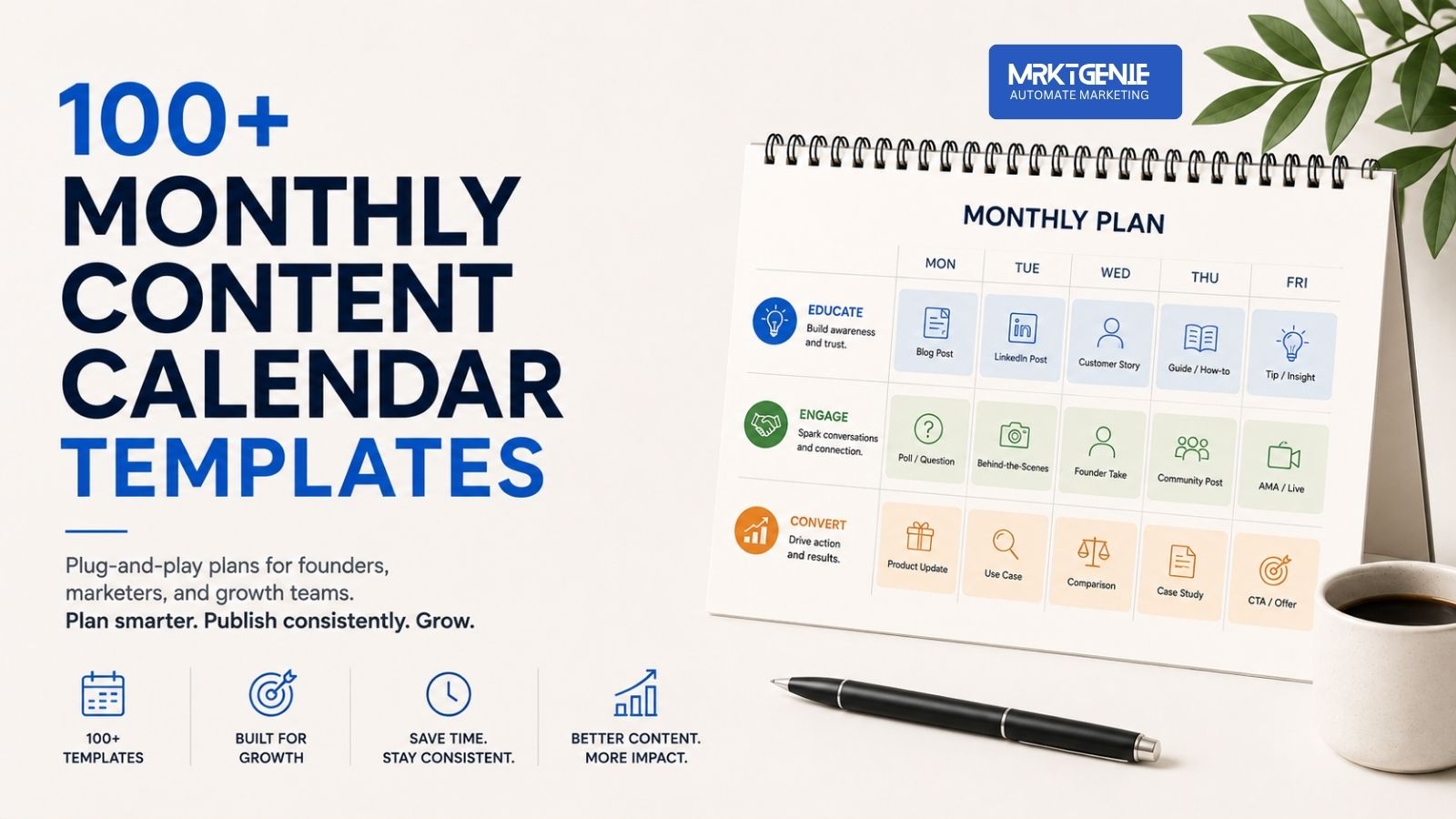
Most content calendars fail before the month even starts.
Not because the team is lazy. Not because the ideas are bad. They fail because someone opens a blank spreadsheet on the 28th, types “Week 1: thought leadership,” “Week 2: product post,” “Week 3: case study,” and mistakes categories for strategy. Two weeks later, the posts feel random, the founder hates everything, the pipeline looks unchanged, and everyone quietly decides content “doesn’t work for us.”
If that felt uncomfortably familiar, this article is for you. You are probably a founder, solo marketer, small startup team, agency operator, or growth lead who does not need more advice about consistency. You need a content calendar that tells you what to publish, why it matters, and how it connects to revenue, trust, and attention. That is what these 100+ monthly content calendar templates are for: plug-and-play plans for B2B, SaaS, marketplaces, agencies, and AI startups.
Who these content calendar templates are for
Let’s name the real reader, because most content advice talks to a fictional marketer with unlimited time and a 12-person team.
This is for the person who is juggling too much. Maybe you are the founder writing LinkedIn posts between product calls. Maybe you are the first marketing hire trying to make content look strategic before there is enough data. Maybe you run an agency and every client wants “consistent content” but cannot explain what that means. Maybe you are at an AI startup where the market changes every week and yesterday’s angle is already stale.
Your problem is not a lack of channels. It is a lack of structure.
The recurring frustration is this: every month starts with optimism and ends with rushed posts, recycled ideas, and a vague feeling that the team is producing noise instead of momentum.
The common misconception? That a content calendar is just a publishing schedule.
It is not. A real content calendar is a decision system. It decides what deserves attention, which audience pain points repeat, how often to educate versus convert, and when to talk about the product without sounding desperate.
The costly mistake many teams make is planning content around what they want to say instead of what the buyer is trying to figure out. That mistake creates polished irrelevance.
The outcome you actually want is simpler: fewer blank-page moments, better content-market fit, and a monthly plan your team can execute without reinventing the strategy every Monday.
Why most monthly content plans collapse
I once watched an early-stage SaaS team spend three hours planning a month of content. The board looked organized. There were color-coded rows, campaign labels, even a column for “virality potential.” It looked impressive. It also produced almost nothing useful.
Why? Because the calendar was built around formats, not customer questions.
“One blog, two LinkedIn posts, one founder story, one product update” sounds like a plan. But a buyer never wakes up thinking, “I hope a startup posts a founder story today.” They wake up thinking, “Why is this workflow still broken?” “What tool fits our stack?” “How do I justify this to my boss?” “What happens if we choose wrong?”
That is the shift. Good calendars are not format-first. They are pain-first and intent-aware. If you have not built your content around real customer pain yet, read how to turn customer pain points into growth content. It will save you from publishing content that sounds busy but changes nothing.
What makes a plug-and-play content calendar actually useful
A useful template does four things.
- It gives you a repeatable monthly structure.
- It balances audience trust, product education, and conversion intent.
- It maps content to a business model, not just a social feed.
- It reduces decision fatigue.
Think of it like meal prep for marketing. The goal is not culinary artistry every night. The goal is not staring into the fridge at 8:40 p.m. wondering what to do. Content teams have the same problem. They do not fail from lack of ideas. They fail from too many disconnected ones.
So below, you will find 100+ monthly content calendar templates grouped by company type. Use them as-is, mix them, or adapt them to your funnel.
How to use these monthly content calendar templates
Before copying a template, answer three questions.
- What stage is the buyer in?
- What proof do they need next?
- What action should this month’s content make easier?
If you skip those questions, even a good template becomes decoration.
A practical rule: build each month with a 40/40/20 split.
- 40% problem-aware content
- 40% solution and trust-building content
- 20% product or conversion content
Most startups reverse this. They spend 70% talking about themselves, then wonder why nobody cares. There is a reason articles like why nobody cares about your startup yet resonate so much: the market usually ignores self-centered content.
B2B monthly content calendar templates
B2B buyers are rarely buying with pure enthusiasm. They are buying with caution, internal politics, and risk in mind. Your calendar should reflect that.
Template 1: Problem-Education Month
- Week 1: Publish a post explaining a costly industry mistake buyers keep repeating.
- Week 1: Share a founder or operator take on why that mistake persists.
- Week 2: Publish a customer-pain article based on support calls or sales objections.
- Week 2: Create a short social post with one surprising stat or observation.
- Week 3: Publish a comparison of old workflow versus modern workflow.
- Week 3: Send an email with a practical checklist.
- Week 4: Publish a soft product tie-in showing how the problem can be solved.
- Week 4: Repurpose the month into a carousel or LinkedIn thread.
Template 2: Objection-Handling Month
- Week 1: “Why change now?” article.
- Week 1: FAQ social post answering the top buyer hesitation.
- Week 2: Case study focused on implementation fear.
- Week 2: Founder post about a common wrong assumption in the category.
- Week 3: ROI explainer with simple numbers.
- Week 3: Sales-enablement email for warm leads.
- Week 4: Competitor-alternative article.
- Week 4: Product demo clip tied to one objection.
Template 3: Category Authority Month
- Week 1: Contrarian opinion on where the market is headed.
- Week 1: Short post reacting to a trend with nuance.
- Week 2: Deep educational guide on a core category topic.
- Week 2: Expert roundup or internal team insights.
- Week 3: Framework post buyers can use immediately.
- Week 3: Founder commentary on tradeoffs in the market.
- Week 4: Product perspective without hard selling.
- Week 4: Newsletter summarizing key lessons.
Template 4: Buyer Journey Month
If your B2B pipeline is messy, your content probably is too. A cleaner approach is to map content to awareness stages. The article on what to publish for each stage of the buyer journey goes deeper, but here is the monthly version:
- Week 1: Problem-aware article.
- Week 2: Solution-aware comparison.
- Week 3: Vendor-evaluation checklist.
- Week 4: Onboarding or adoption content.
More B2B content calendar ideas
- Analyst insight month
- Procurement objection month
- Internal buy-in month
- Use-case spotlight month
- Compliance and risk month
- Industry myth-busting month
- Customer interview month
- Executive education month
- Multi-stakeholder buying committee month
- Retention and expansion month
SaaS monthly content calendar templates
SaaS teams often produce two kinds of weak content: generic SEO posts no buyer remembers, or product updates no non-user cares about. The better path sits in the middle. Teach the market, then connect the lesson to workflow change.
Template 1: Feature-to-Problem Month
A founder once told me, “We shipped six features and nobody noticed.” That usually means the team announced features, not outcomes.
- Week 1: Article on the workflow pain behind the feature.
- Week 1: Social post showing the old manual process.
- Week 2: Feature launch article framed around time saved or errors reduced.
- Week 2: Short tutorial video.
- Week 3: Customer scenario showing who benefits most.
- Week 3: FAQ post on setup friction.
- Week 4: Case study or internal usage example.
- Week 4: Email roundup linking all assets.
If your team struggles to turn releases into real content, use this alongside this feature launch playbook.
Template 2: SEO Cluster Month
- Week 1: Publish a pillar article tied to a core product problem.
- Week 1: Publish one supporting long-tail article.
- Week 2: Publish another supporting article based on a product use case.
- Week 2: Create a LinkedIn post summarizing one insight.
- Week 3: Publish a comparison or alternatives article.
- Week 3: Update internal links across the cluster.
- Week 4: Send a newsletter featuring the cluster.
- Week 4: Add product CTAs based on page intent.
If you want a stronger structure here, read how to build topic clusters that map to your product roadmap.
Template 3: Retention Content Month
Many SaaS companies act like content stops mattering after signup. That is expensive. Churn often starts with confusion, not dissatisfaction.
- Week 1: Publish onboarding friction guide.
- Week 1: Email with quick-start checklist.
- Week 2: Publish best-practices article for activation.
- Week 2: Share a customer example of successful setup.
- Week 3: Publish advanced workflow tutorial.
- Week 3: In-app content or help article snippet.
- Week 4: Publish common mistakes post.
- Week 4: Invite users to webinar or office hours.
This works especially well if you borrow ideas from post-purchase pain content for reducing churn.
Template 4: Founder-Led SaaS Month
- Week 1: Founder story about why the problem mattered enough to build.
- Week 1: Opinion post on a broken industry habit.
- Week 2: Behind-the-scenes product decision post.
- Week 2: Customer lesson from recent calls.
- Week 3: Build-in-public milestone with actual numbers or learnings.
- Week 3: Mini-demo with commentary.
- Week 4: Hard-earned lesson from a failed experiment.
- Week 4: Product invitation or CTA.
More SaaS content calendar ideas
- Onboarding month
- Integration month
- Alternatives and comparison month
- Persona-specific month
- Activation month
- Use-case expansion month
- Customer proof month
- Support-ticket insight month
- AI feature education month
- Workflow transformation month
Marketplace monthly content calendar templates
Marketplaces have a harder content job because they are not speaking to one audience. They are speaking to both sides of the transaction, and each side has different fears.
A marketplace founder once said, “Our buyers want quality, our sellers want demand, and our content somehow satisfies neither.” Exactly. If your calendar is too broad, both sides feel unseen.
Template 1: Supply-Side Growth Month
- Week 1: Publish “how top sellers succeed” article.
- Week 1: Seller spotlight social post.
- Week 2: Publish pricing or listing optimization guide.
- Week 2: Share mistakes new sellers make.
- Week 3: Publish demand trends report or insight.
- Week 3: Founder commentary on what buyers actually value.
- Week 4: Publish onboarding checklist for new suppliers.
- Week 4: Email campaign to inactive sellers.
Template 2: Demand-Side Trust Month
- Week 1: Buyer guide for choosing the right provider or product.
- Week 1: Social post on common selection mistakes.
- Week 2: Publish quality standards or vetting process explainer.
- Week 2: Share customer success story.
- Week 3: Publish comparison article around options or categories.
- Week 3: FAQ on safety, pricing, or fulfillment concerns.
- Week 4: Publish “what good looks like” checklist.
- Week 4: Conversion-focused landing page update.
Template 3: Liquidity Month
Most marketplace content ignores the one thing that matters most: making the market feel active. A restaurant with no one inside scares people away. A marketplace with stale content does the same.
- Week 1: Publish recent transaction or booking trend insights.
- Week 1: Share popular categories this month.
- Week 2: Spotlight one successful match between both sides.
- Week 2: Publish “who is joining now” content.
- Week 3: Share region, niche, or category demand trends.
- Week 3: Publish time-sensitive opportunities.
- Week 4: Create roundup of market activity.
- Week 4: Encourage signups with proof of momentum.
More marketplace content calendar ideas
- Trust and safety month
- New category launch month
- Geographic expansion month
- Power user spotlight month
- Transaction education month
- Supply-demand imbalance month
- Seasonal demand month
- Community and referral month
- Pricing transparency month
- Quality control month
Agency monthly content calendar templates
Agencies often create excellent content for clients and strangely weak content for themselves. Why? Because when selling your own service, you start sounding like every other agency on earth: results-driven, full-service, data-backed, bespoke. Buyers have heard it all before.
If your messaging feels vague, it is usually because your claims are broad and your proof is thin. That is why generic claims get ignored, whether you are a startup or a service business.
Template 1: Expertise Proof Month
- Week 1: Publish teardown of a client problem you solved.
- Week 1: Social post with one sharp before-and-after lesson.
- Week 2: Publish process article showing how you approach a problem.
- Week 2: Share a common misconception buyers have.
- Week 3: Publish mini case study with one metric and one decision.
- Week 3: Founder or strategist opinion post.
- Week 4: Publish “who we are best for” article.
- Week 4: CTA to audit, consult, or strategy call.
Template 2: Client Objection Month
- Week 1: “Why agencies fail clients” article.
- Week 1: Post on how to evaluate an agency partner.
- Week 2: Publish pricing philosophy article.
- Week 2: Share what clients should expect in first 30 days.
- Week 3: Publish communication and reporting framework.
- Week 3: Share a story of rescuing a bad engagement.
- Week 4: Publish fit-disqualifier article to repel wrong leads.
- Week 4: Email warm prospects with trust-building content.
Template 3: Niche Authority Month
- Week 1: Publish one deep insight about your niche market.
- Week 1: Share a contrarian take.
- Week 2: Publish buyer psychology article for that niche.
- Week 2: Create a checklist specific to that audience.
- Week 3: Share tools, process, or campaign examples.
- Week 3: Publish a mini trend report.
- Week 4: Publish case study from that vertical.
- Week 4: CTA focused on niche fit.
More agency content calendar ideas
- Audit month
- Case study month
- Founder perspective month
- Niche-specific month
- Sales objection month
- Behind-the-scenes process month
- Client education month
- Offer repositioning month
- Team expertise month
- Referral partner month
AI startup monthly content calendar templates
AI startups face a strange problem. There is enormous interest, but trust is thin. Everyone claims intelligence. Few explain usefulness. Buyers are curious, skeptical, and exhausted at the same time.
That means your content cannot just sound futuristic. It has to sound credible.
Template 1: AI Reality Check Month
- Week 1: Publish “what AI can do well today” article.
- Week 1: Publish “what AI still does badly” social post.
- Week 2: Share a practical workflow example with boundaries.
- Week 2: Founder post on where hype misleads buyers.
- Week 3: Publish implementation guide for one role or team.
- Week 3: FAQ on risk, hallucinations, privacy, or oversight.
- Week 4: Product walkthrough tied to one realistic use case.
- Week 4: Customer proof or pilot outcome.
Template 2: Trust-Building Month
- Week 1: Explain your data handling and model choices in plain language.
- Week 1: Share your product limitations honestly.
- Week 2: Publish case study with human review process.
- Week 2: Social post on where automation should stop.
- Week 3: Publish expert commentary on AI adoption mistakes.
- Week 3: Show internal quality-control workflow.
- Week 4: Publish customer onboarding expectations.
- Week 4: Invite readers to trial or live demo.
Template 3: Use-Case Expansion Month
- Week 1: Publish one core use-case article.
- Week 1: Share role-specific social post for one persona.
- Week 2: Publish second use case in another department.
- Week 2: Share objection handling for that persona.
- Week 3: Publish third use case with workflow screenshots or examples.
- Week 3: Compare manual process versus AI-assisted process.
- Week 4: Publish “which use case fits you?” guide.
- Week 4: CTA to personalized demo.
Template 4: Expert Positioning Month
In AI, shallow content gets exposed quickly. If you want durable visibility, you need real experience, not content-farm volume. That is why AI search will reward experts, not content farms.
- Week 1: Publish original opinion on an AI market shift.
- Week 1: Share one nuanced disagreement with mainstream advice.
- Week 2: Publish a lessons-from-users article.
- Week 2: Share one failure or false start and what it taught you.
- Week 3: Publish implementation framework.
- Week 3: Share founder commentary on build versus buy decisions.
- Week 4: Publish category prediction grounded in evidence.
- Week 4: Offer product trial or consultation.
More AI startup content calendar ideas
- Prompt education month
- Human-in-the-loop month
- Model comparison month
- AI ethics and governance month
- Workflow replacement month
- Trust and transparency month
- AI myths month
- Role-specific adoption month
- Search behavior shift month
- Expert commentary month
50 more plug-and-play monthly content themes
If you need variety without inventing a strategy from scratch, here are additional monthly themes you can adapt across B2B, SaaS, marketplace, agency, and AI startup contexts.
- Customer interview month
- FAQ month
- Comparison month
- Case study month
- Founder's lessons month
- Industry myth month
- ROI month
- Onboarding month
- Retention month
- Activation month
- Power user month
- Beginner education month
- Advanced tactics month
- Product roadmap month
- Feature education month
- Workflow redesign month
- Time-saving month
- Error-reduction month
- Cost-of-inaction month
- Internal buy-in month
- Stakeholder alignment month
- Trend reaction month
- Contrarian opinion month
- Mini research month
- Customer language month
- Sales objection month
- Implementation month
- Migration month
- Alternatives month
- Persona spotlight month
- Role-based content month
- Team education month
- Community month
- Partner month
- Integration month
- Template month
- Checklist month
- Audit month
- Prediction month
- Mistakes month
- Behind-the-scenes month
- Transparency month
- Trust-building month
- Experiment month
- Win-loss analysis month
- Seasonal opportunity month
- Market shift month
- Use-case expansion month
- Customer success month
- Proof and credibility month
A simple monthly content calendar framework you can reuse
If you want one repeatable system instead of dozens of options, use this four-week structure.
Week 1: Expose the problem
Show the pain clearly. Name the hidden cost. Tell the truth buyers already suspect.
Week 2: Clarify the options
Compare approaches, explain tradeoffs, and help readers make sense of the category.
Week 3: Build trust with proof
Use examples, stories, customer results, founder experience, or operational detail.
Week 4: Connect to the product
Now you have earned the right to talk about your solution directly.
This sequencing matters. Selling before understanding feels like interruption. Selling after demonstrating insight feels like relief.
How to keep your calendar from becoming a graveyard of good intentions
Every team starts with ambition. Fewer teams survive contact with reality.
Three things usually break the system.
1. Planning too much custom content
If every post requires a new idea, new angle, new design, and founder approval, the calendar will collapse. Build around repeatable formats.
2. Ignoring distribution
A calendar without repurposing is half a plan. One article should become social posts, email copy, comments, sales follow-ups, and maybe even a video script. If your team needs help here, see how to turn one piece of content into 20 distribution assets.
3. Chasing volume over resonance
Four sharp posts that reflect buyer reality will beat twenty generic ones. Especially now, when AI has made average content nearly free. The premium is no longer production. It is specificity. That is also why founder teams should think carefully about using AI without sounding like everyone else.
A practical example: one month for an early-stage SaaS startup
Let’s make this concrete.
Imagine you sell project management software for small agencies. Here is a simple monthly calendar:
- Week 1 blog: Why agency projects go off track even when the team is busy.
- Week 1 LinkedIn post: The hidden cost of managing work in Slack and spreadsheets.
- Week 2 blog: Agency project management software comparison for small teams.
- Week 2 email: 7 signs your delivery process is creating invisible churn.
- Week 3 customer story: How one agency reduced missed deadlines by 30%.
- Week 3 founder post: What we learned watching agencies overcomplicate project ops.
- Week 4 product post: How our timeline and approval workflow solves handoff chaos.
- Week 4 carousel: Before-and-after agency workflow.
Notice the flow. It starts with pain, moves to evaluation, adds proof, then introduces the product. That is a calendar with psychological momentum, not just publishing rhythm.
Another example: one month for an AI startup
Imagine you offer an AI assistant for customer support teams.
- Week 1 blog: Where AI support assistants help most, and where they still fail.
- Week 1 social post: Three support tasks that should stay human.
- Week 2 blog: How to implement AI support without hurting trust.
- Week 2 founder note: The biggest misconception buyers have about AI automation.
- Week 3 case study: How a support team cut response time without increasing escalations.
- Week 3 FAQ post: How we handle hallucination risk and human review.
- Week 4 product walkthrough: Best-fit support workflows for our assistant.
- Week 4 email: Trial invitation with realistic setup expectations.
That month does something important: it lowers fear before asking for action.
How to choose the right template for your business
If you are stuck choosing, use this quick decision filter.
- If awareness is low, pick an education or myth-busting month.
- If traffic exists but conversion is weak, pick objection-handling or proof month.
- If users sign up but churn, pick onboarding or retention month.
- If the category is noisy, pick contrarian insight or expert positioning month.
- If your product just shipped something meaningful, pick feature-to-problem month.
- If buyers are confused about your market, pick comparison or buyer-guide month.
In other words, do not ask, “What should we post next month?” Ask, “Where is trust breaking in the buyer decision?” Your calendar should answer that question.
The deeper point: a content calendar is emotional infrastructure
That may sound dramatic, but it is true.
A good calendar does not just organize publishing. It reduces panic. It stops the monthly scramble. It gives founders language when they are tired, gives marketers direction when stakeholders are vague, and gives teams a way to stay coherent when attention is fragmented.
It also does something subtler. It keeps your brand from sounding different every week.
When there is no system, messaging drifts. One post sounds enterprise. The next sounds casual. The next sounds like copied SEO advice. The next sounds like a fundraising deck. Over time, the audience feels the inconsistency even if they cannot explain it. If that problem sounds familiar, this guide on messaging drift is worth reading.
Final thought: the best content calendar is the one your team can actually keep
You do not need a beautiful 90-column spreadsheet. You need a monthly plan that reflects buyer psychology, matches your business model, and survives a chaotic week.
Start smaller than your ambition. Build one month around one audience pain, one proof theme, and one conversion goal. Then repeat what earns attention and trust.
Because the real win is not filling a calendar.
It is reaching the end of the month and realizing your content finally stopped feeling like a chore and started feeling like traction.