Most founders say they want buzz. What they actually want is the feeling they imagine buzz will create: users pouring in, investors suddenly replying, hiring getting easier, the market finally noticing what they built in obscurity.
Then launch week comes. A few congratulatory comments. A spike in traffic. Maybe a Product Hunt badge. Then the graph falls off a cliff, and the room gets quiet again. That is the part nobody likes to admit: hype is easy to admire from the outside and brutal to misread from the inside.
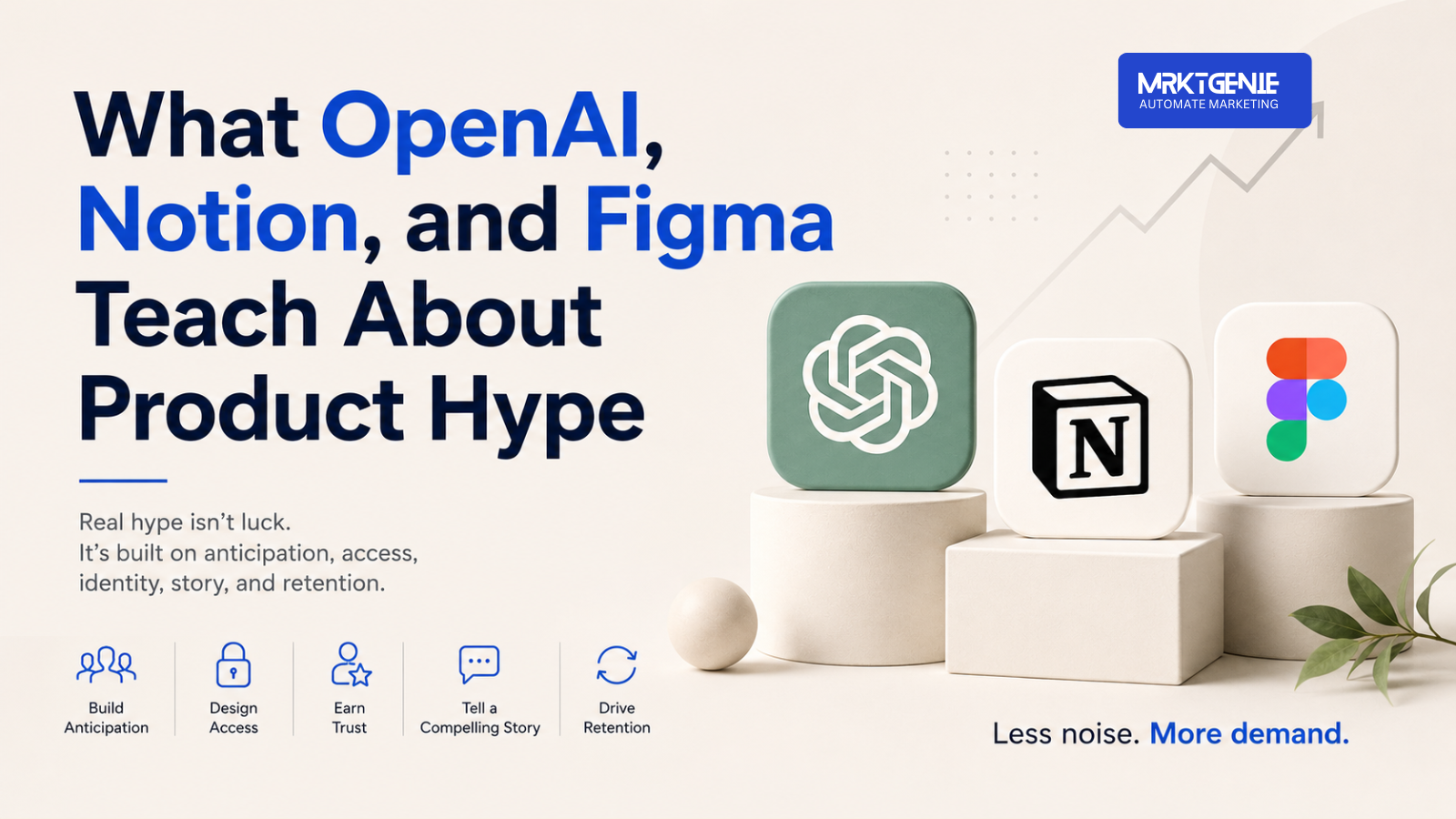
If you have ever looked at OpenAI, Notion, or Figma and thought, “They just had one of those magical launches,” you are seeing the fireworks, not the wiring. Their hype was not an accident. It was not just product quality either. It was a carefully reinforced loop between anticipation, access, identity, story, and retention.
The dangerous misconception is that product hype is mostly about getting attention. It is not. Attention is the receipt, not the strategy. The real question is: why did so many people care before everyone else used the product, and why did that care persist after the first wave?
That is the lesson modern product-led companies teach. Hype is not noise layered on top of a product. At its best, it is demand architecture.
The reader this lesson is really for
This is for the founder, product marketer, or growth lead who keeps shipping solid work and wondering why it lands with a thud.
You are trying to solve a painful problem: how to create real market pull instead of endlessly pushing people toward a product they did not wake up wanting.
The recurring frustration is familiar. You launch features. You post updates. You improve the onboarding. Still, people do not talk about your product the way they talk about the category leaders. You start questioning whether your product is weaker than it is, when often the deeper issue is that your product story never built social momentum around the experience.
The costly mistake is copying the visible tactics of famous companies without the underlying conditions. You are added to a waitlist because they had a waitlist. You ask founders to post more because they posted more. You create scarcity without desire, polish without narrative, and visibility without retention.
The outcome you want is not vanity. You want a launch people anticipate, a product people invite others into, and growth that keeps compounding after the first burst. You want people to feel, before they buy, that getting access means joining something important.
That is what OpenAI, Notion, and Figma understood early.
Community anticipation starts long before launch day
One of the biggest myths in startup land is that hype begins when the product is ready. In reality, hype often begins when the market starts rehearsing a future in which your product matters.
Think about ChatGPT in its early public phase. Yes, the product was startling. But the anticipation around OpenAI had been building for years through demos, research releases, debates, and public fascination with what was coming next. By the time many people tried the product, they were not evaluating a blank slate. They were stepping into a story they had already been following.
Notion did something similar in a very different way. Long before it became a workplace default for many teams, it had become a product people discussed with almost strange emotional intensity. Users shared templates, workflows, desk setups, and “my entire life runs on Notion” videos. That did not happen because of a launch announcement. It happened because the community started projecting identity onto the product.
Figma, meanwhile, benefited from a market that was already frustrated. Designers were tired of clunky handoffs, version chaos, and desktop-bound collaboration. So when people heard there was a browser-based design tool that made multiplayer editing feel natural, they did not just hear a feature list. They heard relief.
This is why building audiences before products matters more than most founders want to believe. Anticipation is easier to build when people have already been following the problem, the founder, or the philosophy behind the product.
A practical question to ask before launch is not “How do we get attention?” But “Have we created enough market conversation that people already know why this product should exist?”
If the answer is no, your launch is doing too much work.
Invite systems work because access changes behaviour.
Founders often copy invite-only systems for the wrong reason. They think invites create hype because scarcity creates demand. Sometimes. But that is an incomplete explanation, and in weak products it falls apart fast.
Invite systems work when access itself becomes socially meaningful.
Early Figma access was not just a gate. It was a signal. If you got in, you were one of the people seeing the future of collaborative design before everyone else. That changes how users talk. They do not merely consume the product; they narrate their access to it.
OpenAI benefited from a similar dynamic across different release cycles. Limited access to powerful models or tools did more than manage capacity. It made usage feel consequential. Screenshots spread because people wanted to show what they had seen firsthand.
There is a nightclub analogy here, but a better one is a dinner party. If nobody wants to attend, a guest list does not make the event desirable. It just makes it smaller. But if the room contains the right people, the right energy, and the sense that interesting things are happening inside, a guest list amplifies intrigue.
That is the mistake many startups make. They build artificial scarcity around a product the market has not yet emotionally priced as valuable.
Invite systems only work when three things are already true:
The product solves a problem people actively talk about.
The people getting access are likely to share what they discover.
Seeing others gain access increases the perceived value of joining.
If those conditions are absent, a waitlist is just a slower signup form.
For most startups, the better move is not “add scarcity". It is “earn desirability first". That often means stronger messaging, better proof, and tighter audience targeting. If your story is muddy, read why many founders struggle to articulate a great product. The issue is usually not only the product. It is the framing.
Founder visibility is not vanity when trust is part of the product
There is a reason people associate Sam Altman with OpenAI, Ivan Zhao with Notion, and Dylan Field with Figma. It is not celebrity for its own sake. It is because in ambiguous, fast-moving markets, the founder often becomes part of the product’s trust layer.
When the category is new, buyers do not only evaluate features. They evaluate conviction. They ask, even if silently. Do these people understand the future they are claiming to build? Do I trust their taste? Their speed? Their judgement?
Founder visibility answers those questions faster than a brand account ever can.
I have seen this pattern repeatedly with early-stage companies. The startup account posts polished graphics and gets polite indifference. Then the founder shares one honest post about why the product exists, what they got wrong in the first version, and what users kept asking for. Suddenly people care. Not because the algorithm was generous. Because the message felt human enough to believe.
This is part of why so many founders now feel pressure to build a personal brand. The phrase can sound performative, but the underlying shift is real. In crowded markets, people trust people before they trust positioning statements.
Notion’s founder visibility helped users attach a philosophy to the product. Figma’s founder visibility reinforced confidence that the team truly understood designers. OpenAI’s leadership visibility shaped the public narrative around capability, risk, and ambition.
Of course, there is a trap here too. Founder visibility cannot compensate for weak product value. But when the product is promising and the market is uncertain, visible founders reduce psychological distance. They make the company legible.
That matters more than most teams realise.
Product storytelling turns features into movements
Plenty of startups can describe what their product does. Very few can make the product feel inevitable.
That is what the best hype cycles do. They do not just announce functionality. They create a narrative in which using the product feels like aligning with where the world is going.
Figma was never just “design in the browser". That framing was too small. The deeper story was that design was becoming collaborative, live, and shared across teams. Once people believed that story, the product’s features made emotional sense.
Notion was not merely documents plus databases plus wikis. It became a story about personal systems, team clarity, and flexible software that bent around the way people think. Users did not just adopt a tool. They adopted a worldview about work.
OpenAI’s strongest storytelling moments have followed the same pattern. The demos are product artefacts, yes, but they also function as narrative devices. They invite the audience to imagine what changes when intelligence becomes easier to access, automate, and embed into daily workflows.
The practical lesson is uncomfortable: features rarely spread on their own. Stories spread because they help people explain the product to themselves and to others.
If your users struggle to retell what is special about your product, your hype ceiling is low. This is where consistent narrative matters, not just a clever launch tweet. Keeping your product story consistent across channels matters because fragmented messaging kills momentum. People cannot repeat what they cannot clearly grasp.
A simple test: can a user explain your product in one sentence without defaulting to a competitor comparison or feature inventory? If not, your story is still underbuilt. This is exactly why founders need to learn to explain their startup in one sentence.
Hype only matters if retention catches it
This is the part people ignore because it is less glamorous.
The most useful thing OpenAI, Notion, and Figma teach about product hype is that hype is not validated by signups. It is validated by repeated use, repeated sharing, and repeated return.
We have all seen the opposite. A startup manufactures a dramatic launch. Big waitlist. Sharp visuals. Strong social buzz. Then users get in and discover the experience is confusing, underwhelming, or disconnected from the promise. The hype does not fade. It inverts. It becomes disappointment at scale.
That is expensive.
One founder once told me, after a successful launch that quickly stalled, “We got the party right and the apartment wrong.” Brutal line. Accurate line.
Figma retained because collaboration was not a gimmick. It changed the workflow in a way teams felt immediately. Notion retained because once users built systems inside it, the switching cost became emotional as much as functional. OpenAI retained because the first useful output often triggered a flood of second and third use cases. The product kept revealing more value after the first session.
This is why launch planning and retention planning should be treated as the same conversation. If your product promise creates a spike in curiosity, what in the experience converts that curiosity into habit?
Some practical retention questions founders should ask before chasing hype:
What is the first moment users feel the product delivered on the promise?
What makes them come back within 24 hours, 7 days, and 30 days?
What natural behaviour causes them to involve teammates or friends?
What part of the product gets better as usage deepens?
If you cannot answer those clearly, hype will expose the weakness faster.
This is also why smart post-launch content matters. Retention is often reinforced by education, examples, and proof, not just UI. Content built around post-purchase pain can quietly do more for growth than another flashy announcement.
Launch psychology is about status, timing, and social proof
People like to pretend they evaluate products rationally. They do not. At least not fully.
Launches work when they intersect with psychology people rarely say out loud.
Status is one. Being early to a product can make users feel informed, sharp, plugged in. This was obvious with early ChatGPT screenshots. People were not just sharing utility. They were signalling proximity to something culturally important.
Timing is another. Figma arrived when design collaboration pain was already intense. Notion hit a moment when people were actively reconstructing how they organised work and knowledge. OpenAI’s public moments landed in a market already primed by years of curiosity and anxiety around AI.
Social proof is the third accelerant. A product starts feeling more legitimate when the right people are seen using it. This is not always influencer marketing in the obvious sense. Sometimes it is a respected designer tweeting a workflow. Sometimes it is a startup team posting how they replaced three tools with one. Sometimes it is simply seeing your smartest friend obsess over a product for a week.
The broader point is that startup growth is becoming more psychological than technical. Better products still matter. But in crowded categories, perception shapes adoption long before users experience enough of the product to judge it deeply.
That does not mean manipulation. It means understanding that launches are social events, not just distribution events.
Ask yourself: what identity does using this product let someone perform? What tension in the market makes this feel timely? Who makes adoption feel safer or smarter simply by being seen with it?
Those questions often matter more than another feature bullet.
The contrarian lesson: hype is usually a lagging indicator
Here is the part many founders resist. By the time a company looks hyped, much of the real work has already been done.
The community has been warmed. The founder has been visible. The narrative has been repeated. The access model has been shaped. The product has enough depth to survive the attention it receives.
In other words, hype is often what outsiders call the visible result of many invisible systems working together.
That is why copying the surface-level tactics of OpenAI, Notion, or Figma usually disappoints. Their invite systems, founder presence, and launch moments worked because they sat on top of real demand, real product coherence, and real market timing.
If you are early-stage, the right takeaway is not “How do I manufacture the same hype?” It is “Which parts of that engine can I honestly build at my stage?”
Usually that means:
Build an audience around the problem before the full product exists.
Develop a story people can repeat without your help.
Make the founder visible enough to transfer trust.
Create access mechanics only after desire is real.
Obsess over the first retention loop before chasing scale.
If that sounds less exciting than a viral launch thread, that is because it is. But it is also how durable momentum is built.
What founders should actually do next
If your product is good but the market response feels muted, do not immediately conclude that the product is the problem. Sometimes the issue is that nobody has been prepared to care.
Go back and audit the hype stack.
1. Audit anticipation
Are people already following the problem space? Have you been publishing ideas, examples, customer pain, or behind-the-scenes thinking that gives the market a reason to pay attention before launch?
2. Audit desirability before scarcity
If you removed the waitlist tomorrow, would demand increase, stay flat, or reveal itself as mostly cosmetic? Scarcity should amplify interest, not impersonate it.
3. Audit founder trust
Does the market know who is building this and why they are credible? If not, you may be hiding the most persuasive part of your brand.
4. Audit the story
Can users explain why your product matters in plain language? Not what it does. Why it matters.
5. Audit retention honestly
If 1,000 people arrived next week, what percentage would still be active in a month? If that number makes you nervous, hype is not your bottleneck yet.
This is also where founders should resist the temptation to imitate larger companies blindly. Big startup growth advice often breaks in early-stage contexts because the underlying assets are different: brand recognition, capital, distribution, and market credibility.
The real lesson from OpenAI, Notion, and Figma
These companies did not just build products people used. They built products people anticipated, talked about, invited others into, and kept returning to.
That is the standard.
The point of product hype is not to look popular for a week. It is to compress trust, attention, and social proof so that a genuinely strong product can spread faster than it otherwise would.
When founders misunderstand this, they chase spectacle. When they understand it, they build conditions.
And that is the perspective shift worth keeping: hype is not something you bolt onto a launch. It is what happens when the market has already started believing your product matters before it has fully arrived.
If that has not happened yet, do not panic. It does not mean your product is doomed. It usually means your story, trust, and distribution systems are still lagging behind your ambition.
Fix that, and the next launch feels very different.